The father-son relationship between Henry IV and Prince Henry
Henry IV, Part 2The father-son relationship between Henry IV and Prince Henry joins private affection to the public crisis of succession: King Henry IV sees his son as a likeness of his own youth, grieves over the company and conduct surrounding him, and finally entrusts him with a crown shadowed by bodily frailty and the king’s troubled past. Their movement from estrangement and anxiety toward recognition unfolds beside the king’s sickbed, where the crown is at once an object of inheritance and a source of sleepless care.
A Son Seen as a Troubled Reflection
King Henry IV’s judgment of Prince Henry is divided between resemblance and disappointment. He calls his son the noble image of his own youth, but says that the image has been overspread with weeds. The metaphor makes their bond intimate as well as political: the father recognizes something of himself in the son, yet sees that likeness obscured by influences he regards as corrupting. His grief is therefore not simply a ruler’s concern about an heir’s fitness. It is also the pain of a father who sees promise and resemblance in the same person as the evidence of decline.
The king’s concern places Prince Henry’s future in two registers at once. As a father, King Henry IV is distressed by what his son has become; as a monarch, he must consider what kind of ruler that son may become. The image of weeds spreading over a noble likeness suggests a condition that has grown around the prince rather than erased his underlying identity. It leaves open the question of whether the heir can recover what his father believes to be there, a question that becomes urgent as the king’s own strength fails.
A Family Observed from the Throne
King Henry IV’s exchange with Thomas of Clarence shows him attending to the relationships within his family as well as to the succession. He asks why Thomas is not with his brother and tells him that Prince Henry loves him, while Thomas neglects the prince. The rebuke identifies affection between the brothers, but also presents the king as someone who notices and intervenes in the family’s attachments. He does not treat the prince’s emotional life as irrelevant to his prospects: he names the brother’s love and reproves its neglect.
That moment offers a different measure of the prince from the king’s image of weeds. Prince Henry is not represented only through paternal disappointment; he is also someone capable of being loved by his brother. The king’s words cannot by themselves settle the state of the father-son bond, but they show its surrounding family world and the king’s attention to it. His intervention is both personal—an appeal to Thomas not to neglect his brother—and an exercise of royal authority, delivered by a father whose household and kingdom are closely connected.
The Sickbed and the Uneasy Crown
The king’s physical vulnerability sharpens the distinction between the living father and the office he must pass on. He reflects that thousands of his poorest subjects are asleep while the crown keeps its wearer from rest. The contrast makes kingship a bodily burden: the subjects can surrender to sleep, but the monarch’s responsibilities deny him that ordinary ease. His observation is not a general abstraction detached from the family story. It comes as his health is failing and Prince Henry is approaching the inheritance that has weighed on his father.
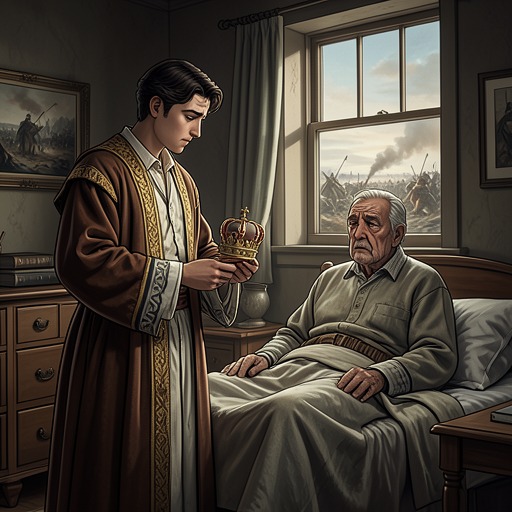
Prince Henry, left alone beside the king, sees the crown lying on his father’s pillow and regards it as a troublesome bedfellow. The object makes the approaching succession physically present in the room: the son watches the father, and the emblem of royal office rests where the king should find repose. The prince’s question about why it lies there registers the crown’s burden even before he bears it. In the scene, inheritance is not presented as a clean transfer of power between healthy rulers; it is entangled with a father’s illness and a son’s vigil.
When Prince Henry speaks to his father, he says that he had not thought he would hear him speak again, and his tears obstruct his speech. That response gives the encounter a plainly filial dimension at the point where the political future might otherwise dominate it. King Henry IV, in turn, tells his son that God put it into his mind to take the crown away. Read beside the prince’s solitary watch and the crown on the pillow, this response marks a change in how the king receives the act: the crown’s removal becomes something he can interpret as providential rather than simply as a challenge between father and heir.
Inheritance and the Father’s Counsel
The language of accession makes the change in their relationship inseparable from a change in political identity. Prince Henry is no longer only the son whose conduct grieves his father; he becomes the king who must take responsibility for the Crown of England. King Henry IV’s recognition of the succession does not erase his earlier fears. Instead, the sickbed encounter brings the father’s apprehension, the son’s grief, and the transfer of office into a single moment of reckoning.
King Henry IV’s counsel looks beyond the immediate handover. He directs Prince Henry toward leading people to the Holy Land, arguing that rest and inactivity might allow unsettled minds to turn too near the king’s own position. Foreign conflict, in this advice, is a means of occupying political energies that might otherwise threaten the state. The counsel is therefore both paternal instruction and a frank disclosure of the calculations through which the king has understood rule. He prepares his son not only to possess authority but to manage the dangers that gather around it.
The father also speaks of how he came by the crown, asks God’s forgiveness, and hopes that it may live in true peace. His words attach a moral burden to the inheritance: Prince Henry receives not an untroubled emblem of legitimacy, but a crown whose history troubles the father who passes it on. The relationship reaches its decisive change when King Henry IV can address Prince Henry as successor and counsel him, while the son’s tears keep the transfer rooted in their bond as father and child. Kingship outlasts the failing body, but the father’s grief, warning, and hope for peace shape what the inheritance means.