
The English Common Soldier
Henry VThis thread follows ordinary soldiers’ fear, arguments about kingship, and the struggle to make meaning of battle.
increasing Bearing strength in each event
 decreasing
Bearing strength in each eventdecreasingThe Army’s Hardship
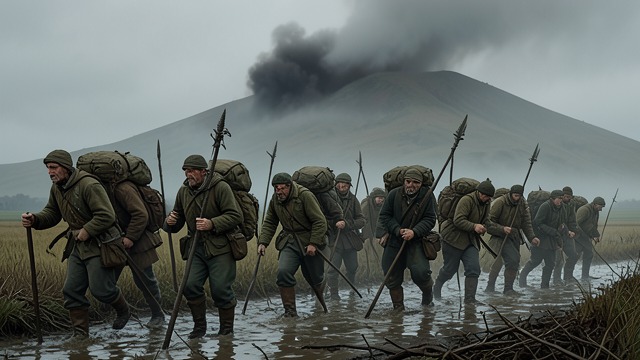
The Army’s Hardship
Sickness and scarcity
The English army reaches the approach to Agincourt exhausted and understrength. Its physical condition sharply contrasts with the confident French force.
Unequal expectations
The soldiers face a battle whose outcome appears doubtful before it begins. Their vulnerability gives the king’s later appeals a concrete human audience.
Fear Before Dawn
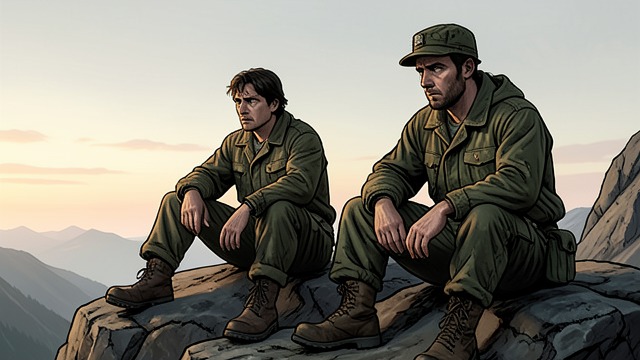
Fear Before Dawn
Soldiers assess their chances
John Bates and his companions watch daybreak without welcoming it. They see the danger that the coming battle may bring to ordinary lives.
A shared uncertainty
Their conversation gives the audience access to fears not spoken in the royal council. The battle’s stakes are rendered from below rather than only through command.
The King Is Human
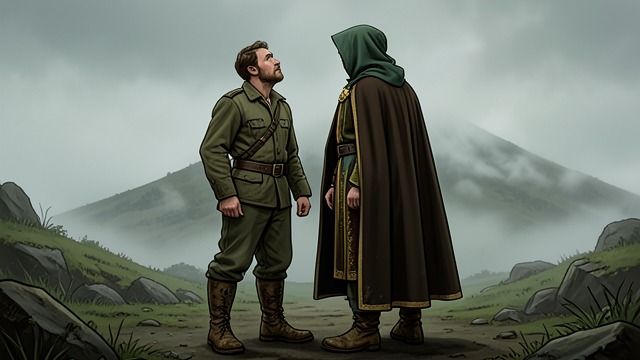
The King Is Human
Equality beneath office
King Henry V, disguised as a common soldier, argues that a monarch shares ordinary human fears and senses. His words challenge the distance created by ceremony.
Fear kept private
He also says a king cannot freely display fear without discouraging the army. The disguised encounter reveals how authority depends on emotional concealment.
The Soldiers’ Moral Debate
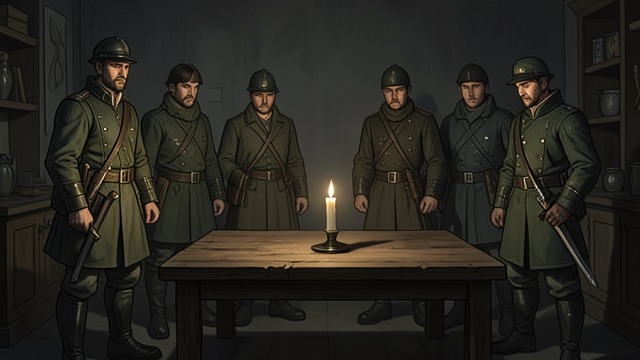
The Soldiers’ Moral Debate
Who answers for death
Michael Williams asks whether the king bears responsibility for soldiers killed in an unjust cause. John Bates emphasizes obedience, while still recognizing the king’s burden.
Uneasy resolution
King Henry V defends the separation between a ruler’s command and each subject’s soul. The argument offers no easy escape from the soldier’s duty or the ruler’s accountability.
A Brotherhood Remembered
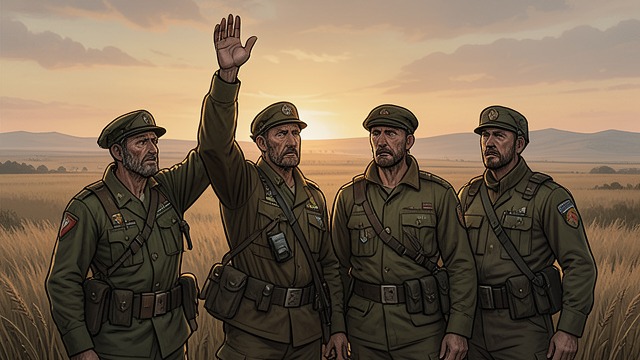
A Brotherhood Remembered
Shared danger embraced
King Henry V tells the soldiers that those who fight together will become brothers in memory. He reframes numerical weakness as a source of shared honor.
A story carried home
The imagined survivors will retell the day to later generations. Fellowship offers meaning, but it is built upon the prospect of shared bloodshed.
During the march toward Calais
The morning before Agincourt
During the king’s disguised visit to the English camp
Later in the same night, before the battle
As the English prepare to fight on Saint Crispin’s Day
