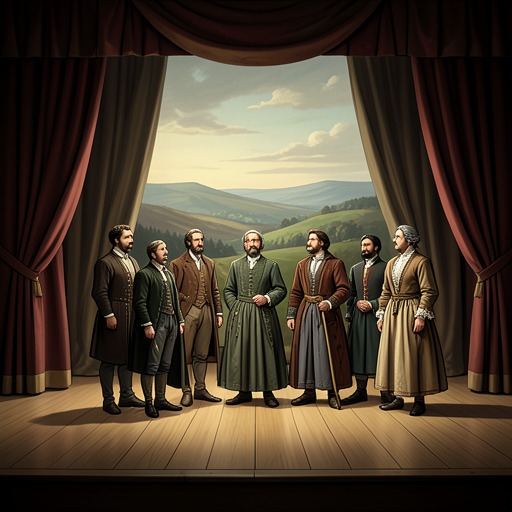
A little touch of Harry in the night
Henry V“A little touch of Harry in the night” is the passage’s compact name for the comfort people draw from King Henry V’s presence. Its decisive significance lies in the scale of that comfort: amid fear, even a brief sight of the king can steady those who behold him. The phrase makes royal authority felt not only as ceremony or command, but as a human presence whose effect spreads through a crowd.
Meaning and Wording
The expression joins modest measure to powerful consequence. “A little touch” suggests something slight: a passing impression or moment of contact, not an elaborate speech or a recorded act of reassurance. Yet the surrounding lines describe frightened observers taking comfort from the king’s looks. The smallness belongs to the encounter, not to its emotional effect. The wording thus captures how little is required for his presence to matter to those who see him.
“Harry” gives that presence an intimate register. The passage otherwise describes a king whose “sweet majesty” and “cheerful semblance” freshly overcome what has tainted or burdened him. Against this elevated public image, the familiar name makes the king feel near. The phrase does not discard his majesty; it shows that the very figure invested with majesty can also be experienced personally, through a fleeting glimpse.
The final words, “in the night,” place the encounter in darkness, when the observers’ fear is especially prominent in the description. The phrase does not specify what the king says or does during this moment. Instead, it makes his appearance itself the meaningful event. Its economy suits the scene it describes: a brief presence, registered by its effect rather than by a detailed exchange.
Comfort Shared Among the Observers
The passage first presents its observers as “every wretch, pining and pale before,” a collective defined by visible distress. Their pallor and suffering make fear bodily legible, rather than leaving it as an abstract condition. When they behold King Henry V, they “pluck comfort from his looks.” The verb suggests that reassurance is gathered from what they can see: the king’s appearance becomes a resource for people who had been diminished by anxiety.
That comfort is described as broadly distributed. The king’s generosity is “like the sun,” and his “liberal eye” gives to “every one.” The image makes his attention seem to reach across the assembled group rather than being reserved for a favored individual. The passage does not describe separate gifts or private conversations; its account of generosity is visual and universal. The king looks, and those who behold him draw comfort.
The effect is also expressed as a change in emotional temperature: his presence is “Thawing cold fear.” Fear is figured as cold and therefore as something that can be loosened by warmth. The sun image and the thawing image reinforce one another: the king’s visible generosity does not erase the observers’ distress by argument, but is represented as easing it through its felt effect. “A little touch” names this influence in miniature, while the surrounding imagery expands its reach to the whole group.
Majesty, Rank, and the Reach of a Look
The account holds royal elevation and shared human vulnerability together. King Henry V appears with majesty, but the passage’s attention also turns to those who are “pining and pale.” His authority is not described only as a distinction separating him from them. It becomes a capacity to give comfort through his gaze. The king remains above the crowd in status, yet the scene measures his presence by what happens to those who look at him.
The phrase “mean and gentle all” widens that response across differences of rank. In the passage, both low and high can behold the king and take part in the same experience of reassurance. The image of universal largesse therefore has a social dimension: the king’s eye is said to give to everyone, and the effect of seeing him is not confined to one class. The wording presents a shared response without claiming that the observers’ different positions disappear.
At the same time, their access to the king remains visual. They behold him “as may unworthiness define,” a qualification that keeps their perspective limited by their own sense of unworthiness. The passage does not say that they speak with him or approach him. Its intimacy is therefore particular: the king is close enough to be seen and to comfort, while remaining a majestic figure whose presence is encountered through the looks available to his observers. The phrase holds that distance and nearness in tension.
Narrative Placement and Significance
The expression comes at the end of a description that moves from the king’s appearance, through the comfort of the distressed, to the general reach of his generosity. It gathers that movement into a memorable, personal formulation. After presenting the king’s “cheerful semblance and sweet majesty,” the passage concludes not with a formal title or an account of a command, but with the felt impression of Harry at night. The change in register turns public kingship into an experience that can be carried by those who see him.
Immediately afterward, the Chorus says that the scene must fly to the battle. That transition places the reassuring image beside the movement toward combat, without making the phrase itself a description of the battle or an account of what happens there. The king’s night-time presence is the passage’s final note before the narrative changes scene. In that position, its compactness matters: it leaves the audience with a portrait of authority whose effect is not only to command action, but to thaw fear and offer comfort before the account moves on.