Anglo-French Treaty and Succession Settlement
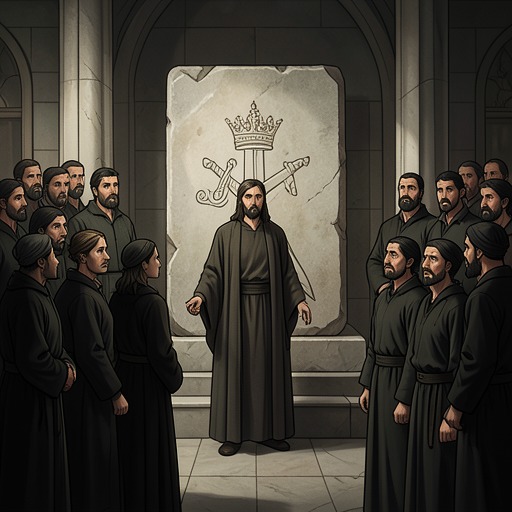
Henry VThe Anglo-French Treaty and Succession Settlement is the play’s movement from a contested claim to a negotiated bond between rival kingdoms. Its terms join political agreement to marriage: the King of France accepts King Henry V’s demands, including his daughter’s marriage to the English king, and hopes that their issue will help end the hostility between France and England. The settlement answers, without erasing, the earlier dispute over the legal basis of Henry’s claim.
The claim and its legal grounds
The agreement has its argumentative prehistory in the question of whether the Salic Law bars King Henry V’s claim to France. The Archbishop of Canterbury is asked to unfold the matter justly and religiously, and he presents the rule against female succession as the obstacle advanced by France. His reply contests not only the rule’s effect but its relevance: he argues that the Salic land was in Germany, between the rivers Sala and Elbe, rather than in France. He identifies that territory with Meisen and invokes accounts that place the French beyond the Sala after the subjugation of the Saxons in 805.
The Archbishop of Canterbury also invokes dynastic history. His account refers to King Pepin, who deposed Childeric, and to a marriage through which the line of Charles the Great was reunited with the French crown. He concludes that the titles of Pepin, Hugh Capet, and King Lewis support the English claim and undermine the rival titles he describes as usurpations. The play thus presents the inheritance dispute as an interpretation of geography, law, and royal descent, not simply as a demand backed by force. King Henry V’s question about whether he may make the claim with right and conscience puts the moral burden of that argument directly before him; the exchange makes clear that legal confidence and ethical certainty are not automatically identical.
This legal case sits within a drama that has already asked its audience to imagine two great monarchies within the limits of the stage. The Chorus invites spectators to enlarge that restricted space through their thoughts. In that theatrical frame, the claim to France is both a matter argued by speakers and a conflict the audience must mentally supply. The later settlement gives the dispute a formal political outcome, but its foundations remain the competing accounts of inheritance offered earlier.
From demands to agreement
In the later negotiation, the Duke of Burgundy has urged peace and described the defects that grow from its absence. King Henry V answers that peace must be bought through full agreement to his just demands. The French side has heard the terms but has not yet answered them; Henry makes the response itself decisive, saying that the peace urged by Burgundy depends on that answer. Peace is therefore not presented as a general wish detached from the dispute. It has conditions, and the parties must address them before reconciliation can proceed.
The King of France eventually consents to all terms he considers reasonable. The English lords then specify what that assent includes: according to the Earl of Westmoreland, every article has been granted, with the King of France’s daughter first and the remaining articles following. The report makes the order meaningful. Marriage is not an ornamental addition after the political business; it stands at the head of the accepted terms. Yet the agreement is not represented as a single effortless declaration. The Duke of Exeter identifies one article that has not yet been subscribed. The King of France indicates that he will let the matter pass at Henry’s request, and Henry asks that the article rank with the rest. The exchange shows assent being secured through attention to the status of individual provisions, not merely proclaimed in broad terms.
Marriage as dynastic settlement
Once the King of France has accepted the terms, King Henry V asks for the daughter’s hand in the language of love and alliance. The King of France gives her to him and asks that issue be raised from her blood. His stated hope is that the contending kingdoms, whose shores seem to look upon one another with envy, may cease their hatred. The marriage is thus made to carry a political expectation: descendants of the union might bind together the houses and kingdoms whose rivalry has sustained war.
The King of France’s imagined outcome is more than a pause in fighting. He describes the conjunction as a means of planting neighbourhood and Christian accord between the two peoples, and hopes that war will not advance again between them. The language offers reconciliation as a future produced by kinship, but it does not make peace automatic. The treaty depends on accepted articles and oaths kept; its promise is conditional upon political commitments being honored. At the scene’s close, the call for those oaths to be kept and prosperous gives the agreement a ceremonial seal while preserving that obligation.
Dramatic significance and limits
The settlement redirects the play’s language of conflict into a language of terms, alliance, and succession. Earlier, the feast of Saint Crispian is named in a speech that binds those who survive the day through shared memory. Here the political future is imagined through the French princess and the descendants the King of France hopes she will have with King Henry V. The contrast is between a bond made among fighters in the present and a dynastic bond intended to outlast them.
The scene’s resolution is substantial but carefully framed. The King of France accepts the terms, his daughter is promised in marriage, and both sides invoke a future without renewed war. The play nevertheless shows how that result is assembled: Henry insists on his demands, the French king grants them, the lords report which articles are accepted, and one remaining provision is explicitly negotiated. The agreement provides a political answer to the succession dispute and a hopeful design for reconciliation, but the final appeal to kept oaths leaves its success dependent on future fidelity.