Battle of Agincourt
Henry VThe Battle of Agincourt turns the campaign of King Henry V in France into a victory remembered through both fellowship and troubling cost. The English enter the confrontation sickened and diminished, while the play places their confidence, their king’s appeal to shared honor, and the slaughter of prisoners alongside the claim that the outcome belongs to God. Its ending is not simply a report of triumph: it is also a reckoning with responsibility for the dead.
Causes and Conditions
The campaign rests on a disputed claim to the French crown. In the earlier debate, the Archbishop of Canterbury is asked to explain why the Salic law in France should or should not bar the English claim. The argument for war is therefore framed as a question of inheritance and law, but its speakers recognize that the decision could bring consequences far beyond the court. The Archbishop warns King Henry V to take care before committing himself and the kingdom to war, invoking the bloodshed that follows when two kingdoms contend.
The play connects that legal and political choice to the scale of the undertaking. The Archbishop urges King Henry V to divide England into four and take a quarter of it into France. The image of a kingdom committed to the expedition gives the campaign a national dimension, while also sharpening the warning that the enterprise places many lives at stake. At Harfleur, the Chorus asks the audience to imagine the siege in concrete terms: ordnance on its carriages, aimed at the town. King Henry V declares that he will not leave the town half-conquered, and threatens that once mercy’s gates are shut, soldiers will range with bloody hands. The battle thus follows a campaign whose rhetoric already exposes the violence that victory may authorize.
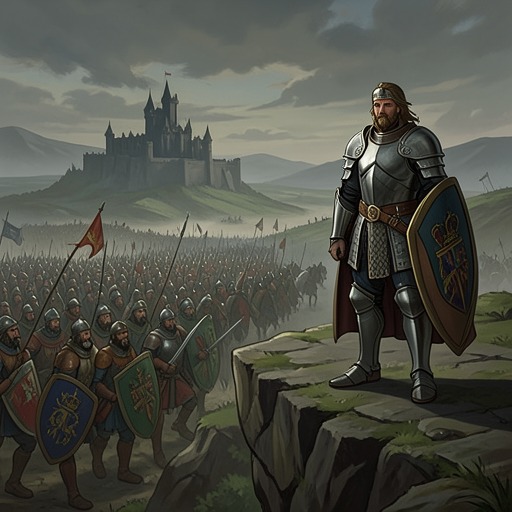
By the approach to Agincourt, the English army’s condition is precarious. Montjoy carries the French king’s message that apparent weakness may conceal an advantage and that patience can be a better soldier than rashness. King Henry V, in turn, acknowledges that sickness has greatly weakened his people, that their numbers have fallen, and that his remaining soldiers are hardly better than the French. The contrast between this admission and the scale of the coming victory is central to how the play presents the event: success does not grow out of an image of English abundance.
The Night Before and the King's Appeal
On the eve of battle, King Henry V moves among his soldiers at night. The Chorus describes the visit as a little touch of Harry in the night, a brief human contact that thaws fear among men of different ranks. The episode places the king among his troops before the public ceremony of battle, but does not erase the distance between them: his presence is a touch, not a promise that danger can be removed.
The next day, the Earl of Westmoreland wishes that England had ten thousand more men who are idle at home. King Henry V answers by refusing to treat the shortage as a reason for shame. He turns the fewness of the army into the basis of a fellowship that will be remembered, and names the day the feast of Crispian. Those who survive and return home, he says, will take pride when the day is named. The speech makes remembrance part of the soldiers’ stake: the small company will possess a shared renown that those absent cannot claim.
That fellowship is not presented as a simple cure for fear or moral doubt. Before the battle, Williams warns that if the cause is not good, the king himself will have a heavy reckoning when the limbs and heads cut off in battle rise to confront him. The soldier’s challenge gives the campaign’s legal justification an intimate human consequence. The dispute over the cause of war is no longer only a question for bishops; it bears upon the king’s responsibility for individual deaths.
The Battle and the Prisoners
As the French prepare to charge, King Henry V says that all things are ready if the soldiers’ minds are ready. He gives the leading of the vanguard to the Duke of York, then orders the soldiers to march and leaves the day to God’s disposition. The moment joins command and religious submission: the king directs the army’s movement but does not claim complete power over what the battle will bring.
The battle’s course is conveyed through alarms, reports, and the king’s changing knowledge of events. When the French reinforce their scattered men, King Henry V orders every soldier to kill his prisoners and has the command passed through the army. Later, the explanation offered is that the French have burned and carried away everything in the king’s tent; the king is said to have caused the prisoners’ throats to be cut. The play presents the order and its rationale, but the explanation does not make the act disappear. The victory is accompanied by a deliberate killing of captives, a stark counterpoint to the language of honor and mercy elsewhere in the campaign.
After the fighting, King Henry V says he does not know whether the day is theirs and asks to view the field and dispose of the dead. Montjoy identifies the place as Agincourt, and the king names it the field of Agincourt, fought on the day of Crispin Crispianus. The naming converts an uncertain and bloodied scene into a public historical event, while the king’s first concern remains the field and its bodies, not an immediate declaration of success.
The Report of Losses and the Meaning of Victory
The herald’s report gives the victory its startling proportions. King Henry V reads that ten thousand French lie slain, among them princes and nobles bearing banners. The number and the status of the dead make clear that this is not a narrow escape or a merely symbolic success. The French losses include the leadership and nobility whose presence had marked the opposing force.
The English account is sharply different. Asked for the number of his own dead, King Henry V is told of the Duke of York, the Earl of Suffolk, Sir Richard Ketly, and Davy Gam, followed by five and twenty others. The named losses prevent the English total from becoming an abstraction, even as the small number intensifies the apparent scale of the victory. The king responds by ascribing the outcome to God’s arm alone, insisting that the result belongs not to the English but to divine power. In this final interpretation, the Battle of Agincourt is both a triumph of overwhelming consequence and a limit on the victor’s claim to personal credit. Its memory holds together the fellowship promised on Saint Crispin’s Day, the dead counted on the field, and the moral weight of decisions made in the name of war.