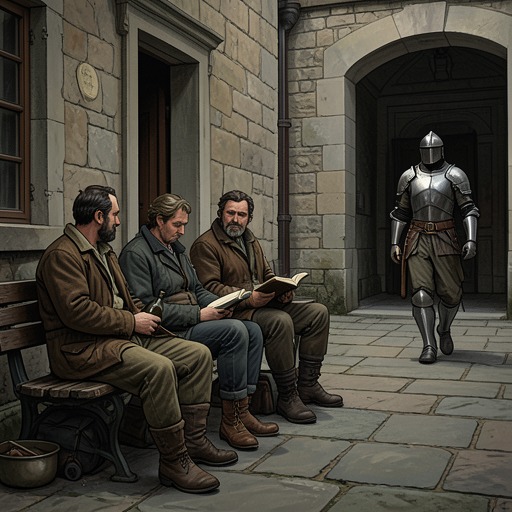
Captain Fluellen
Henry VCaptain Fluellen is an English army captain whose presence at the siege of Harfleur joins the immediacy of assault to a concern for military discipline. He urges soldiers toward the breach, questions whether mining conforms to the rules of war, and engages with fellow officers in exchanges that reveal a practical, evaluative side to his command.
Identity and Role
Fluellen appears as a captain serving in the English campaign in France. At Harfleur, where the siege is presented through the image of artillery trained on the town, he gives a sharp order to move up to the breach. His command is not a distant report of battle: it places him among the officers attempting to direct men in the assault itself.
The scene’s urgency is set against the wider strain on the English force. King Henry V acknowledges that sickness has weakened his people and that his numbers have fallen. This establishes the conditions of the campaign without making Fluellen responsible for them; his contribution is the local work of command within a costly and difficult operation.
Siege and Military Discipline
Fluellen’s authority is not expressed only through exhortation. When told that the Duke of Gloucester wishes to speak with him at the mines, he sends word that it is not good for the duke to come there, because the mining is not in accordance with the disciplines of war. His objection makes procedure part of his understanding of military effectiveness: even amid a siege, the manner of conducting operations matters.
That concern gives his command a different emphasis from the force of his order at the breach. He can press soldiers forward while also scrutinizing the methods by which the siege is carried out. The play thus places bodily danger and military rules side by side in his brief appearances, rather than presenting warfare as action without standards or judgment.
Exchanges with Other Officers
Fluellen speaks appreciatively of the Scottish captain Captain Jamy, calling him valiant and praising his great expedition. The remark shows him recognizing a fellow officer’s qualities, not merely issuing instructions to subordinates. His assessment is concise but specific: courage and promptness are the traits he singles out.
In another exchange, Ancient Pistol asks a captain to speak for a man’s life, and Fluellen replies that he partly understands Pistol’s meaning. The qualification matters: he acknowledges the appeal without claiming to understand it completely. Together, these encounters present a captain whose brief scenes encompass command, professional judgment, and attention to the claims made by those around him.