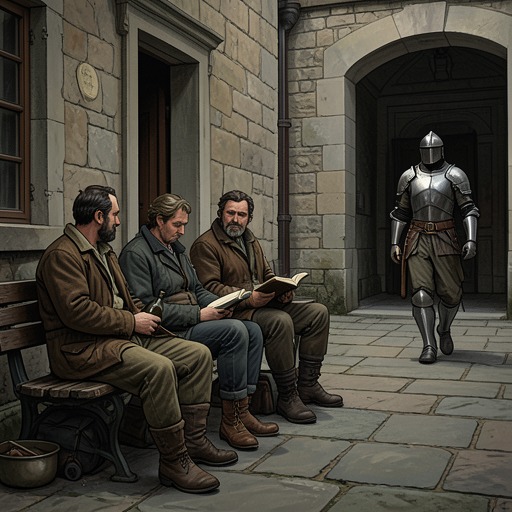
Captain Gower
Henry VCaptain Gower is an English officer whose brief appearances connect the practical business of a siege with the play’s portrait of the army’s varied, sometimes disreputable company. He summons Captain Fluellen to the mines on the Duke of Gloucester’s authority, questions Captain Macmorris about the miners’ work, and later identifies Ancient Pistol as a man he remembers as a pimp and pickpocket.
Identity and Setting
Captain Gower appears in company with Captain Fluellen, first in a scene concerned with the mines and later at the English camp in France. The stage direction introducing that later scene places the two officers together again, establishing Gower as part of the continuing military world of the campaign rather than as a figure with an independent plotline.
The Mines and the Chain of Command
When Captain Fluellen returns with Gower following him, Gower says that the Duke of Gloucester wants Fluellen to come immediately to the mines. The summons makes Gower a messenger within the army’s command structure: he conveys an order from a superior rather than setting out his own mission. Fluellen objects that going to the mines is not consistent with the disciplines of war, so Gower’s straightforward errand leads directly into a discussion of military procedure.
Gower also addresses Captain Macmorris at the mines. He greets him as Captain James and asks whether he has left the mines and whether the pioneers have given up their work. The questions place Gower in the midst of the siege’s engineering activity, attending to whether the men responsible for the mineworks are still at their task. The exchange gives him a practical, questioning presence in a scene otherwise shaped by Fluellen’s insistence on military discipline.
Recognition of Ancient Pistol
In another exchange, Gower recognizes Ancient Pistol and recalls him as a pimp and a pickpocket, calling him a counterfeit rascal. The moment punctures Pistol’s self-presentation by setting it against Gower’s claim to remember his disreputable past. Gower’s judgment is sharply specific, but the evidence presents it as his recognition and accusation, not as an independent account of Pistol’s history.
Dramatic Function
Gower’s appearances are brief, but each gives him a clear function: he carries the Duke of Gloucester’s summons, checks on the progress of the mines, and supplies a skeptical recognition of Ancient Pistol. His return beside Captain Fluellen at the English camp in France reinforces his place among the officers who persist across the campaign’s changing scenes. The play offers no extended personal history or resolution for Gower; his significance lies in these concrete contacts with command, siege work, and the army’s rougher characters.