Chorus
Henry VChorus is the play’s framing speaker and an active mediator between its imagined history and the audience. Appearing at the opening and at key transitions, Chorus acknowledges that the stage cannot show the full scale of events, then asks spectators to supply that scale through imagination. The result is not merely a narration of action: the audience is enlisted to help make the action present.
Identity and Dramatic Function
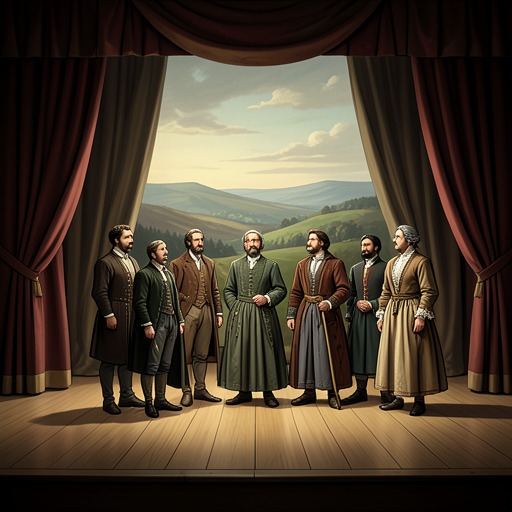
Chorus enters in the opening prologue and identifies its role as a prologue-like guide to the history being presented. It asks for the audience’s patience, attentive hearing, and kind judgment, establishing a direct relationship between speaker and spectators before the dramatic action proceeds. Chorus does not conceal the play’s constructed form; it makes the act of presenting history part of the experience.
The speaker’s principal task is to bridge what the play describes and what the stage can physically show. Rather than treating theatrical limitation as a defect to be hidden, Chorus names it and asks spectators to compensate with their thoughts. The production thus depends on a visible collaboration: performers offer words and gestures, while the audience imagines the larger world those signs evoke.
The Opening Appeal and the Work of Imagination
At the beginning, Chorus asks the audience to imagine two mighty monarchies contained within the theatre’s walls, with a perilously narrow ocean separating them. The scale of the political and geographical world exceeds the stage, so spectators are urged to divide a single performer into many imagined figures and to supply a force the available spectacle cannot literally provide. The request makes the audience’s imaginative effort a condition of the history’s theatrical realization.
This appeal also shapes how the play’s scale is understood. Chorus compresses the accomplishment of many years into theatrical time and asks that this transformation be accepted through attentive listening and imaginative participation. The prologue therefore prepares spectators not for a naturalistic illusion, but for a performance whose changes of scale and place will be openly negotiated with them.
Transitions and the Journey to France
Before Act II, Chorus reports that England’s youth are fired with energy and refers to the threatened treason surrounding the king’s departure for France. It then announces that the king has left London and relocates the imagined scene to Southampton. The audience is asked to continue its patience as the play bridges the distance between one setting and the next. Southampton becomes the audience’s temporary theatrical location before Chorus promises to convey the spectators onward to France.
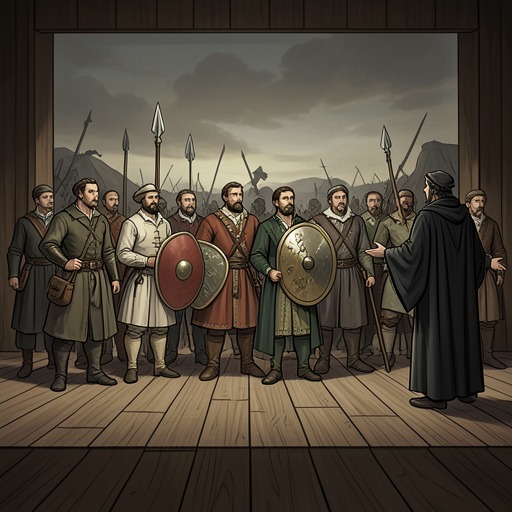
At a later transition, Chorus describes the scene as flying with the speed of thought and again instructs the audience to imagine what is not materially shown. It asks spectators to envision a siege and directs attention to the artillery on its carriages, its mouths aimed at Harfleur. The movement from a verbal cue to an imagined military scene shows how Chorus can supply both transition and spectacle: a brief address carries the audience across space and lets language suggest a battlefield too extensive for the stage to reproduce.
Framing the Play
Chorus appears again in the epilogue, returning at the close to the framing position established by the opening entrance. The play thus marks its beginning and ending with the same speaking figure, keeping the audience’s awareness of theatrical mediation in view even as the history is performed. Across the opening appeal, the relocation to Southampton, and the imagined siege at Harfleur, Chorus repeatedly makes spectators responsible for completing the stage picture. Its significance lies in that double function: it narrates movement through the story while making the audience’s imaginative participation part of the drama’s form.