Divine providence and victory in war
Henry VDivine providence and victory in war gives the play a religious language for both undertaking the French campaign and interpreting its outcome. Its force lies in the tension it preserves: England’s leaders appeal to God while recognizing that a disputed claim and the decisions made in war can bring extensive human suffering.
Providence as a Warrant and a Warning
The debate over the Salic Law begins as a question about whether France’s inheritance rule should bar the English claim. The clergy are asked to explain the law justly and religiously, placing the proposed campaign within an argument about legal right rather than presenting it as self-evidently sacred. The warning that the king must take care before committing himself gives that argument a grave consequence: two kingdoms, the speaker says, have not contended without much blood being shed. Religious language thus accompanies scrutiny of the claim; it does not erase the anticipated cost of pursuing it.
When the legal discussion turns toward action, the Archbishop of Canterbury recommends that England be divided into four parts and that one quarter accompany the king to France. The scale of the proposed expedition makes the stakes concrete. Henry, meanwhile, appeals to God and says that future generations may curse the Dauphin’s scorn, but leaves the matter within God’s will. The appeal joins a political response to an insult with an acknowledgment that its consequences exceed the king’s control.
After the Southampton Conspiracy is exposed, Henry treats its discovery as a gracious act of providence: a danger that might have hindered the campaign has come to light, and the obstacles seem cleared. He calls his countrymen to put their force into God’s hand. The language makes the army’s departure an act of religious trust, but it also follows a practical political event—the uncovering of treason—and therefore presents providence as a way of interpreting events, not as proof that the campaign is free of risk or responsibility.
Providence Under the Conditions of War
The religious confidence surrounding the campaign does not make its military conduct morally simple. At Harfleur, the siege is imagined through the guns on their carriages, their mouths aimed at the town; Captain Fluellen objects that mining is not in accordance with the disciplines of war. Yet when the assault presses forward, King Henry V threatens that the gates of mercy will be shut and that soldiers will range with bloody hands. The appeal to a just cause therefore sits beside the prospect of violence against a besieged town, exposing the distance between religious warrant and the means used to pursue victory.
The same tension appears in the question of responsibility. John Williams warns that if the cause is not good, King Henry V will face a heavy reckoning when the severed limbs and heads of the dead join to accuse him. His warning shifts judgment beyond the battlefield: invoking God cannot settle whether the war itself is just, or free the king from responsibility for its casualties. The play thus makes providence a language of hope and interpretation, not an automatic absolution for the human choices made in war.
Victory, Attribution, and Cost
On the night before battle, the Chorus describes how a little touch of King Henry V’s presence steadies both high and low in the army. The scene then moves toward battle, where confidence in the king’s leadership meets uncertainty about the result. After the fighting, King Henry V tells Montjoy that he does not know whether the day is theirs; only when Montjoy confirms the victory does he praise God rather than English strength. Providence becomes the explanation for a result the king had not presumed to know in advance.
The reported numbers sharpen that attribution. Among the English dead, the account names Sir Richard Ketly and Davy Gam, then gives the number of other men killed as five-and-twenty. King Henry V declares that God’s arm was present and refuses to ascribe the outcome to Englishmen or stratagem. He and his company go in procession to the village, while he orders death to be proclaimed through the host; when Captain Fluellen affirms the victory, the king insists that God fought for them. The procession gives the claim a public, ritual form, turning military success into an act of thanksgiving rather than a celebration of human prowess alone.
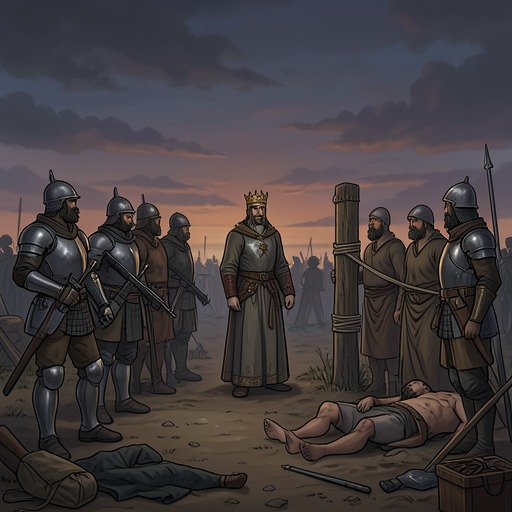
Yet the victory is accompanied by an order that complicates any simple account of divine favor. When the French have reinforced their scattered men, King Henry V commands every soldier to kill his prisoners. A report that the French have burned and carried away everything in the king’s tent is offered to explain the order, and the speaker calls it worthy; the scene nevertheless places the killing of captives beside the language of providence. The play therefore distinguishes acknowledging God as the source of victory from resolving the moral responsibility of the victors. Religious attribution does not make the army’s conduct beyond scrutiny.
Providence Against Military Uncertainty
The French message delivered by Montjoy offers a rival account of how war turns: the King of France says that his forces had seemed dead but had only been sleeping, and that advantage is a better soldier than rashness. King Henry V, for his part, acknowledges that sickness has weakened his people and reduced his numbers until the few remaining are almost no better than the French. These admissions place the later language of providence against concrete uncertainty, not effortless confidence: neither side can treat victory as assured, and the English army enters battle depleted.
That imbalance gives the king’s refusal to claim the victory for English strength its particular force. His thanksgiving follows a result he had not presumed, and the small number of named English dead, with five-and-twenty others reported, becomes part of the evidence through which he reads the outcome as God’s work. Providence supplies an interpretation of contingency and a limit on royal credit; it does not remove the moral questions raised by the campaign’s cause, its violence, or the treatment of prisoners.