English Army's Depleted Condition at Agincourt
Henry VThe English Army's depleted condition at Agincourt is the material counterweight to the victory's heroic language. Before the battle, the English force is described as weakened by sickness and reduced in number; when it faces the French, its men appear starved, while the opposing army is fresh and estimated at five times their strength. The play makes these conditions visible through reports, military preparations, and the contrast between the king's intimacy with his soldiers and the scale of the danger confronting them.
Strategy and the demands of the campaign
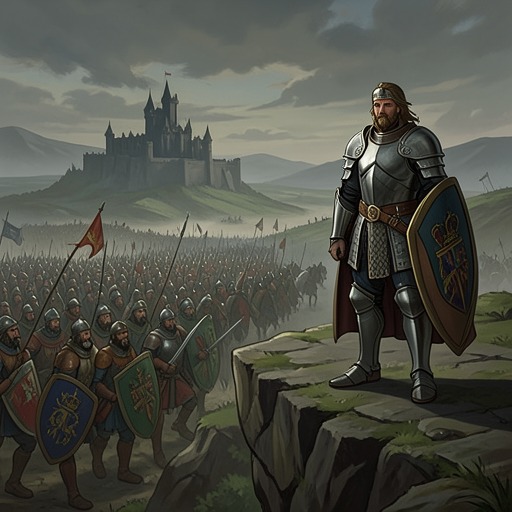
The expedition begins with an expansive strategic proposal: the Archbishop of Canterbury advises King Henry V to divide England into four and take one quarter into France. This is counsel about committing the kingdom's resources to the campaign, not a headcount of the force that eventually reaches Agincourt. The distinction matters: the proposed invasion has a grand scale, but the army later described on the battlefield is diminished and vulnerable.
The campaign also requires siege operations. A speaker asks the audience to imagine a siege, with ordnance mounted on its carriages and its mouths directed at Harfleur. This image presents military action as engineering and preparation as well as combat. The scene at the mines adds a question of method: Captain Fluellen objects that the proposed work is not according to the disciplines of war. The evidence does not establish that this objection causes the army's later shortage or sickness; it does show that the campaign involves technical choices and judgments about proper military practice, alongside the larger demands of taking and holding ground.
Attrition acknowledged
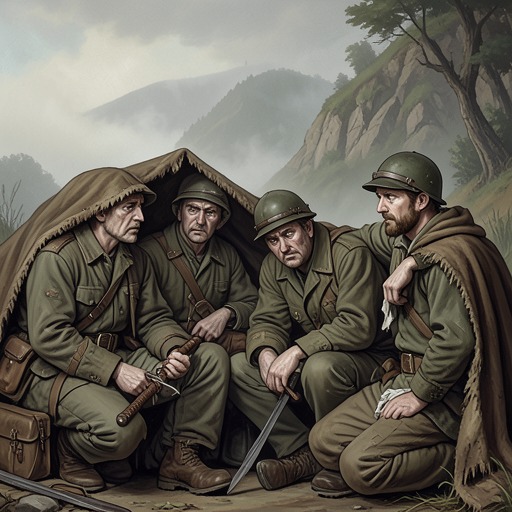
The clearest account of the army's condition comes from the French king's message, delivered by Montjoy. In explaining the English position, King Henry V concedes that sickness has greatly enfeebled his people and that his numbers have been reduced. He goes further, saying that the few remaining are almost no better than an equivalent number of French soldiers. The admission is striking because it comes from the opposing side of a negotiation with an enemy capable of exploiting weakness. Henry recognizes the risk of revealing so much, yet the report makes illness and numerical loss explicit rather than leaving them as a general impression of hardship.
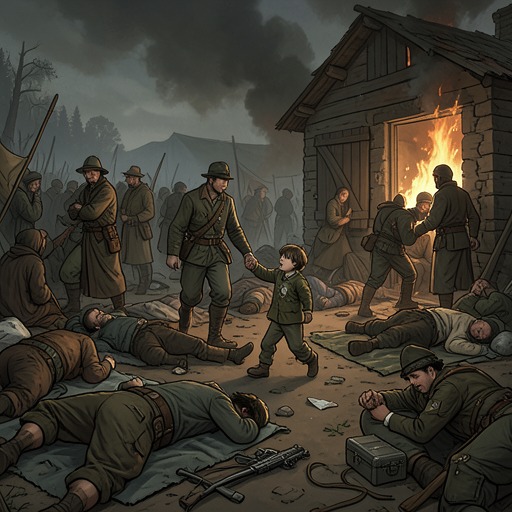
The account also separates two forms of weakness. Sickness has diminished the fighting capacity of the English people, while reduced numbers leave fewer soldiers available; Henry's comparison with French soldiers suggests that the survivors cannot simply be treated as an undiminished elite. The play supplies no figures for English strength and gives no precise account of the sickness. Its emphasis is instead on a dwindling force whose remaining members are themselves compromised. That limitation in the evidence is part of the dramatic effect: the army's danger is unmistakable even without a full tally.
The imbalance before battle
The French assessment turns this weakness into a battlefield contrast. The Constable of France points to a poor and starved band and warns that the sight of the French army will drain the English soldiers' spirits, leaving them like husks. The description is both an observation of physical privation and an attempt to magnify its psychological force. It is spoken by an enemy commander, so it carries the confidence of the stronger side; still, its language accords with Henry's earlier admission that sickness has weakened his people and his numbers have fallen.
The disparity is made numerical as well as rhetorical. The Earl of Westmoreland reports that the French have a full three score thousand fighting men, and the Duke of Exeter adds that they outnumber the English five to one and are all fresh. The figures are presented as the French army's apparent advantage, not as a count of English soldiers. The contrast combines scale with condition: the English face not only more opponents, but opponents who have not been described as similarly worn down. The Duke of Bedford says that King Henry V has ridden out to view their battle, placing the king in direct relation to the approaching force without diminishing the imbalance his soldiers must meet.
The king among a vulnerable force
Against this military picture, the Chorus recalls a little touch of King Henry V in the night and then moves the scene toward battle. The phrase offers a concentrated image of the king's personal presence among soldiers whose fear is thawing; it does not erase sickness, restore lost numbers, or alter the French advantage. Its placement matters: the movement from nighttime reassurance to the impending battle sets intimate contact beside a danger that no gesture can make small.
Pistol's praise supplies a different, openly admiring view of the king, calling him a lad of life and fame and praising his valour. Such praise helps explain how the king can be represented as a source of morale, but it is not evidence that the army has recovered physically. More starkly, King Henry V describes the soldiers' estate as that of men wrecked on a sandbank who expect the next tide to wash them away. The image makes their precariousness his own language: the force is not simply outnumbered in an abstract calculation, but exposed to an approaching power that seems likely to overwhelm it.
These contrasts make depletion a structural condition of the battle scene. Strategic ambition and siege preparation give way to sickness, reduced strength, hunger, and an enemy reported as both numerous and fresh. The king's presence and the soldiers' praise offer courage and emotional connection, not a correction to the military facts. Consequently, the English Army's depleted condition at Agincourt frames the encounter as a confrontation between morale and material disadvantage, while the reports of the imbalance give the eventual battle its exceptional stakes.