English army
Henry VThe English army is the force King Henry V leads into France, moving from a politically financed expedition to siege and battle under conditions of sickness and reduced numbers. The play shows it through both the machinery of war—soldiers, ladders, and ordnance—and the human limits that royal command and martial rhetoric cannot erase.
Mobilization and Political Support
Before the campaign, the Archbishop of Canterbury describes a bill that could strip the church of much of its temporal property, including lands given by testament. He says the church would lose the better half of its possessions if the measure passed. In the same political discussion, he offers the king an unusually large clerical contribution, explicitly connecting it to matters concerning France. The exchange places the expedition alongside a contest over resources: the church’s proposed payment is offered in a moment when its property is under legislative threat. The evidence records the offer, not its final terms or how much money reached the army.
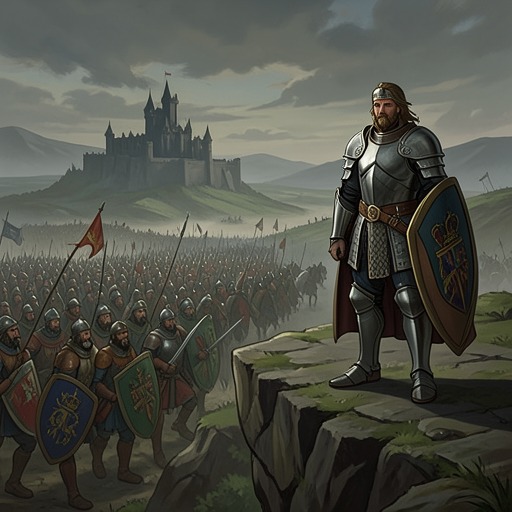
Canterbury urges King Henry V to divide England into four and take one quarter into France. The proposal gives the campaign an image of national mobilization, but it is counsel rather than a reported muster or a precise count of troops. The distinction matters: the play’s expansive language about the force going abroad sits beside later evidence of its limited and weakening condition.
Command and the Siege of Harfleur
The army appears as a commanded body rather than an undifferentiated crowd. Before Harfleur, the stage direction brings King Henry V in with the Duke of Exeter, the Duke of Bedford, the Duke of Gloucester, and soldiers carrying scaling ladders. Later, in the English camp, the Duke of Gloucester, the Duke of Bedford, the Duke of Exeter, Sir Thomas Erpingham, the Earl of Salisbury, and the Earl of Westmoreland are present with the host. These scenes establish a visible group of commanders around the king without detailing a formal chain of command.
The Chorus asks the audience to imagine the siege’s ordnance on its carriages, its mouths aimed at Harfleur. That appeal makes the army’s equipment part of the drama even as the stage itself depends on spectators supplying the battle’s scale. The play also presents military discipline as a practical constraint. Captain Fluellen objects to going to the mines, arguing that the proposed action does not accord with the disciplines of war. His intervention shows that the army’s methods are judged against rules, not only against their usefulness in taking a town.
Attrition and Battle
A message from Montjoy conveys the French king’s claim that advantage is a better soldier than rashness. King Henry V, answering an enemy’s challenge, acknowledges that sickness has greatly weakened his people, that his numbers have diminished, and that those remaining are scarcely better off than the French. The admission sharply qualifies the army’s earlier image of a quarter of England moving abroad: its presence in France does not mean it remains healthy or numerically secure.
The play then shifts among the English camp, the field of battle, and the Chorus’s account of the night before the fighting. The Chorus describes a brief personal contact with King Henry V among the troops, calling it a little touch of Harry in the night, before directing the scene toward battle. This transition binds the army’s collective anxiety to the king’s presence without suggesting that his attention reverses its material disadvantages.
Representation and Significance
The English army is made legible through contrasts: an ambitious plan of national commitment against acknowledged sickness and reduced numbers; the king’s public leadership against the soldiers’ fear; siege engines and ladders against the limits of what can be represented onstage. The Chorus repeatedly mediates that scale, first asking the audience to picture the siege and later carrying the action from the night into battle. As a result, the army is both a fighting force within the plot and an imaginative subject whose size, equipment, hardship, and exposure the audience must assemble from speech and stage images.