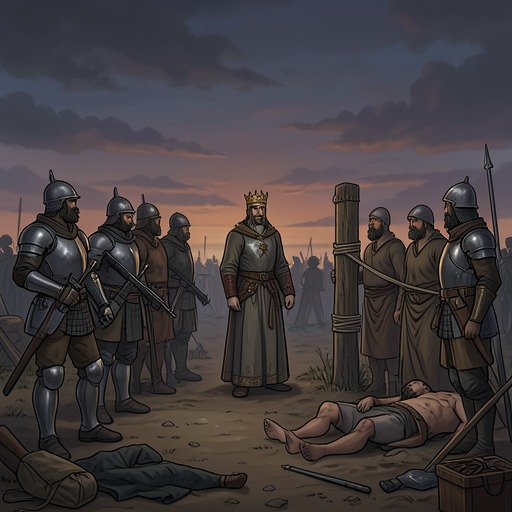
English claim to the French crown
Henry VThe English claim to the French crown is the legal and dynastic argument through which Canterbury urges Henry V to assert his right to France. Its importance lies not in a detached ruling on inheritance, but in the way the play makes historical descent, disputed law, royal conscience, and diplomacy converge around a claim with consequences for war and settlement.
The claim and its dramatic setting
Before the legal case is laid out, the Chorus asks the audience to imagine that the bounds of the stage contain two mighty monarchies, separated by a narrow ocean, and to supply in thought what theatrical space cannot show. That framing matters: the claim is part of a much larger conflict than the stage can physically represent. Its history and geography, too, must be made present through speech. The play turns genealogy and legal interpretation into instruments for imagining a contest between kingdoms.
Canterbury addresses Henry V and the assembled peers, presenting the French crown as the subject of a reasoned claim rather than merely a desired conquest. He says that no bar to Henry’s title has been produced except the rule attributed to Pharamond that women should not succeed in Salic land. Canterbury’s argument therefore begins by identifying the opponent’s legal objection and asking whether it applies to France at all. The question is not simply who descends from whom; it is also which territory the rule governs.
The play records Henry’s own hesitation in moral terms. He asks Canterbury whether he may make the claim with right and conscience. Canterbury answers by urging him to stand for his own inheritance and look back to his ancestors. The exchange shows that the argument is meant to authorize action while also addressing the king’s responsibility for taking it. The claim needs more than a lineage: it must be represented as a justifiable cause before the king and his peers.
Canterbury’s reading of Salic Law
Canterbury contests the French appeal to Salic Law by separating the name of the law from the territory to which it supposedly applies. He says that the land called Salic lies in Germany, between the rivers Sala and Elbe, and identifies it with the place then called Meisen. From those geographical claims he concludes that Salic Law was not devised for France, and that the French did not possess the Salic land. The argument makes territorial location decisive: if the rule belongs to another country, it cannot automatically bar Henry’s French inheritance.
Canterbury adds a historical chronology to strengthen that distinction. He points to the French settlement beyond the river Sala after the Saxons were subdued, dating that movement to the year 805. He also invokes the accounts of earlier rulers, including Pepin, who deposed Childeric and, Canterbury says, descended as an heir general. These references place the inheritance dispute inside a sequence of transfers and settlements rather than allowing the opposing rule to stand as an unquestioned, timeless prohibition.
His account also brings royal marriages and competing lines into the case. Canterbury says that a marriage reunited the line of Charles the Great with the French crown, then presents Pepin’s title, Hugh Capet’s claim, and King Lewis’s satisfaction as parts of a wider demonstration. The surviving argument links these precedents to the assertion that French titles have been wrongfully taken from Henry and his ancestors. It is Canterbury’s advocacy, not an impartial legal judgment: the details are arranged to make the English succession appear clear and the contrary titles crooked.
From genealogy to political action
The claim moves from exposition toward action when Canterbury urges Henry to look to his ancestry and assert what he presents as Henry’s own. The ancestral tomb becomes an emblem of the past that the king is being asked to convert into present policy. In this account, genealogy is not merely a record of descent. It supplies a political obligation: Henry is told to recover rights attributed to his forebears.
The French response, as relayed by Exeter, challenges the premise of inherited royal authority. The message tells Henry to lay aside the glories bestowed by heaven and presents a pedigree intended to answer his own. It also offers a memorable line, described as demonstrative in every branch, while expressing a willingness to overlook Henry’s pedigree. The exchange makes clear that ancestry is a contested diplomatic resource. Each side can present descent as evidence, and the French message directly opposes the English account rather than accepting its interpretation as settled.
The play thus places legal reasoning beside the pressure of political persuasion. Canterbury speaks before Henry and the peers to establish that the claim can be made with justice; Exeter carries the French king’s counterargument into the same dispute. The two modes of speech—counsel at court and a message between rulers—show how the issue is argued both within the English leadership and across the diplomatic divide. The claim functions as a case to be defended, not as an uncontested fact shared by both kingdoms.
Negotiation and significance
At the later settlement, the French King says that all terms of reason have been accepted. Exeter then identifies an outstanding qualification: the French King has not yet subscribed to the demand concerning matters of grant. The exchange indicates movement toward agreement but also preserves a distinction between general consent and formal acceptance of a particular condition. The scene does not make the earlier argument disappear; it carries the dispute into the practical language of terms and signatures.
The English claim therefore joins several kinds of authority without reducing one to another. Canterbury offers a geographic interpretation of Salic Law, a chronology of political settlement, and a genealogy connecting royal lines; Henry tests the claim against conscience; the French message disputes the English pedigree; and the concluding negotiation registers the difficulty of turning asserted right into agreement. The play gives the case force by showing how it is argued and answered, while leaving the audience to recognize the distance between a persuasive account of inheritance and its acceptance by the opposing crown.