English national identity
Henry VEnglish national identity in the play is not simply inherited from the country or its rulers: it is summoned through war, tested by betrayal, and made durable through shared remembrance. The Chorus first pictures England as a nation aroused for action, then measures its potential against internal division. King Henry V’s appeals to ancestry and fellowship give that national idea an emotional force, while his exchange with Fluellen shows the king honoring a Welsh identity within the larger community he leads.
Mobilization and the danger of division
The Chorus announces a change of national mood with the image of England’s youth “on fire.” The “silken dalliance” left in the wardrobe marks a turn away from ease and toward military action; the flourishing armorers make that turn visible in the material world. The passage links private conduct, preparation for war, and public honor: the country’s young people are not merely excited, but oriented toward an undertaking in which honor is at stake.
That energy is set against a more complicated image of national capacity. England is praised as a “little body with a mighty heart,” a compact figure whose strength lies within it. Yet the Chorus makes that strength conditional, imagining what England might accomplish if all its “children” were “kind and natural.” The language makes unity a matter of relationship as well as military power: the country’s potential is limited when its members do not act as kin.
The contrast sharpens when the Chorus says that France has found “a nest of hollow bosoms” within England and filled it with “treacherous crowns.” The image places betrayal inside the national household, not beyond its borders, and describes the compromised men as a vulnerability through which an external enemy can work. National solidarity is therefore presented as something that must be repaired and defended. The call to serve England has force precisely because England’s greatness is not treated as automatic: its “mighty heart” can be undermined by disloyalty among its own people.
Ancestry, action, and fellowship
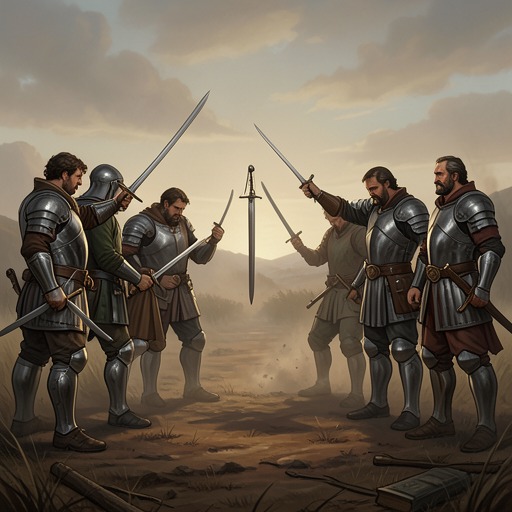
Before battle, King Henry V addresses his soldiers through bodily commands: set the teeth, stretch the nostril, hold the breath, and bend the spirit “to his full height.” The exhortation turns fear and anticipation into deliberate readiness. Calling the soldiers “noblest English,” he connects their present action to the “fathers of war-proof” from whom their blood is said to come. Ancestry gives the troops a martial inheritance, but the speech makes that inheritance meaningful through what they do now: they must rise to the stature their forebears represent.
The charge’s momentum is compressed into the announcement that “The game's afoot,” followed by the instruction to follow one’s spirit. The invocation of God, England, and Saint George gathers religious appeal, national allegiance, and a shared emblem into a single battle cry. Its sequence presents the coming action not as an individual contest but as a collective undertaking. The earlier image of a divided England is answered, at least for this moment, by a company asked to move and fight under a common name.
The speech on Saint Crispin’s Day develops that collective identity beyond the immediate charge. King Henry V imagines the day being recalled by survivors who return home, and the story taught by a good man to his son. Those who remember the battle in their cups will remember particular names, but the king’s central claim is broader: “We few, we happy few, we band of brothers.” Membership in this fellowship comes from shedding blood together. The assurance that even a man who is otherwise “vile” will be a brother if he shares that danger makes battlefield action a bond that can cross distinctions of rank or reputation. In this account, English identity is not only a common ancestry; it is also a relationship made through mutual exposure and sacrifice.
Battle as a source of shared memory
King Henry V’s Saint Crispin’s Day speech joins present danger to future remembrance. The soldiers are promised that anyone who survives and comes safely home will remember the day with pride; those who do not survive are nevertheless included in the story that will be told. The imagined audience extends beyond the fighters to later generations, since the battle’s story will pass from father to son. National memory is thus formed in two registers: private recollection among survivors and public transmission through family storytelling.
The speech also gives this remembrance a recurring calendar marker. Saint Crispin’s Day is to be named again and again, so that the date itself recalls the group formed by the battle. The promise is not that every soldier will become famous in isolation. Rather, the king makes their common participation the basis of shared renown: when the day is remembered, “we in it shall be remember'd.” The movement from “few” to an enduring story makes the company’s smallness a source of intimacy rather than insignificance. Its national importance rests on a fellowship that can be carried forward in speech long after the immediate danger has passed.
Welsh identity within the king’s community
The exchange between King Henry V and Fluellen adds a distinct regional dimension to the play’s presentation of belonging. Fluellen asks whether the king takes scorn to wear the leek on Saint David’s Day. King Henry V answers that he wears it “for a memorable honour” and explains, “For I am Welsh, you know, good countryman.” The leek is a particular sign of Welsh custom, and the king describes wearing it not as a concession or a joke at his expense but as an honor worth remembering.
The moment complicates any reading of the play’s national language as erasing regional identity. The king’s earlier appeals gather soldiers under the name “English”; here he identifies himself as Welsh and addresses Fluellen as a countryman. The scene does not explain the relation between those identities as a political theory, but it places them together in the conduct of the same king. His public role as leader of a national army does not prevent him from affirming a more particular belonging. The leek, a small and visible object, gives that affirmation a concrete form: national fellowship need not make every identity within it indistinguishable.