Every subject's duty is the king's; but every subject's soul is his own
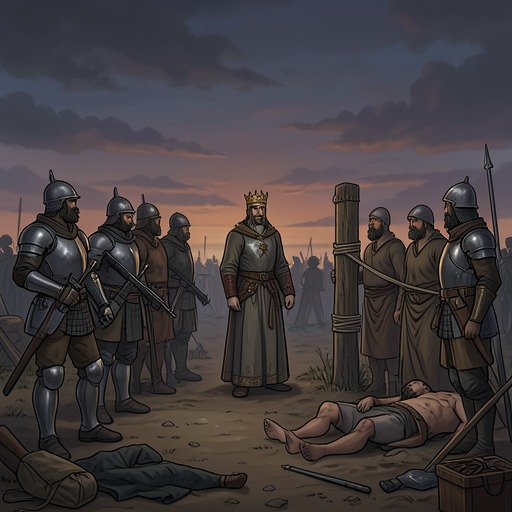
Henry VThe expression “Every subject's duty is the king's; but every subject's soul is his own” draws a boundary between political service and personal moral responsibility. King Henry V uses it to acknowledge the claims a king can make on his subjects while insisting that no ruler can take charge of another person’s conscience. Its force comes from the danger surrounding the soldiers: they may owe the king their service, but the meaning of their lives and deaths remains their own to confront.
The distinction between duty and conscience
The sentence turns on its contrast between duty and soul. The first belongs, in a political sense, to the king: subjects serve under his authority and may be called to fight in his cause. The second remains individual. King Henry V does not present obedience as a way to escape moral judgment; rather, he separates the obligation to serve from the responsibility each person bears for the state of his own conscience. The line therefore limits the reach of kingship at the same moment that it recognizes its demands.
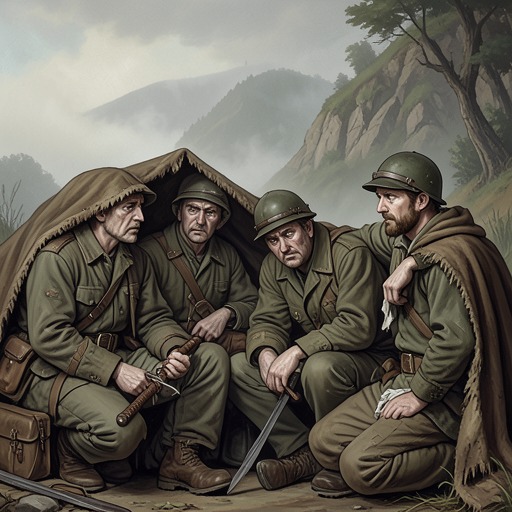
That distinction is not abstract advice detached from the soldiers’ circumstances. King Henry V says that each soldier in war should act as a sick man in bed would, washing every mote from his conscience. The image makes preparation for death an inward task: before a person faces the possibility of dying, he should examine and cleanse his conscience. The soldier cannot perform that work by relying on the king’s authority or by treating military service itself as moral absolution.
Death, preparation, and spiritual accountability
The speech gives the soldiers’ preparation two possible outcomes. If a soldier dies after making this examination, death is presented as an advantage; if he survives, the time spent preparing has still been blessedly gained. In either case, conscience-work has value independent of the military result. The possibility of survival does not make preparation unnecessary, and the possibility of death does not make it pointless. The reasoning makes spiritual readiness the one benefit that cannot be taken away by the uncertain outcome of battle.
King Henry V also considers the case of a soldier who escapes. Such a man, he says, need not regard it as sinful to think that God accepted his free offer and let him survive. This qualification keeps the argument from making death itself the measure of virtue: the soldier’s duty includes readiness, but survival may also be understood within a religious account of events. The king can speak about the battle and urge his men to prepare, yet the judgment connecting a soldier’s conscience, death, and salvation is not his to issue on God’s behalf.
The king’s claim and its limit
The surrounding reflection makes the expression more complicated than a simple declaration of royal power. King Henry V observes that the king is a man, sharing ordinary human senses, and that laid aside, ceremony does not alter that human condition. Elsewhere in the same sequence, he considers the private burdens that kings neglect and asks what they possess beyond ceremony. Against that recognition of royal vulnerability, the claim about duty identifies what the king does possess: a subject’s political service. But the sentence refuses to turn that authority into ownership of the subject’s soul.
The distinction matters because the soldiers’ own response imagines a much broader transfer. They call for their lives and souls, debts, wives, children, and sins to be laid upon the king. Their declaration gathers the whole weight of ordinary life and guilt into an appeal to royal responsibility. Set beside King Henry V’s insistence that each subject’s soul is his own, it exposes a tension between what subjects may wish to place upon their ruler and what a ruler can actually answer for. The king can carry the burden of command; he cannot simply absorb every soldier’s personal moral account.
Dramatic and ethical significance
The expression holds two obligations together without confusing them. It does not deny that subjects owe service, nor does it treat that service as sufficient preparation for death. Instead, the soldiers’ political duty and their individual spiritual responsibility operate at once: the king may summon them to war, while each must attend to his own conscience. That division is especially sharp in a setting where the king’s decisions place others in mortal danger. Royal authority organizes the action, but it cannot make the resulting moral reckoning exclusively royal.
King Henry V’s later prayer that God steel his soldiers’ hearts and remove their fear carries the same limit into action. He can pray for them and lead them, but the prayer does not erase the individual responsibility he has just described. After the victory, he attributes the outcome not to the soldiers or himself alone, but to God’s arm. Across these moments, command, conscience, and divine agency remain distinct: the king’s power is real, yet neither the soldiers’ souls nor the ultimate meaning of victory belongs to him.