Harfleur
Henry VHarfleur is the focus of a siege that culminates in its surrender to King Henry V. The play first asks its audience to imagine the town encircled by artillery, then brings the action to Harfleur’s walls and gates, where the Governor’s admission that the town is no longer defensible leads directly to Henry’s order to enter. Its importance lies in this change from threatened stronghold to occupied town, staged through the opening and passage of its gates.
Setting and Stage Picture
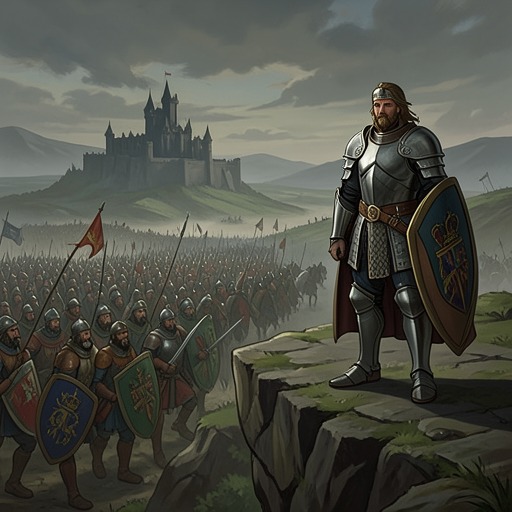
Harfleur’s position is established through a sharply divided stage picture: the Governor and citizens stand on the walls, while the English forces are below. When King Henry V and his train enter, the town’s defenses become the setting for a direct exchange between besieger and besieged. The walls mark the separation between them; the gates will make that separation temporary.
The scene’s focus on walls and gates gives the town a practical and dramatic role. Harfleur is not merely named as a destination: its defenses organize the encounter and make surrender legible as an action. The Governor speaks from within the town’s threatened position, and Henry answers with an order that changes who may pass through its entrance.
The Siege in Theatrical Imagination
Before the action at the gates, the play presents the siege through an appeal to the audience’s imagination. It directs attention to ordnance mounted on carriages, its mouths gaping toward Harfleur, and asks the spectators to picture the assault. The town is thus made the object of a force that the stage can evoke in words and images before the later scene shows the people who must decide whether to resist it.
This movement from imagined siege to negotiation gives Harfleur two connected forms of presence. First, it is the threatened place toward which artillery is directed; later, it is a community represented by its Governor and citizens. The transition brings the military pressure into a political encounter at the walls rather than leaving the town as scenery in a description of weapons.
Surrender and Entry
The Governor says that the town’s expectation has come to an end and recalls that its people had appealed to the Dauphin for succor. He then states that they are no longer able to defend themselves and offers the gates, himself, and the town’s inhabitants to Henry’s disposal. The surrender is therefore presented as a consequence of the collapse of defensive capacity and the end of hope placed in assistance.
Henry answers by ordering the gates opened. He sends the Duke of Exeter to enter Harfleur and remain there. That command converts the Governor’s offer into an immediate change of control: the English forces, previously positioned below the walls, are to pass into the town under Exeter’s direction. The scene ends this confrontation not with a further assault but with the opening of the defended boundary.
Narrative Significance
Harfleur’s surrender is staged as a clear reversal in the town’s status. The artillery image establishes the danger surrounding it; the Governor’s words make the limits of resistance explicit; Henry’s order completes the turn from enclosure to entry. The sequence concentrates the consequences of siege in a brief exchange, connecting military pressure to the civic decision to yield.
The town also anchors the play’s shift between theatrical scale and human consequence. The earlier invitation to picture ordnance makes Harfleur part of a broad spectacle of war, while the scene at the gates gives that spectacle local representatives and a concrete outcome. The walls that first distinguish defenders from besiegers become the threshold through which the English forces enter once the Governor acknowledges that the town can no longer hold.