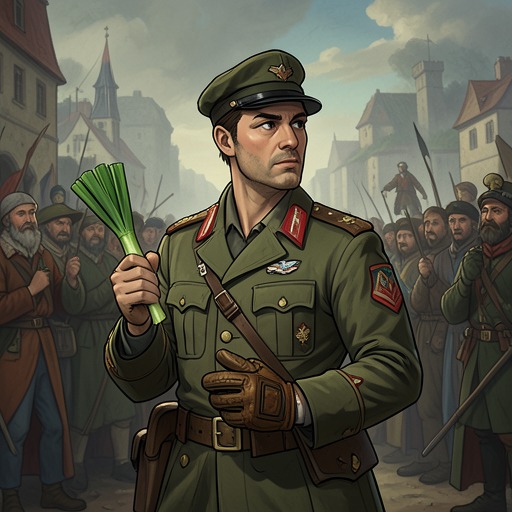
Henry V and John Williams
Henry VHenry V and John Williams are joined by an exchange that makes the justice of war personal: Michael Williams asks whether the king can answer for the dead if his cause is unjust, and Henry accepts the soldier’s proposed quarrel. Their exchanged gloves carry that dispute into the aftermath of battle, where Henry recognizes Williams and answers the old challenge with a gift.## Political Claims and the Soldier’s DoubtThe relationship unfolds against Henry V’s effort to establish the justice of his claim to France. He asks the Archbishop of Canterbury to explain whether Salic Law should bar that claim, framing the question as one requiring a just and religious account. Yet Henry also warns that when kingdoms contend, innocent blood will be shed. His appeal to law and God therefore comes accompanied by an acknowledgment of the human cost that political arguments may set in motion.At Harfleur, Henry’s language makes that cost more immediate: he vows not to leave the city unfinished, declares its gates of mercy shut, and gives the soldier free rein to violence. This earlier threat supplies a sharp counterpoint to Michael Williams’s later insistence that the king’s cause cannot be considered apart from the bodies destroyed in its pursuit. The play does not resolve the tension simply by having Henry claim a lawful title; it lets a common soldier ask what that title requires of the man who leads the army.## The Exchange Before AgincourtThe relationship takes shape in the English camp before Agincourt, when John Bates, Alexander Court, and Michael Williams discuss the army’s condition and the justice of its cause. Henry V describes his men as shipwrecked people about to be washed away by the next tide. His comparison makes their precarious position plain, but it does not settle their doubts about the war. When the king’s company and honourable quarrel are offered as grounds for confidence, Michael Williams answers that this is more than the soldiers know.He presses the issue beyond uncertainty about the army’s prospects. If the cause is not good, he argues, the king will face a heavy reckoning when the limbs and heads cut off in battle join against him. The image converts casualties into witnesses: those who die are not merely the price of victory but a moral claim upon the sovereign. Williams does not announce that the cause is unjust; he insists that the king’s responsibility depends on whether it is. That distinction gives the exchange its force. The soldier’s question places the king’s spiritual burden beside the soldiers’ physical danger.## A Quarrel Bound by GlovesThe debate becomes a personal compact. Williams proposes that, if both men live, their disagreement should become a quarrel between them; Henry accepts. Williams gives Henry a glove and asks for one in return. In that exchange, the argument about royal responsibility acquires a material token and a future condition: survival will bring the two men’s opposing positions back into contact.The glove makes the relationship unusually reciprocal across the distance between ruler and soldier. Henry can command an army, while Williams can question the moral basis of its campaign; for a moment, their difference is not settled by rank or by the battle’s outcome. Each accepts the other’s token, and the unsettled argument is carried forward as a promise between individuals. The later return of the glove shows that the gesture was not incidental: it gives the earlier conversation a consequence that can be recognized after the fighting.## Victory and the Cost of CommandThe battle’s aftermath darkens the question Williams had raised. When the French reinforce their scattered men, Henry orders that the prisoners be killed. A report explains that the French have also burned and carried away everything in the king’s tent, and says that Henry has consequently ordered every soldier to cut his prisoner’s throat. The order is presented as a response to a renewed threat and the loss of the royal tent, but it remains a royal decision involving the lives of captives.This does not show that Williams witnesses the order or responds to it. It does, however, sharpen the moral context of his earlier challenge: the king whose cause the soldier questioned exercises direct authority over life and death after victory. The exchange between them therefore cannot be reduced to a friendly wager settled by English success. The play places Williams’s demand for accountability beside Henry’s capacity to impose a lethal command, leaving the ethical tension visible even as the military situation changes.## Recognition and SettlementHenry V later asks Michael Williams why he wears a glove in his cap. The question recalls the token exchanged before battle and brings their promised quarrel back into the king’s presence. Henry asks Williams for the glove and presents its fellow, making the matching pair a means of recognition. What had seemed a private pledge between two men is now legible within the public aftermath of victory.Williams’s challenge had been framed around survival: the quarrel would follow if both lived. Henry’s return to the glove confirms that the encounter has endured, but he does not answer the soldier by restaging a fight. Instead, he directs his uncle Exeter to fill the glove with crowns and give them to Williams. The gesture settles the immediate personal exchange through payment and royal generosity, without erasing the question that began it. Their relation thus moves from moral opposition, to reciprocal pledge, to recognition and reward; the glove preserves the path between those stages, while the issue of the king’s responsibility remains larger than the private settlement.