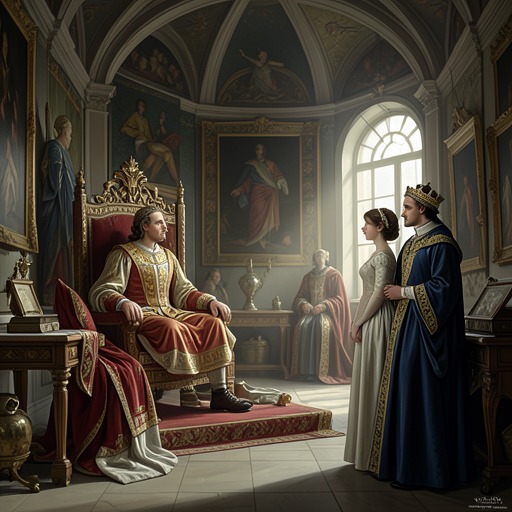
Henry V and Katharine
Henry VHenry V and Katharine is a relationship formed at the intersection of courtship and diplomacy. King Henry V approaches Princess Katharine in person, but their proposed marriage is also the closing act of a political settlement: her father gives her to him in the hope that their descendants will reconcile France and England. The play lets the exchange carry both meanings, while Princess Katharine’s answer leaves her agreement conditional on her father’s will.
A Marriage Shaped by the Claim to France
The relationship’s political setting is established well before the courtship. King Henry V asks whether he can pursue his claim to France with right and conscience, after inviting the clergy to explain whether Salic Law should bar it. Canterbury argues that the law’s name does not make it applicable to France: the land called Salique, he says, lies in Germany between the Sala and Elbe, and is identified with Meisen. He also invokes royal succession precedent, including Pepin’s descent as an heir general. The claim is thus presented not as a settled right but as an argument assembled from legal interpretation, geography, and dynastic history.
That argument has consequences beyond the courtship. Canterbury warns that a contest between two kingdoms brings bloodshed, and King Henry V is urged to consider carefully before committing the realm to war. Against this background, Princess Katharine’s marriage is not a separate romantic episode detached from the conflict. It becomes part of the resolution negotiated after the claim has been pursued by force: a dynastic bond is offered as a way to change the relationship between the kingdoms that have been contending over France.
Courtship Through Language
When the other members of the party leave, King Henry V remains with Princess Katharine and Alice. He opens their private exchange by asking Princess Katharine to teach a soldier terms of her language. The request makes the encounter a lesson as well as a proposal: the king presents himself not only as a ruler negotiating with France, but as a man who must communicate with the woman he hopes to marry.
Princess Katharine replies that the French he speaks is better than the English she speaks. Her response marks a difference in fluency without stopping the conversation. Later, King Henry V asks her to express herself in broken English and directly asks whether she will have him. The language barrier gives the scene its immediate texture, but the exchange does not establish a fluent or equal conversation about their future. Instead, the proposal is made plainly across their imperfect command of one another’s languages, with the political agreement already shaping the circumstances in which it is asked.
Consent and Dynastic Agreement
Princess Katharine answers that the matter is as it pleases the king, her father. The reply does not amount to an unqualified personal declaration of love or an independent acceptance; it places the decision within her father’s authority. The play gives her a speaking part in the exchange—she comments on their relative command of French and English and responds to the proposal—but her answer locates the marriage’s formal consent in the royal family’s political structure.
That structure becomes explicit when King Henry V asks the French king to give him his daughter, after stating that the English party has consented to all reasonable terms. The French king agrees, telling him to take her and asking that their union produce an heir. He hopes that the conjunction of the two royal lines will end their kingdoms’ hatred and establish accord between them. The marriage therefore has a public purpose stated by the participants themselves: it is to connect the rival houses and make future peace imaginable through their issue.
Personal Union and Political Resolution
The relationship’s ending is a negotiated union, not an extended account of married life. The evidence moves from King Henry V’s direct request, through Princess Katharine’s deference to her father, to the French king’s consent and hope for an heir. It does not show how the couple’s relationship develops beyond this agreement, or establish that Princess Katharine privately shares the full political hopes attached to it. Those limits matter: the scene offers courtship, but places its outcome within treaty and dynastic expectation.
The contrast between the private language lesson and the public settlement gives the relationship its significance. King Henry V asks for Princess Katharine’s hand in a personal exchange, yet the French king’s response casts that hand in terms of inheritance, national reconciliation, and an end to war. The marriage is presented as an effort to turn a disputed claim and military conflict into kinship and accord. Its promise is consequential, but it remains a promise voiced at the treaty’s conclusion rather than a peace demonstrated by the couple’s later life.