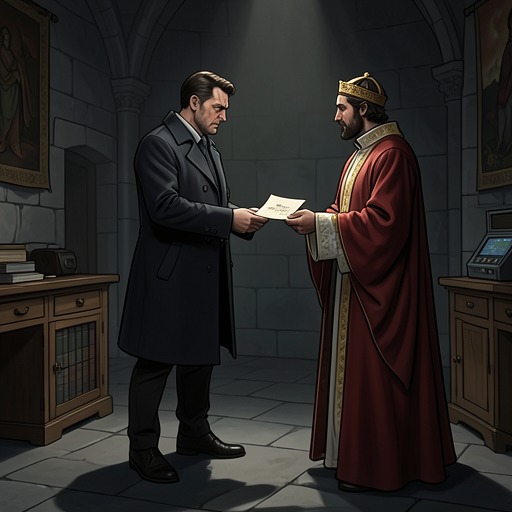
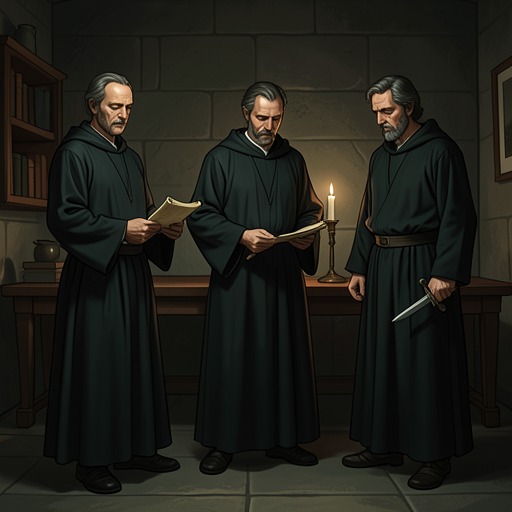
Henry V and Lord Scroop
Henry VThe relationship between King Henry V and Henry Lord Scroop of Masham is defined by a stark reversal: a man admitted to the king’s private confidence is exposed as a traitor to his person. Scroop’s betrayal is especially consequential because it violates not only royal authority but also the intimacy and favor that had bound him to the king. King Henry V responds with anger and disbelief, yet directs the conspirators to answer under law rather than treating the discovery as a private quarrel alone.
Trust and Favor
Before confronting Scroop, King Henry V learns that the conspirators’ intentions have been discovered through an interception they did not anticipate. The means of interception are not specified here; its significance is that the plot is known before the conspirators can act without the king’s awareness. The disclosure places the relationship under the pressure of knowledge: the king must recognize as betrayal what he had previously understood as loyalty.
Scroop’s position makes that recognition particularly painful. Exeter identifies him as the king’s bedfellow, a description of personal closeness, and emphasizes that King Henry V had dulled and satisfied him with gracious favors. The passage presents Scroop as someone who had received both intimacy and generosity, not as an outsider who might plausibly claim ignorance of the king’s trust. His favor heightens the moral contrast between what he was given and what he is accused of doing in return.
The Discovery of Betrayal
King Henry V names Scroop among the men whose treason has been uncovered, alongside Richard Earl of Cambridge and Sir Thomas Grey. He addresses each directly, making the exposure a face-to-face confrontation rather than an abstract report about a conspiracy. Scroop’s particular betrayal is tied to the confidence placed in him: King Henry V recalls that Scroop carried the key to all his counsels. The image makes the breach more than a failure of allegiance. A person entrusted with access to the king’s deliberations has turned that access against the very person who granted it.
The charge also gives the betrayal a material dimension. Exeter says Scroop would sell his allegiance for a foreign purse, and King Henry V later declares that the conspirators conspired against his royal person and joined a proclaimed enemy. The accusation connects private disloyalty to an external political threat. Scroop’s conduct is presented as both a personal treachery and participation in a conspiracy aligned with an enemy; the passage does not describe the intercepted information or specify the precise terms of the foreign payment.
Grief, Anger, and Judgment
King Henry V’s first response to Scroop is marked by the difficulty of accepting what the evidence establishes. He describes the truth as plain as black and white, yet says that his eye can scarcely see it. This moment registers the strain between knowledge and personal recognition: the evidence may be unmistakable, but the accused is someone whose closeness makes the truth difficult to take in. His denunciation of Scroop as cruel, ungrateful, savage, and inhuman follows from that rupture of trust.
King Henry V frames treason and murder as partners working toward the same purpose, and compares the revolt to another fall of man. Those images enlarge Scroop’s offense from a breach between two individuals into a moral and political collapse. Yet the king’s response is not represented solely as outrage. He orders the conspirators arrested to answer the law and asks God to acquit them of their practices. When he turns again to Scroop, he says that God may quit him in mercy and proceeds to pronounce the sentence. The passage thus places accusation, legal process, and judgment in sequence; it does not, in these lines, give the sentence’s full terms or describe its execution.
Significance of the Relationship
Scroop’s betrayal tests the boundary between the king as a man with trusted companions and the king as the holder of public authority. The bedfellow and the keeper of counsels belong to the private side of that relationship; conspiracy against the royal person belongs to the political one. Their collision helps explain why King Henry V’s response carries both personal anguish and formal severity. The man who had been admitted close to him is now treated as an accused enemy of the crown.
The relationship also sharpens the contrast between favor received and loyalty returned. Scroop’s prior access and benefits do not prevent treason; in the king’s account, they make it more ingrateful. By ordering the conspirators to answer under law, King Henry V turns the discovery from a private wound into a public proceeding. The relationship ends, in the supplied episode, not with reconciliation but with judgment pending: trust has been irreversibly broken, and Scroop must answer for the conspiracy.