Law of Arms
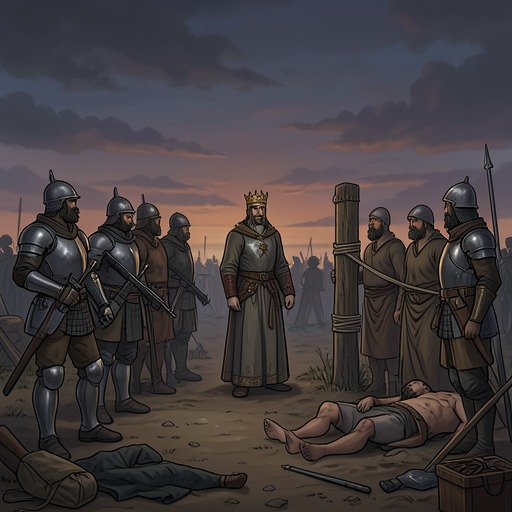
Henry VThe Law of Arms is the standard of military conduct that Captain Fluellen invokes when he condemns the killing of boys and the army’s luggage. The play gives that standard concrete force at Agincourt, then exposes its vulnerability: after the French kill the boys and plunder King Henry V’s tent, Henry orders the English army to kill its prisoners. The rule is therefore presented not as an abstract code safely outside the action, but as a measure against which battlefield conduct can be judged even when fear, loss, and retaliation press against it.
Meaning and Context
The play does not provide a systematic definition of the Law of Arms. Instead, it reveals the rule through disputes about particular military actions. Captain Fluellen objects that an attack on boys and the luggage violates the disciplines of war; his protest identifies both the vulnerable people and the property exposed to violence. The scene makes the standard legible through the act it forbids, rather than through a formal legal explanation.
The conflict also unfolds against earlier arguments about the justice and consequences of war. In the debate over the English claim to France, the Law Salique is examined as a possible bar to that claim, while a warning to King Henry V stresses that kingdoms at war bring much bloodshed. The succession argument concerns the grounds for making war, not the conduct of soldiers once fighting has begun. Read alongside Captain Fluellen’s appeal, it helps distinguish the question of a war’s justification from the separate question of what conduct warfare permits.
Conduct Before Agincourt
At Harfleur, King Henry V threatens that the gates of mercy will be shut and that his soldiers will range with bloody hands if the city does not yield. This is a threat made in the course of the siege, not a ruling on the Law of Arms. Yet it gives the later appeal to military discipline a charged context: the play has already shown royal speech placing civilians under threat, before it presents a soldier objecting to violence against boys.
The play also gives a smaller indication that military conduct is a matter of discipline and judgment. Captain Fluellen warns that it is not good for the Duke of Gloucester to come to the mines, because the mines are not according to the disciplines of war. The surviving exchange does not set out the rule in detail or connect this warning directly to the later killing of prisoners. It does, however, show Captain Fluellen applying the language of military discipline beyond the Agincourt scene: for him, conduct in war can be assessed against standards, rather than treated as whatever a commander or soldier happens to do.
Agincourt: Rule and Retaliation
The decisive confrontation comes after an alarm announces that the French have reinforced their scattered men. King Henry V orders the English soldiers to kill their prisoners. The timing makes the order an immediate response to a changed battlefield situation, but the following exchange supplies a more specific explanation of the violence that has already taken place. Captain Gower says that no boy is left alive; he attributes the slaughter to French soldiers who fled the battle and adds that they burned and carried away everything in the king’s tent. He then says that King Henry V has caused every prisoner to have his throat cut.
Captain Fluellen’s protest follows this account. He condemns the killing of boys and the luggage as contrary to the Law of Arms and calls it knavery, making his appeal both a statement of military discipline and a rebuke to the perpetrators. The juxtaposition is stark: the English army condemns an attack on boys and baggage, while its king orders the execution of prisoners. The play presents the order and the protest together, so the rule cannot be reduced to a simple declaration that one side observes it and the other breaks it.
Responsibility and Significance
The scene explains the order through the killing of the boys and the destruction and removal of the king’s tent’s contents. That explanation establishes the sequence and the immediate grievance; it does not erase the distinction between the acts Captain Fluellen condemns and King Henry V’s command against prisoners. Nor does the play present the order as a neutral definition of the Law of Arms. The standard’s force comes instead from its use as a judgment on conduct, including conduct undertaken by the victorious army.
Elsewhere, John Williams raises a related question of responsibility: if the cause of the war is not good, the king himself will face a heavy reckoning when the soldiers’ severed limbs and heads are accounted for. His argument concerns the king’s responsibility for the cause and cost of war, rather than a specific rule for treating prisoners. Together with the Agincourt dispute, it keeps two moral questions in view: whether the war is justly undertaken, and whether its actions conform to restraints claimed within warfare. The Law of Arms matters because the play makes those questions difficult to separate from the people who suffer their consequences.