Saint Crispin’s Day
Henry VSaint Crispin’s Day is the name King Henry V gives to the day of the Battle of Agincourt, and the date becomes more than a marker on a calendar. In Henry’s speech, it is a future tradition in the making: survivors will meet again, show their wounds, and pass the battle’s story to another generation. The day’s force lies in this conversion of immediate danger into communal memory, even as the battle’s aftermath complicates any simple celebration of honor.
The Day and the Battle
The name enters the action as a point of identification. Montjoy says the battle is called Agincourt; King Henry V answers by naming the field and associating the fight with the day of Crispin Crispianus. This exchange binds a particular place to a particular day. The calendar name does not replace Agincourt, but gives the battlefield a second identity: the date by which those who survive will remember it and others will learn of it.
Henry’s speech makes that naming prospective as well as commemorative. He imagines the man who outlives the fighting returning home safely, then standing taller when the day comes around again. The speech does not report an established annual observance. Instead, it forecasts one, describing how survival might develop into a repeated act of remembrance. The day is at once a dangerous present and a future occasion that its survivors will recognize together.
From Survival to Shared Memory
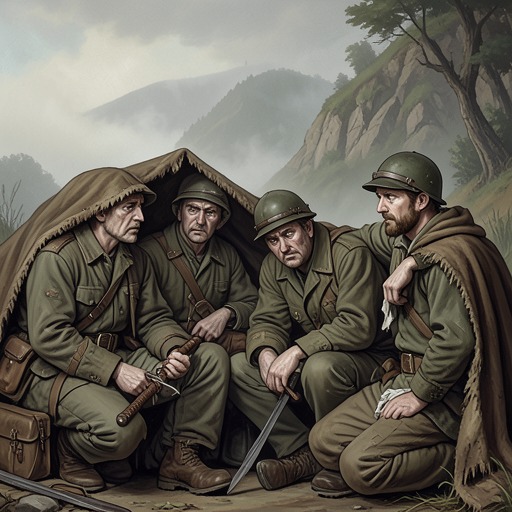
The imagined observance begins with neighbors gathering on the vigil of the feast. A survivor will recall the next day’s name and show the scars on his sleeve, making the body itself evidence of participation. The wounds are not merely private injuries in this account: displayed and linked to the day, they become a record that others can see. The speech gives physical marks a social afterlife, carrying the experience of battle into a later gathering.
That imagined gathering also makes memory transmissible. Henry pictures a good man teaching the story to his son, so that recollection passes beyond those who fought. The annual return of the date and the repeated telling work together: one renews the occasion, while the other gives it a voice in a succeeding generation. The forecast thus moves outward from individual survival, through neighbors assembled at a feast, to a family story that can continue beyond the original witnesses.
Henry also sets the prospect of forgetting against the persistence of shared recollection. The speech acknowledges that old men forget, yet imagines this day and its story being recalled afresh in company. The contrast does not make memory automatic. It presents remembrance as something people do: they gather, recount the wounds, and teach the story. The claim that the day will not pass from memory until the world’s end is the speech’s largest promise, growing out of these specific, repeatable acts.
Fellowship, Glory, and the Cost of the Date
The community Henry imagines is defined by having faced death together. His appeal to men unwilling to die in the company of someone who fears sharing their fate makes fellowship a condition of the speech’s memorial promise. Those who survive will have more than a date in common: they will be able to identify one another through the risk they shared. The annual recollection turns that bond into a public story, and the scars make the bond visible.
Yet the battle’s immediate context prevents the day from meaning only triumph or fellowship. When the French reinforce their scattered men, King Henry V orders the English soldiers to kill their prisoners. A later report says that the French have burned and carried away everything from the king’s tent, and that the king has consequently ordered every soldier to cut his prisoner’s throat. This order is part of the same battle sequence that gives the feast its commemorative power. The contrast matters: the day’s promised shared renown sits beside an act of lethal violence against captives. Its remembrance is therefore attached not just to a stirring forecast of solidarity but to the hard moral circumstances of war.
Dramatic and Historical Significance
The speech gives a future shape to an event whose outcome is not yet secured at the moment of address. It asks its hearers to picture men who survive, return home, and remember; the anticipated yearly gathering depends on survival, while its confident promise reaches toward a future the combatants cannot yet possess. The date becomes a hinge between the peril of battle and the later stories through which that peril may be understood.
That transformation also suits a play that asks its audience to imagine what a stage cannot fully contain. At the beginning, the Chorus calls on spectators to supply with their thoughts the scale and force that the stage cannot show. Henry’s naming of the day performs a related act of imaginative enlargement: a single battle-day is made to contain future reunions, displayed wounds, family teaching, and remembrance extending beyond the lives of its participants. Saint Crispin’s Day consequently functions both as a date within the action and as a compact model of how public history is made—through naming, repetition, and the passing on of stories.