Siege of Harfleur
Henry VThe Siege of Harfleur is the first major test of King Henry V’s French campaign: English forces bring the town to surrender, but the victory exposes the limits imposed by sickness, depleted numbers, and the coming winter. The play sets the siege against an earlier proposal to take a quarter of England’s strength into France, then presents the campaign not as effortless conquest but as a pressure-filled operation involving artillery, ladders, negotiation, and a difficult decision about what the army can sustain.
Causes and Strategic Frame
The expedition is proposed as a way to turn England’s resources toward France. In counsel to King Henry V, the Archbishop of Canterbury recommends dividing England into four and taking one quarter into France, with the expectation that the invasion will shake the country. The siege at Harfleur gives that broad strategic ambition a specific objective: a defended town whose capture can be represented onstage as both a military achievement and a test of the king’s authority.
The Chorus helps make the scale of the operation legible to the audience. Rather than relying only on dialogue, it asks spectators to imagine a siege, with ordnance mounted on carriages and directed toward Harfleur. The town’s defenses and the machinery of attack are thus part of the play’s theatrical argument: the audience must supply a battlefield that the stage cannot show in full. The siege is at once a military episode and an act of imaginative construction.
The Assault and the Town’s Surrender
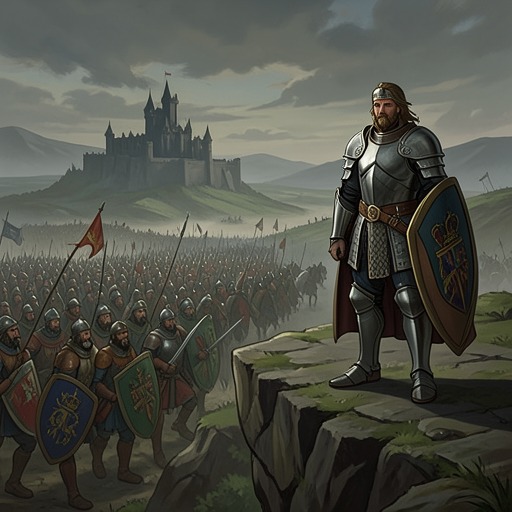
The action is set before Harfleur, where King Henry V enters with the Duke of Exeter, the Duke of Bedford, the Duke of Gloucester, and soldiers carrying scaling ladders. The stage picture places the means of assault alongside the commanders who must decide how to use them. A later scene fixes the opposing positions more sharply: the Governor and citizens stand on the walls, while the English forces wait below the gates.
The play also indicates that siege work involves more than a frontal assault. Captain Fluellen objects to the mines, arguing that mining does not accord with the disciplines of war. The detail introduces a dispute about the conduct of the operation without presenting a full technical account of it. It shows the siege as labor and method as well as spectacle, and places questions of military discipline inside the action rather than leaving them to the Chorus’s imagined artillery.
At the gates, King Henry V calls the exchange the last negotiation he will allow. He presses the Governor to yield and warns that continued resistance will bring destruction; the choice is framed as surrender or the consequences of defending the town. The Governor answers that the defenders’ expectation has ended. They had sought succor from the Dauphin, but the awaited help has not come, and the town can no longer be defended. The Governor therefore yields Harfleur and places its people and possessions under the king’s control.
Occupation and the Cost of Success
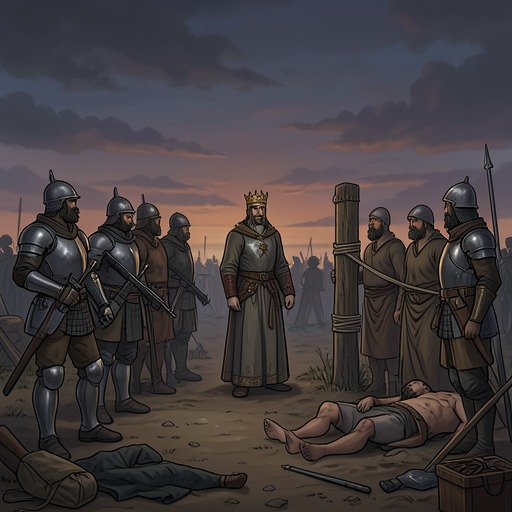
The surrender produces an immediate change of control, not an open-ended advance. King Henry V orders the gates opened and sends the Duke of Exeter into Harfleur to remain there and fortify it against the French. At the same time, he orders mercy for the inhabitants. Occupation and restraint are joined in the settlement: the English are to secure the town, but the captured population is not to be treated as an enemy to be punished indiscriminately.
The king’s next decision makes the limits of the victory plain. Winter is coming, and sickness is spreading among the English soldiers; King Henry V therefore announces a withdrawal to Calais. The siege has succeeded in securing Harfleur, yet the army cannot simply convert that success into continued campaigning. The sequence links the town’s capture to its logistical price: holding the place requires a garrison, while the wider force is weakened by illness and the season.
The play later makes the army’s condition explicit through King Henry V’s assessment to Montjoy, the French messenger. He acknowledges that sickness has enfeebled his people, that his numbers have fallen, and that the remaining soldiers are nearly no better than an equal number of French. This admission complicates the image of conquest. The English have taken Harfleur, but the king recognizes that the force which accomplished it is diminished and faces a powerful opponent.
Dramatic Function and Aftermath
The French king’s message, delivered by Montjoy, answers English confidence with a different account of military judgment. France had seemed dead, the message says in substance, but had only slept; advantage, rather than rashness, makes the better soldier. The exchange sets caution against the momentum of invasion. It does not undo the surrender of Harfleur, but it warns that the campaign’s next stage will not be settled by the town’s fall alone.
The Chorus later calls the night scene a little touch of King Henry V, linking the king’s presence among his soldiers to the movement from Harfleur toward the battle that follows. The siege therefore functions as a hinge: it establishes the king’s command, shows the English taking a fortified town, and then carries the narrative forward under conditions of sickness and numerical weakness. Its outcome is real but bounded. Harfleur is secured and entrusted to the Duke of Exeter, while the army withdraws to Calais; the campaign continues with the cost of the siege still visible in the condition of the men.