Theatrical imagination and stage representation
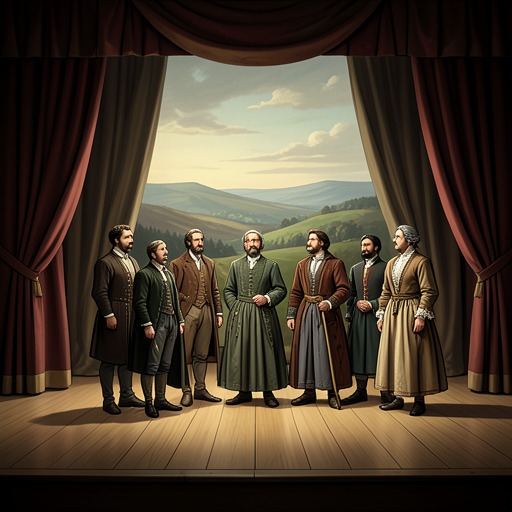
Henry VTheatrical imagination and stage representation in Henry V make the audience’s mind an essential part of the stage. The Chorus openly acknowledges that a small playhouse cannot contain the fields, armies, distances, and years of the history it presents, then turns that inadequacy into a method: spectators are asked to imagine what the physical scene cannot show. The result is not simply a reduced version of historical spectacle, but a performance built on exchange between the limits of the stage and the imaginative work of its audience.
A Small Stage and a Vast History
The Chorus begins by wishing for a fiery Muse and a kingdom that could serve as a stage, a scale adequate to princely action. The actual playing space is instead described as an unworthy scaffold and a cockpit. Its dimensions provoke a practical question: can it hold the vast fields of France, or the helmets that once filled the air at Agincourt? The distance between those images and the small space named by the Chorus establishes the play’s central representational problem. The history demands more space than the stage can physically provide.
The Chorus does not conceal that mismatch. It asks pardon for the smallness of the theatrical figure, while proposing that a crooked or imperfect shape can stand for a million. The wooden O is therefore both a visible boundary and an invitation to see beyond it. Within the girdle of the playhouse walls, spectators are asked to imagine two mighty monarchies, divided by the perilously narrow ocean. The stage does not reproduce that world in miniature through detailed scenery; the audience is asked to construct its scale from words and thought.
This appeal makes theatrical limitation productive rather than incidental. The Chorus asks spectators to supply what the performance cannot literally provide, including a multitude of people and the force of an army. It describes the audience’s thoughts as the means of repairing the play’s imperfections. The imagined spectacle is thus collaborative: the actors and Chorus present the prompts, while spectators complete the pictured world. The play’s claim to represent a vast history depends on acknowledging that no single stage image can contain it.
The Audience as Builder of the Scene
The Chorus gives this imaginative task concrete forms. When horses are mentioned, spectators are asked to picture their hoofs striking the earth. When the kings appear, the audience’s thoughts must furnish their presence and carry them from place to place. These examples move from bodily motion to the representation of authority: neither a cavalry charge nor the full presence of monarchs is treated as self-evidently available on the stage. Each must be made present through a combination of spoken performance and spectators’ mental visualization.
The appeal also changes the audience’s role from passive witness to active interpreter. The Chorus asks spectators to divide one man into a thousand parts and imagine military power on that scale. It asks them to follow movement across places and to transform the accomplishment of many years into an hourglass of theatrical time. These requests identify the specific operations by which the play expands its means: multiplication supplies numbers, imagination supplies force, and mental movement supplies distance. The represented history is larger than the visible action because the audience is continually asked to enlarge it.
The Chorus also frames this participation as a matter of judgment. It asks for patient hearing and kind judgment, making the audience’s imaginative labor part of an agreement about how the play should be received. Spectators are not asked to mistake the stage for a literal battlefield. They are asked to understand its conventions and help make its signs sufficient. The play’s direct address keeps that agreement visible, repeatedly reminding its audience that historical scale is something performance and spectators produce together.
Changing Place and Compressing Time
The Chorus actively manages the play’s transitions, using speech to reposition the audience when the visible setting cannot carry the full geography of the action. After referring to the agreed treason and the king’s departure from London, it announces that the scene has moved to Southampton. The audience is told to treat the playhouse as Southampton and to follow the action onward from there to France. The transition does not depend on a fully rendered journey. The Chorus names the new place and directs spectators to relocate the scene in thought.
The same principle governs the movement toward Harfleur. The Chorus describes an imagined flight of the scene and asks the audience to picture a siege, with artillery mounted and aimed at the fortified town. The spoken image supplies a direction of attention and a few decisive objects; spectators are responsible for assembling the wider scene around them. The transition is therefore both narrative and performative. By announcing movement, the Chorus changes where the audience understands itself to be, even as the playhouse remains the same.
Time is handled with comparable freedom. The Chorus explains that the action must pass across years within the short duration of performance, and later announces a rapid return to France after an interval. It tells spectators to accept abridgment and advance their eyes after their thoughts. The phrasing links the audience’s imagined movement to the play’s temporal movement: thought travels ahead, and the visible action follows. Instead of presenting every intervening moment, the Chorus makes compression part of the theatrical experience and openly enlists the audience in bridging what the performance leaves out.
Night, Battle, and the Risk of Representation
Before the battle, the Chorus again begins with an invitation to imagine, this time a moment when murmuring and darkness fill the wide vessel of the universe. It then directs attention to a brief touch of Harry in the night before moving the scene to battle. Darkness and night are presented through the Chorus’s spoken prompt, while the audience is again asked to form the larger setting around the detail it provides. The movement from the night scene to Agincourt repeats the play’s established pattern: announce a transition, offer a pointed image, and ask spectators to complete the world.
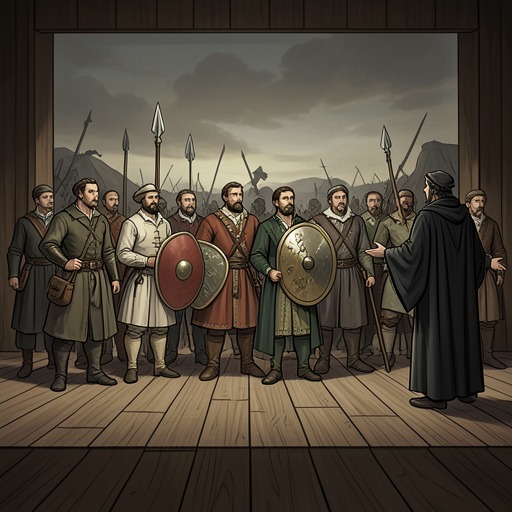
The Chorus is especially candid about the difficulty of representing Agincourt. It warns that four or five ragged foils in a ridiculous brawl will disgrace the battle’s name. The warning sets the imagined historical event against the limited number and appearance of the stage combatants. Rather than claiming that a handful of performers can reproduce a vast battle, the Chorus acknowledges the discrepancy before the scene proceeds. That acknowledgment makes the audience’s imaginative work indispensable once more, while also preserving a distinction between the historical scale invoked by the play and the smaller spectacle available in performance.
Elsewhere, the Chorus addresses both spectators unfamiliar with the story and those who have read it, asking the former to be prompted and the latter to excuse the telling. It later turns from the distribution of credit to the image of London pouring out its citizens, then asks the audience to accept another abridgment and return in thought to France. These gestures situate the play between remembered history and its present staging: the audience may bring prior knowledge, but must still follow the Chorus’s directions through the play’s compressed representation. Theatrical imagination is consequently not a single act of picturing an army. It is the continuing practice by which spectators accommodate changes of scale, setting, and time, allowing a small stage to carry a history it cannot literally contain.