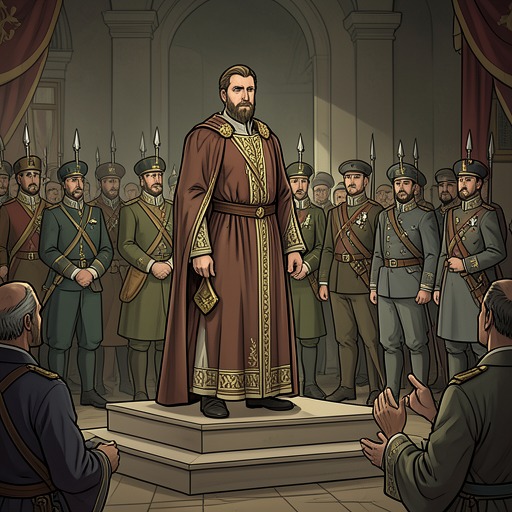
What have kings, that privates have not too, save ceremony
Henry V“What have kings, that privates have not too, save ceremony?” is the pivot of King Henry V’s meditation on royal power: the king differs from other people less in his human nature than in the public forms that surround his office. The expression makes ceremony both the visible source of royal authority and a poor substitute for the ease and ordinary humanity the king must surrender.
Context and Meaning
Henry frames the thought through a contrast between the monarch and the private person. He says that the king is a man as he is, and that the violet smells and the elements appear to the king as they do to him. Royal rank does not alter the conditions of the senses. When ceremony is laid aside, the king appears “but a man”; what distinguishes him is therefore not a different kind of body, but an elevated public position.
The expression’s question sharpens that comparison into a test of what kingship actually provides. Its answer is ceremony: “place, degree and form,” which create awe and fear in other people. Those terms describe an ordered display of rank, rather than an inner quality or a private comfort. Ceremony gives the king a visible difference, but Henry immediately asks what that difference is worth to the person who must inhabit it. The gap between being feared and being happy becomes the passage’s central irony: the ritual that magnifies the king’s status does not free him from mortal grief.
The Burden Behind the Display
The thought gains force from the soldiers’ understanding of royal responsibility. They declare that they will lay their lives, souls, debts, careful wives, children, and sins upon the king. Their list reaches from life and spiritual accountability to household obligations. Their allegiance makes the king the recipient of an enormous moral burden: his office is not simply a privilege enjoyed above the common people, but a focus for what they risk and entrust to him.
Henry’s meditation turns from that public burden to what kings must forgo. He asks what “infinite heart’s-ease” kings must neglect, even while private men enjoy it. The expression does not claim that ceremony is unreal: it creates genuine awe and fear in those who witness it. Instead, it exposes the cost on the other side of that effect. The king’s formal elevation separates him from forms of ease that remain available to people without his office. Ceremony can secure distance and deference, but it cannot give its bearer the uncomplicated peace it helps deny him.
The Rhetorical Turn
The passage moves by successive questions. Henry first asks what ceremony is worth, then what its “soul of adoration” might be, and finally what kind of god it resembles. This language tests the reverence attached to rank by treating ceremony as if it demanded worship. Yet the comparison is unsettling rather than triumphant: ceremony can make others fear the king, but it remains unable to spare him the griefs of mortal life. The questioning thereby separates the appearance of near-sacred authority from the human condition beneath it.
The expression itself is compact and almost accounting-like: it asks what kings possess beyond what private people also possess, then answers with an abstraction. That abstraction opens into a more concrete description of “place, degree and form.” The movement matters. “Ceremony” might sound like a single, impressive possession; Henry’s unpacking shows it to be a set of arrangements that stages hierarchy and produces an effect in other people. Its power lies in how it is performed and received, not in changing the king’s senses or removing his vulnerability.
Human Vulnerability and Kingship
The surrounding speech holds the monarch’s two conditions together without resolving their tension. Ceremony makes the king publicly exceptional, while Henry’s account of shared sensation insists that he remains human. The expression names the boundary between those conditions: royal authority is socially legible and consequential, yet it does not amount to bodily or emotional invulnerability. Indeed, the king’s elevation can intensify isolation by making ordinary ease something he must neglect.
After the meditation, Henry turns to prayer, asking the God of battles to steel his soldiers’ hearts and not possess them with fear. That appeal gives the earlier questioning a practical consequence: the king who has examined the limits of ceremony still faces responsibility for frightened men. Later, after victory, he says that only twenty-five men of name remain besides the named dead, and attributes the outcome to God’s arm rather than to the English. These moments extend the expression’s contrast between visible human authority and dependence on powers beyond it. Ceremony distinguishes the king from private men; it does not make him sovereign over fear, loss, or the outcome of battle.