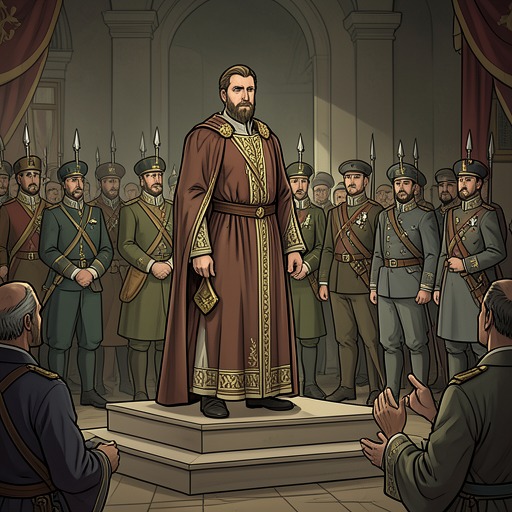
What infinite heart's-ease must kings neglect, that private men enjoy!
Henry V“What infinite heart's-ease must kings neglect, that private men enjoy!” is King Henry V’s sharpest formulation of the human cost of royal responsibility. The expression turns ceremony from a sign of privilege into a condition of separation: the king bears what others lay upon him, yet cannot share their ordinary ease.
Context and Speaker
King Henry V speaks the expression in a reflection on the distance between the king and his subjects. After the soldiers have gone, the speech considers what is placed upon the monarch and what royal status withholds from him. Its question is not an abstract definition of kingship: it follows an accumulation of lives, souls, debts, wives, children, and sins imagined as burdens laid on the king.
The expression also develops a claim Henry has just made about the monarch’s physical humanity. He says that the king’s senses have the same human conditions as other people’s, and that, with ceremony laid aside, he appears simply as a man. The violet smells to him as it does to another person; the elements affect him as they do others. Against that bodily likeness, the burdens and privileges of office create a social difference that cannot be set aside so easily.
Ceremony and Its Cost
The phrase’s central contrast is between “kings” and “private men.” Henry asks what kings possess beyond ceremony, then challenges ceremony as idle. The question makes public distinction sound less like a reward than a barrier: the king’s elevated position brings scrutiny and responsibility, while private people retain forms of “heart's-ease” that the monarch must neglect.
The surrounding speech gives that deprivation a specific political weight. The soldiers’ words place their lives and dependants’ welfare, along with their debts and sins, upon the king; Henry describes the condition as “Twin-born with greatness.” Greatness therefore arrives joined to exposure. The king is subject to the breath of others, including those who feel only their own suffering, and his office makes him answerable to concerns beyond his private self.
The Human King and the Burden of Rule
The expression belongs to a sustained tension between the king’s natural body and his public role. Henry insists that royal ceremony does not change his senses or make him more than human, yet the demands directed at the king exceed the ordinary limits of private life. His words refuse both easy conclusions: he is neither merely a privileged figure nor simply another man, because the office binds his human life to the expectations of the realm.
That tension sharpens when Henry turns from reflection to prayer, asking the God of battles to steel his soldiers’ hearts and keep fear from them. Later, after the fighting, he says that only five and twenty men of name, besides those he names, were lost, and credits victory to God’s arm rather than human stratagem. The later gratitude does not erase the burden expressed here; it shows how the king’s responsibility reaches from the lives entrusted to him to the interpretation of their survival.
Significance
The expression compresses the play’s contrast between royal appearance and human vulnerability into a question about what kings must give up. “Heart's-ease” names not luxury but an ordinary freedom from the weight of public responsibility. By placing that ease on the side of private people, Henry makes kingship seem at once elevated and costly: ceremony distinguishes the monarch, while the duty attached to that distinction denies him the untroubled life it might seem to promise.