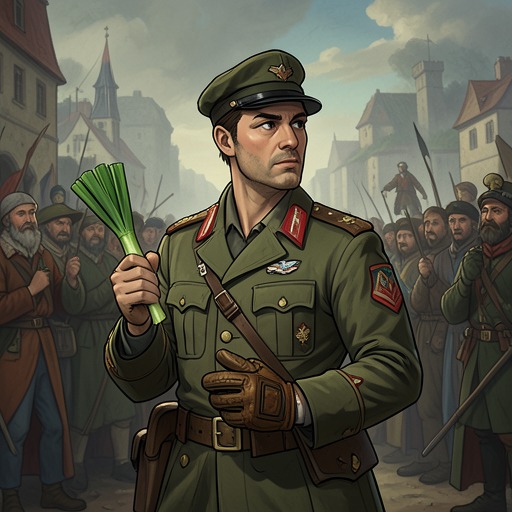
Williams and Henry's exchanged glove
Henry VWilliams and Henry's exchanged glove is both a private recognition token and the material hinge of a public misunderstanding. A soldier's challenge to remember their bargain returns at the king's pavilion, where the glove prompts a confrontation with Captain Fluellen and ultimately enables King Henry V to settle it with money, honor, and reconciliation.
The Exchange and Its Terms
The glove originates in a conversation between Michael Williams and King Henry V about how they would recognize each other again. Henry asks Williams for a pledge he can wear in his bonnet; if Williams later dares to acknowledge it, Henry says, he will take the matter up as his quarrel. Williams offers his glove and asks for one of Henry's in return. Henry gives him another glove, making their exchange reciprocal: each man carries an object associated with the other.
Williams makes the bargain pointedly conditional. He says that he will wear Henry's glove in his cap, but if Henry comes to him after the next day and claims it as his, Williams will strike him on the ear. The object is therefore more than a keepsake. It gives the two men a practical means of recognition, but also records a promise that can be tested. Williams's warning makes the exchange an unusually direct meeting between a king and a soldier: the king accepts a token from a subject whose future response is framed as a challenge, not as ceremony.
The Glove Becomes a Challenge
The glove returns in the scene before Henry's pavilion. Henry has given Captain Fluellen a glove that he says he plucked from the helmet of the Duke of Alencon when they were down together. He tells Fluellen to put it in his cap and directs him to apprehend anyone who challenges it, describing such a challenger as an enemy to the king. The token now carries an apparent royal charge: to question its possession is, under Henry's instruction, to risk being treated as a threat to his person.
Michael Williams recognizes the glove and asks Fluellen whether he knows it. Fluellen answers literally, saying that he knows it is a glove; Williams then says he recognizes it and challenges it, striking Fluellen. The contrast is between the glove's ordinary identity as clothing and its particular history as a pledge exchanged with the king. Fluellen responds to Henry's order and the glove's supposed connection to Alencon; Williams responds to the personal claim embodied in the earlier exchange. Their opposing understandings turn a small object into the immediate cause of a physical dispute.
Recognition, Payment, and Reconciliation
With Captain Gower and Williams outside the pavilion, Williams asks Fluellen whether he knows the glove and then strikes him. When Henry enters with the Duke of Exeter, Williams explains that this was his glove and that its fellow was given to the man with whom he had exchanged it. Henry asks to see Williams's glove and produces its counterpart. The paired objects establish the earlier bargain in front of the others and allow the king to recognize the claim Williams has made.
Henry orders the Duke of Exeter to fill the glove with crowns and give it to Williams. He tells Williams to keep it and wear it in his cap as an honor until Henry challenges it. The glove thus changes from a pledged token to a container for a substantial royal gift, while retaining its place in the cap as a visible sign. Henry also orders that Fluellen and Williams must become friends. The conclusion does not erase the blow or the confusion that produced it; instead, Henry uses the recognized exchange to convert the confrontation into a settlement that joins compensation to reconciliation.
The Object's Dramatic Role
The glove's meaning shifts with the person holding it and the claim made for it. At first it is a reciprocal pledge between a king and a soldier. In Henry's hands and under his instruction to Fluellen, it becomes a test by which a challenger may be identified and detained. In Williams's hands, it is evidence of a prior exchange; when Henry produces its fellow, that private agreement becomes publicly legible. Crowns placed inside the glove then make the same object a gift and an honor.
This sequence gives material form to the scene's conflict over recognition and authority. Williams does not simply assert that the glove is his: he identifies the history connecting it to its fellow, and Henry confirms that history by producing the matching object. The resolution depends on physical correspondence as well as royal judgment. The glove can provoke a blow when its history is misunderstood, but once the exchange is acknowledged, Henry redirects its force toward payment and friendship.