wooden O
Henry VThe wooden O is the play’s compact theatrical space and the imaginative frame through which its vast military world becomes visible. Rather than conceal the gap between a stage and the wars it represents, the Chorus names that gap and asks the audience to bridge it, making theatrical inadequacy the basis of a shared act of imagining.
A Small Stage and a Vast Subject
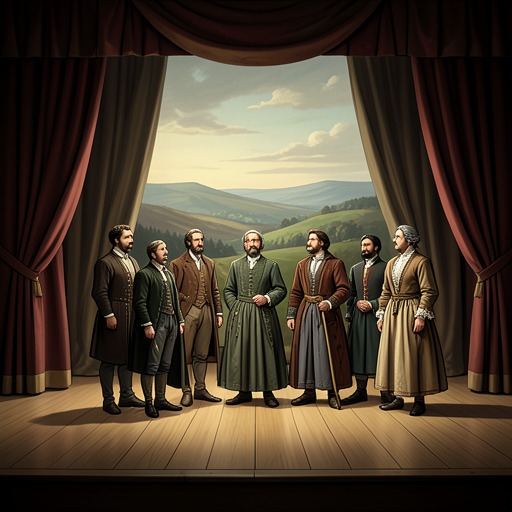
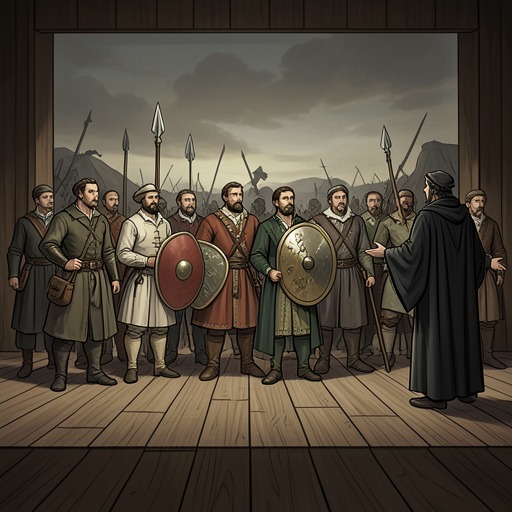
The Chorus tests whether a “cockpit” can hold the vast fields of France and whether the wooden O can contain the helmets associated with Agincourt. The questions make the mismatch explicit: a confined playing space must represent not merely a landscape but the scale and force of armies. The wooden O is therefore both a physical boundary and a figure for the challenge the play sets itself.
The Chorus does not claim that the stage can reproduce everything it evokes. It asks spectators to accept that a “crooked figure” may attest to a million, and casts the performers as ciphers in a greater account. The contrast between small theatrical means and immense historical subject matter remains visible rather than being smoothed away.
The Audience’s Work
The Chorus invites the audience to supply what the stage cannot provide. It asks them to imagine two mighty monarchies confined within the walls, with the perilous ocean between them, and to “Piece out our imperfections with your thoughts.” The wooden O becomes a boundary that spectators are asked to mentally enlarge: their imaginative effort gives the play’s limited space its otherwise absent scale.
This appeal makes spectators participants in the representation, not simply witnesses to a completed illusion. The Chorus acknowledges theatrical imperfection directly, then makes that acknowledgement an instruction. What cannot be materially shown must be divided and multiplied in the mind, so that the narrow stage can suggest armies and territories far beyond itself.
A Space That Changes with the Story
The wooden O does not remain tied to one setting. When the Chorus announces that the scene has moved to Southampton, it tells the audience that the playhouse is now there; from that point, the imagined journey will carry them onward to France. The shift is achieved through narration and spectators’ acceptance of the new location, rather than through any claim that the physical stage has become a real town or country.
Later, the Chorus describes the scene as flying with the speed of thought and asks the audience to imagine a siege at Harfleur, with ordnance on its carriages and their mouths directed at the town. The change from the playhouse to the siege depends on the same compact mechanism: words establish the action, while the audience supplies the expansive view.
Theatrical Meaning
The wooden O gives the play a way to represent historical magnitude without pretending that its stage can literally contain it. Its limits are part of the performance’s subject: the gap between a small enclosure and the scale of France, Agincourt, or a siege is repeatedly exposed, then crossed through collective imagination. The Chorus’s appeals make that crossing a recurring dramatic method, turning theatrical space from a passive container into a collaboration between performers and audience.