Charles
Her First Werewolf (BBW, Werewolf, Prince Charming, Fairy Tale Romance)Charles is the principal supernatural and romantic counterpart to Flora, and his significance lies in the way he overturns the story’s inherited image of the Wolf. He enters the narrative as a handsome stranger in the forest, but his true identity emerges only after intimacy and danger have stripped away his human appearance. Rather than remaining a simple monster, Charles becomes a figure through whom the story joins Lycanthropy to tenderness, social privilege, sexual desire, and a proposed future beyond Flora’s impoverished farm life.
Identity and Introduction
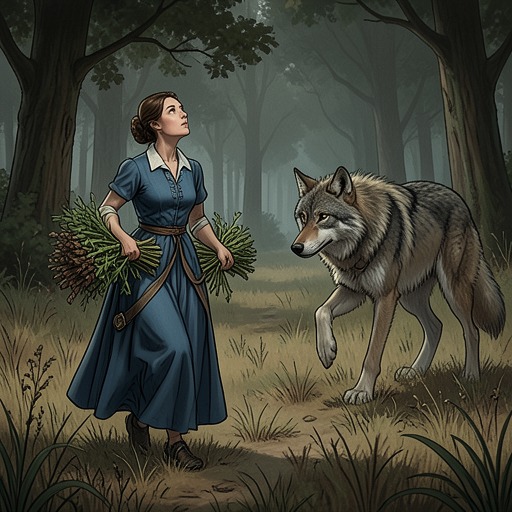
Charles first appears in the sunlit glen after Flora has tried to reassure herself that there are no fairies, trolls, or Werewolves. His entrance therefore answers her denial with an immediate, unsettling presence: he has overheard her speaking to the forest and addresses her as a fellow traveler. He is tall and handsome, with dark, silky hair, green eyes, broad shoulders, and fine, clean clothing. His appearance distinguishes him from the farmers and herdsmen Flora knows, and his polished presentation hints at a social position that she has not yet recognized.
His manner is confident and teasing. He moves closer while asking where such a beautiful young maid is going, then removes a leaf from Flora’s hair and turns the harmless gesture into an opportunity for charm. When she offers him milk, he gives his name as Charles and accepts the invitation to share her meal. He also responds warmly when she reveals that her real name is Flora, saying that he likes it. The exchange establishes a pattern that persists throughout their relationship: Charles uses wit, physical boldness, and affectionate attention to make a frightened and shy woman feel specifically noticed.
The Forest Encounter and Courtship
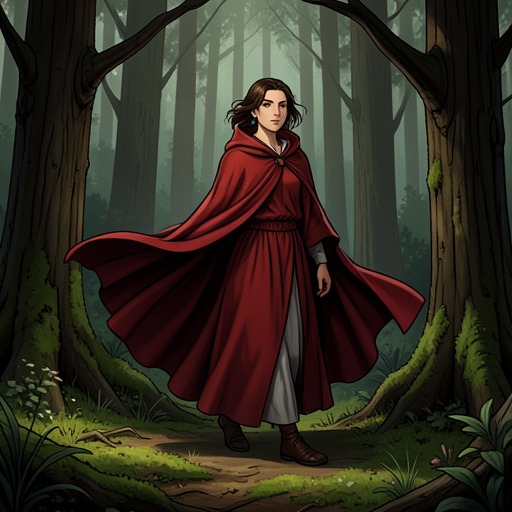
Charles’s first meeting with Flora occurs within a recognizable Little Red Riding Hood motif. Flora wears Flora’s red velvet cloak, has been sent by Morgan toward a family destination beyond the forest, and has been warned to Stay on the path. Yet Charles is not introduced as an obvious Wolf waiting to prey upon her. He is first a cultivated man whose appearance and conversation invite trust, and the danger of the encounter is obscured by his charm.
After sharing the forest meal, Charles promises to visit Flora in town so that they can continue enjoying each other’s company. Flora is conscious of the social distance between them: her home is quaint and poor, while Charles appears wealthy enough that she doubts he could genuinely want a milkmaid. She also insists internally that she does not want a man in her life, even as her heart briefly overrides that judgment. Charles treats her reluctance lightly, claims that he is charming when he wishes to be, and steals a kiss from her cheek. The gesture is presumptuous, but the scene presents it as the beginning of a mutual attraction rather than as a completed courtship arranged by their families.
His pursuit is more deliberate than the meeting initially suggests. After revealing his nature, Charles tells Flora that he has been tracking her at the farm for days and wants to take her away from her present life. This admission gives his courtship a double aspect. It can be read as attentive interest, because he has observed her before approaching her, but it also carries the unease of surveillance. The story places protection and predation close together, making Charles’s desire inseparable from the animal identity that he has concealed.
Lycanthropy, Danger, and Protection
Charles’s Werewolf identity becomes undeniable during a sudden encounter with a large black snake whose bite is said to cause instant death. When the snake approaches Flora, Charles tells her not to move and takes up a stick, but his decisive intervention is not human. Before her eyes, he changes from a man into a huge, black-furred Wolf and eats the twenty-foot snake in a single bite. His transformation is terrifying in its physical scale, yet the familiar emerald glow in his eyes remains kind, allowing Flora to recognize the beast as Charles rather than as an entirely separate creature.
The revelation follows an earlier warning sign. During their sexual encounter in the forest, Charles’s howl, increasingly bright eyes, and lengthening, sharpening teeth make Flora question what he really is. She hears the sound of a Wolf but remains uncertain whether it might simply be an unusual human response. The narrative thus delays full recognition until the transformation is visible, allowing desire to coexist with incomplete knowledge. Charles’s body shifts between human and animal states, and each form carries a different kind of power: the man seduces and speaks, while the Wolf possesses extraordinary strength and saves Flora from immediate death.
Charles openly identifies the condition as a source of shame. In Wolf form, he communicates with Flora through a voice inside her head and says that he is ashamed but is a Werewolf. The repeated confession emphasizes that Lycanthropy is not merely a secret plot device; it is a stigmatized identity that has shaped his self-understanding. His lowered doglike eyes and hesitant posture make vulnerability visible even while his body remains physically dominant. Flora’s response unsettles the expected boundary between monster and victim. She asks whether he has always been this way, reaches out to stroke his black fur, and calls him beautiful. When she calls him a dog, he protests that he is not a dog, and she corrects herself by calling him a beautiful Wolf.
The Wolf form is consequently associated with both menace and care. Charles can devour a lethal animal, yet he does not attack Flora. He curls beside her, nuzzles her thigh, licks her face after saving her, and accepts her embrace. He also jokes that the form has practical advantages because he never needs to worry about freezing in Winter. These details soften, without eliminating, the danger of his animal nature. Charles is not cured, normalized, or separated from the beast; instead, Flora’s acceptance makes the Werewolf form part of the relationship itself.
Romance, Status, and Proposal
Charles’s attachment becomes explicit after the danger has passed. In Wolf form he tells Flora, “I think I’m falling for you,” and promises to care for her if she wants him, even acknowledging that she might be pregnant after their encounter. Flora answers that she barely knows him but feels as though she has known him all her life, while Charles says that he feels the same. He then changes back into the man to whom she has given her maidenhood and kisses her shoulder while breathing in the scent of her hair.
His statement that he loves Flora’s scent preserves the animal dimension of his attraction even in human form. Desire for him is sensory and instinctive, but it is also directed toward a specific person whom he has chosen to follow and address by her real name. The movement between bodies makes their romance a negotiation of human and nonhuman intimacy rather than a simple concealment followed by assimilation.
Charles’s social identity is revealed only after Flora has already encountered him as a desirable man and accepted him as a Wolf. He tells her that he has a castle in Endenbrook and explains that he is not first in line to inherit the throne. Six older brothers and their entire families would have to die before he could become king, so he describes himself as a black sheep within his family. Flora turns the phrase into a joke about a black Wolf, and his grin strengthens the playful bond between them.
The proposal follows almost immediately. When Flora asks whether his invitation is a proposal, Charles confirms that it is and explains that his “affliction” gives him unusual freedom: his father has allowed him to choose whom he will marry. This declaration connects his Werewolf status to his marital autonomy. Royal status does not make him powerless; instead, the family’s recognition of his difference appears to loosen the usual constraints on his choice. His offer also answers the social anxiety surrounding Flora. Morgan has been trying to secure a wealthy match for her daughter, while Flora has feared being trapped in a marriage that would take away her ability to read and think for herself. Charles presents departure for Endenbrook as both an escape from poverty and a marriage selected by the participants rather than imposed by the town.
Relationships and Narrative Role
Charles’s relationship with Flora is shaped by contrast. Flora comes from a farm marked by hard labor, her father’s death, and Morgan’s anxiety about the hazards of Unmarried womanhood. Charles appears from outside that world, wearing fine clothes, possessing wealth, and belonging to a family connected with a castle and royal succession. Their attraction therefore crosses the boundaries of Class and marital matching that have already troubled Flora’s family history: Flora’s father had married Morgan despite the objections caused by the difference between his wealthy background and her poorer one.
At the same time, Charles does not simply reproduce the respectable marriage Morgan imagines. He approaches Flora outside formal social arrangements, reveals himself as a Werewolf, has sex with her before marriage, and proposes after the revelation rather than before it. His courtship therefore violates the Premarital sex taboo while also supplying the conventional promise of protection and marriage. The tension is central to his role: he is both the dangerous forest stranger whom traditional warning stories teach a young woman to fear and the socially powerful suitor who offers a castle, care, and a chosen marriage.
Charles also functions as a Shapeshifter in the narrative sense. His changing body produces the major reversal in Flora’s understanding, but the change is not limited to surprise. The human Charles and the Wolf Charles show different registers of the same character: social charm, erotic initiative, physical violence, shame, playfulness, and tenderness. The story’s most important transformation is therefore interpretive. The category of Wolf changes from a rumor associated with Flora’s father’s death into a living identity that Flora can touch, converse with, and love.
Change and Ending Position
Charles does not undergo a confirmed cure or renounce his animal nature. His development instead consists of disclosure and relational acceptance. He begins as a stranger who withholds his identity, becomes a lover whose body exposes the truth, and ends the available episode as a suitor proposing a move to Endenbrook. His confession turns secrecy into a condition of intimacy, while Flora’s refusal to fear him allows him to speak about the part of himself that he regards with shame.
The final position Charles occupies is both romantic and disruptive. He offers Flora a life away from the farm, but the proposed future is not a return to ordinary social order. It is a castle life with a Werewolf whose family recognizes his “affliction,” whose inheritance is uncertain, and whose freedom to marry has been shaped by his marginal place in the succession. Charles thus embodies the narrative’s revision of the Little Red Riding Hood motif: the Wolf does not merely consume the girl or threaten the grandmother’s world. He saves Flora, reveals a wounded self, claims love, and asks her to enter his world. The promise of that future rests on the unresolved but accepted coexistence of human romance and Lycanthropy.