Flora
Her First Werewolf (BBW, Werewolf, Prince Charming, Fairy Tale Romance)Flora, known throughout her town as Red or Little Red, is the central young woman whose movement from a constrained farm life toward love, danger, and a promised new life gives the story its decisive arc. She resists being defined by agricultural labor, widowhood’s aftermath, or the marriage expectations imposed on an unmarried young woman. Her encounter with Charles tests that resistance through desire and revelation, while his proposal appears to offer both intimacy and escape: a life at a castle in which her family may accompany her and “the world is yours if you so chose it to be.”
Identity and Background
Flora is the daughter of Morgan and the child of a father whose death reorganized the family’s entire existence. When Flora was fifteen, her father died in an attack that townspeople attributed to a Werewolf, although Morgan knew that a bear had actually killed him. The family farm consequently became a place marked by fear and isolation, while Flora entered a life of relentless practical work: milking dairy cows, cleaning stalls, and assisting Hans, the family’s field hand. Her daily routine is presented as repetitive and precarious, organized around crop yields, the health of the sheep, and the possibility of surviving another Winter.
Flora’s appearance connects her to Morgan while also intensifying the contrast between the life she has inherited and the life she wants. She shares her mother’s dark hair and blue eyes, but she does not want to reproduce Morgan’s physical decline under the pressure of labor and time. Morgan had once been the town beauty; years of work have left her more withered and increasingly hunched. Flora therefore sees beauty not merely as an attribute but as a possible route out of the farm, even as she resists the idea that marriage should be the price of that escape.
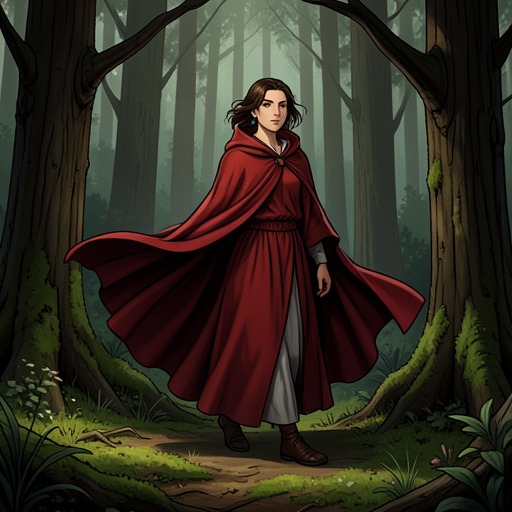
Her chosen name is Flora, a name associated with field flowers, while Red comes from Flora’s red velvet cloak. A trader gave the cloak to Flora and Morgan when Flora was fourteen, after staying with them and taking more than eggs from Morgan in trade. The garment becomes Flora’s most prized possession and the visible source of the nickname she dislikes. Its rich red color places her within the Little Red Riding Hood motif, but the name Flora preserves a more personal identity: she is not content to be reduced to a costume, a village label, or a story told by others.
Flora’s intellectual formation also separates her from the narrow future available on the farm. Her father came from a wealthy family, possessed many books, taught her to read, and encouraged her to think independently. He demonstrated how knowledge and the reading of other people’s behavior could influence social encounters, even selling passage over a local bridge to make a point about persuasion. Although Flora remained shy, his instruction in body language and communication becomes important when she meets Charles. The memory of his affection—especially the sense of safety she experienced in his arms—also establishes the emotional standard against which later intimacy is felt.
Life Under Marriage Expectations
Flora’s principal early conflict is with the belief that a young woman’s security depends on marriage. Morgan urges her to attend a party at the town hall because it may provide a chance for “A new life!” Morgan argues that Flora is too beautiful and intelligent to remain trapped milking cows, yet imagines that transformation primarily through a socially advantageous marriage. She further insists that Flora’s father would have wanted her “settled and married, and married well at that.”
Flora rejects this plan directly. She states that she does not wish to marry and questions whether marriage would leave her able to read or think for herself. Her objection is not a vague dislike of romance but a concern about the loss of intellectual and personal autonomy. She values her freedom and sees the institution proposed by Morgan as potentially incompatible with the habits her father cultivated in her: reading, independent thought, and attentive judgment.
Morgan answers with the social language of danger. She warns that being a single young woman is unsafe and claims that Flora does not yet understand the threats of the world. The pressure is reinforced by material circumstances. Flora owns no suitable dress for the party; her plain dark-brown dress is already too small across the top, while the family lacks the fabric needed to replace it. Morgan therefore sends Flora to her wealthy grandmother, who lives beyond the forest, hoping that the older woman can provide money or assistance.
Flora agrees outwardly while withholding inward consent. She tells Morgan that perhaps she will marry someone just as her mother wishes, explicitly because she knows that is what Morgan wants to hear. Internally, she feels ill at the idea of asking an old woman for money for something as frivolous as a dress. This split between compliance and conviction characterizes Flora’s early agency: she cannot yet control the economic conditions around her, but she can recognize the difference between what she says to preserve peace and what she actually wants.
The Forest Encounter with Charles
Morgan’s instructions place Flora inside a recognizable fairy-tale structure: the red cloak, the basket, the forest, the grandmother’s house, and the command “Don’t stray from the path!” Flora’s journey nevertheless marks a departure from the domestic routine she resents. Summer is ending, the leaves are turning orange and yellow gold, and the walk provides a temporary release from farm labor. The forest becomes both a space of danger and the setting in which Flora’s identity can exceed the roles assigned to her.
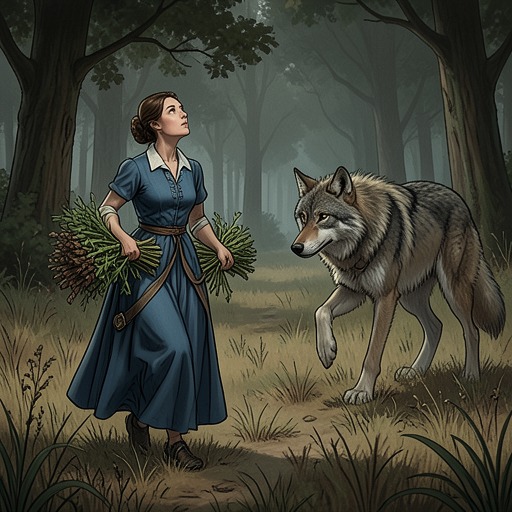
Flora meets Charles in the woodland and introduces herself first through the public nickname before clarifying her real name: “Red, just Red. Well, my actual name is Flora, but everyone calls me Red.” Charles responds positively to the name Flora, and the exchange allows her to be recognized as an individual rather than as the village’s red-cloaked girl. Among the flowers, she finds conversation unexpectedly easy. She studies Charles’s body language using the lessons her father taught her and decides that he appears genuine and free of a hidden agenda. Her guardedness relaxes into the feeling that the two are old friends reunited.
The encounter quickly becomes physical and changes Flora’s relationship to her own body. When Charles asks, “Do you want me to stop?” Flora does not want him to stop, despite her awareness that she barely knows him and her fear of becoming pregnant and being forced into marriage. The scene therefore places explicit consent beside strong situational pressure: Flora chooses continuation, but her choice occurs within the very social danger she has feared. Her desire is represented as a force that temporarily overtakes her rational concern, turning the forest from a route to a grandmother’s house into a private space of sexual awakening.
The encounter also reveals that Charles is not simply an attractive stranger. During their intimacy, he howls, his eyes grow brighter, and his teeth become longer and sharper. Flora initially tries to interpret the sound as an effect of sex, but the uncertainty is resolved when a large black snake threatens her. Charles changes before her eyes into a huge black-furred Wolf and kills the twenty-foot snake in a single bite. The familiar emerald glow in the creature’s eyes persuades Flora that the animal remains Charles, although transformed.
Charles, Lycanthropy, and Choice
Charles confirms his identity through a voice Flora hears inside her head, admitting that he is a Werewolf and expressing shame. His revelation alters the meaning of the earlier encounter. The threatening Wolf of the forest is no longer an external monster belonging only to village rumor; the supposedly dangerous figure is also Flora’s lover and protector. Her response is compassion rather than rejection. She asks whether he has always been this way, and his repeated admission of shame emphasizes that Lycanthropy is both a bodily condition and a source of social stigma.
Flora’s acceptance is immediate but not uncritical. She recognizes that she barely knows Charles, yet says, “Of course. I barely know you at all, but I feel as if I’ve known you all my life.” The statement echoes the ease she experienced when they first spoke and converts unfamiliarity into emotional certainty. Charles then returns to human form, and the transformation becomes part of their intimacy rather than a reason for separation. Flora’s response to his dual nature shows how the story revises the Little Red Riding Hood motif: the Wolf is not simply a warning against male danger but a desired and eventually marriageable partner.
Charles tells Flora that he has been tracking her for days at the farm and wants to take her away from everything there. His knowledge of her predates their meeting, giving the romance an element of pursuit and surveillance. Flora experiences the promise of being watched over as emotionally exhilarating, even though the revelation complicates her earlier insistence on freedom. The story thus places protection and autonomy in tension: Charles offers escape from exhausting work and social limitation, but he has also been following her without her knowledge.
Their relationship reaches a formal turning point when Charles proposes. Flora is surprised by the sudden escalation and explicitly asks whether his words constitute a proposal. Charles explains that he is not first in line to the throne because he has six older brothers and their families, and that he is treated as a black sheep because of his affliction. His Lycanthropy both marks him as different and gives him unusual freedom: his father has allowed him to choose whom he will marry. The proposal therefore joins personal choice to royal hierarchy and family power.
Change and Ending
Flora’s answer to the proposal reverses her earlier refusal of marriage, but the reversal is grounded in a different set of conditions. Earlier, marriage represented the possible loss of reading, thought, freedom, and self-direction. Charles presents marriage as a chosen union with a partner who accepts her family and offers movement away from the farm. When Flora asks whether her family can come to the castle, Charles agrees without qualification, promising that anyone she wants may accompany her and that she may have whatever she wants.
Her response is emphatic: “Yes,” she whispers, “A thousand times, yes!” The ending presents Flora as moving from reluctant conformity to active acceptance. She has not agreed merely because Morgan demanded that she marry well; she accepts Charles after speaking with him, experiencing desire, witnessing his transformation, hearing his confession, and testing the practical consequences of his offer. Yet the conclusion remains romantically compressed. The story promises a new social position and a shared future at the castle rather than depicting the negotiations, risks, or continued constraints that such a transition might involve.
Flora’s final transformation is consequently both liberating and ambivalent. She begins as a farm daughter whose labor, poverty, and unmarried status seem to narrow her choices. She ends as the chosen prospective bride of a royal Werewolf who claims that the world can be hers and agrees to bring her family with her. The plot converts the red cloak from a sign of village categorization into an emblem of passage: Flora travels through the forest, encounters the Wolf, and returns from the encounter with a new name-bearing identity, a lover, and the promise of a life beyond the farm.
Narrative and Thematic Significance
Flora embodies the story’s central negotiation between female freedom and marital autonomy. Her objections to marriage are voiced through concrete concerns about literacy, independent thought, bodily vulnerability, and the social dangers attached to unmarried womanhood. Morgan’s advice is practical within the family’s economic world, but it also reproduces the idea that beauty should be converted into a secure match. Flora’s eventual “yes” does not erase the earlier resistance; instead, it dramatizes her desire for a relationship that appears to preserve choice while supplying the security marriage is supposed to provide.
Her arc also connects labor and class to romance. Flora’s life is defined by farm work and limited resources, while her father’s wealthy origins and Charles’s Royal status widen the horizon of possible marriage. The grandmother’s wealth, the missing dress, the castle, and Charles’s freedom to choose a spouse all make social position material rather than abstract. Flora’s promised escape is therefore not only emotional. It is a movement from agricultural precarity toward royal privilege, with her family included in the imagined reward.
Finally, Flora is the perspective through which the story turns the Wolf from a cultural object of fear into a figure of desire, vulnerability, and protection. She learns that Charles’s animal form is real only after intimacy has already made him familiar. His shame does not destroy her attraction; his danger becomes inseparable from his tenderness. Through Flora, the forest tale’s warning structure is rewritten as an erotic and romantic fantasy in which the heroine does not merely survive the Wolf but chooses him, accepts his proposal, and claims the future he offers.