Hans
Her First Werewolf (BBW, Werewolf, Prince Charming, Fairy Tale Romance)Hans is the field hand who works alongside Flora and her mother on their farm, and he serves as the clearest representative of the ordinary rural future Flora hopes to escape. His presence is woven into the repetitive labor of the household—milking cows, tending livestock, cleaning stalls, and helping with the harvest—so that his relationship with Flora begins not in spectacle but in the daily economy of work. Through him, the narrative gives personal form to the life Flora finds secure yet suffocating: useful, familiar, and governed by expectations she does not share.
Identity and Place in the Household
Hans works as the family’s field hand after the death of Flora’s father. In the years following that death, the townspeople keep their distance from the farm because they believe a Werewolf killed Flora’s father, although the truth is that a bear attacked him. Hans nevertheless remains part of the household’s working world. He helps Flora with the farm’s practical demands while Morgan manages the home and Flora divides her time between agricultural labor and domestic tasks.
His position is materially and socially distinct from that of the wealthy visitors Morgan hopes Flora will meet at the town-hall party. Hans belongs to the local working environment, discussing the harvest and helping carry milk, whereas Flora’s possible suitors are described through wealth, military service, connections, and family status. That contrast makes Hans important even when he is not the central romantic possibility: he represents the accessible marriage prospect of Flora’s existing class and community, while the party promises entry into a more elevated social world.
Daily Work and Familiarity with Flora
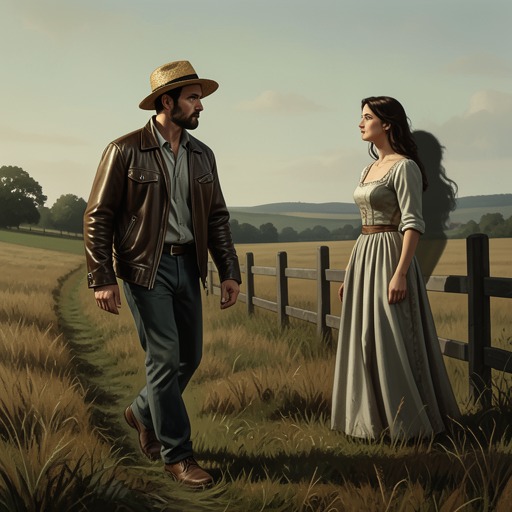
Hans first appears while Flora is milking a cow and thinking about the sameness of farm life. He asks whether she has seen the new lamb, and their exchange places him within the intimate routine of the barn, among the livestock and chores that structure Flora’s days. His golden hair catches the sunlight as he speaks, giving him a visible warmth within an otherwise monotonous setting, but the scene remains grounded in labor rather than courtship.
Hans tells Flora that he may someday want to take a wife. Flora answers that, unlike most young people, she does not want marriage. The disagreement is immediate and fundamental. Hans treats marriage as a normal destination for young adults, while Flora sees it as a possible surrender of the freedom that allows her to read and think for herself. Their conversation therefore reveals more than differing preferences: it exposes the social pressure surrounding Flora and the alternative represented by a man already embedded in the farm’s daily structure.
Hans also helps Flora with the milk after she finishes milking. He eagerly reaches for the bucket and says, “It’s no trouble when it comes to you, Red,” a remark that makes his personal attachment clear without transforming the relationship into a fully developed romance. Flora accepts his assistance and walks with him while he discusses the year’s harvest, yet she experiences the conversation as one she has had every day of her life. His kindness is real, but its familiarity is precisely what makes it feel like part of the unchanging existence she wants to leave.
Expectations of Courtship and Marriage
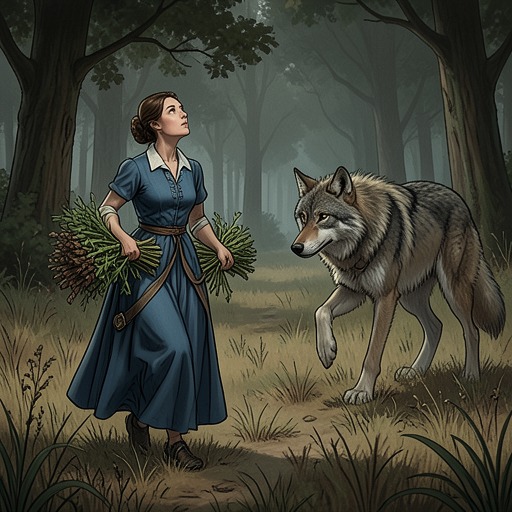
Hans expresses a conventional belief about what young women desire. When Flora rejects marriage, he responds that all maids say the same thing and argues that what they truly want is for someone to chase them as a wolf chases a lamb. The comparison links courtship to pursuit and predation, turning romantic desire into a familiar social script. Flora immediately challenges the image by asking whether the wolf eats the lamb. Her question punctures Hans’s confidence and exposes the danger concealed inside the supposedly playful metaphor.
The exchange also places Hans beside the story’s recurring Wolf imagery. He uses the Wolf as a figure for masculine pursuit, while Flora recognizes that pursuit can contain appetite and harm. The contrast becomes especially significant because the wider plot associates the feared Werewolf with both danger and desire. Hans speaks from the language of ordinary courtship, but Flora’s response shows that she is already suspicious of the assumptions beneath it.
Morgan’s marriage campaign gives Hans’s position additional context. She tells Flora that her father would have wanted her settled and married well, warns that unmarried young womanhood is dangerous, and urges her to attend the town-hall party so that a man might be caught by her beauty. Hans is not identified as the distinguished visitor or as the route to the new life Morgan imagines, but his conversation reveals the same social horizon: laboring adulthood is expected to culminate in marriage. Flora’s resistance to Hans’s assumption is therefore also resistance to the wider system Morgan seeks to enforce.
Relationship with Flora and Narrative Function
Hans and Flora share familiarity produced by work, but not the same vision of the future. He addresses her as “Red,” the nickname derived from Flora’s red velvet cloak, while she dislikes the name and prefers Flora, the name associated with field flowers. His use of the nickname places him inside the community that knows her through appearance and habit rather than through the intellectual and personal identity she inherited from her father.
Flora does not encourage Hans’s attempt to prolong their companionship. After listening to him discuss the harvest, she apologizes and says she needs to do some mending. Hans then slinks away with the pail of milk while Flora watches him before entering the cabin. The moment is quiet but decisive: she does not openly condemn him, yet she withdraws from a conversation that reproduces the life she finds repetitive. Their distance is created less by a dramatic quarrel than by Flora’s refusal to mistake kindness and familiarity for the future she wants.
Hans consequently functions as a foil to the later stranger Flora encounters in the forest. Hans is physically present in the farm’s ordinary routine, offers practical assistance, and speaks in the language of conventional marriage. The stranger appears outside that routine, is marked by fine clothing and an unfamiliar social position, and presents escape rather than continuity. The contrast does not prove that one relationship is safer or morally superior; it shows how strongly Flora’s desire for another life shapes what she is prepared to recognize as romance.
Contrast with Flora’s Chosen Future
Flora’s father taught her to read, to think independently, and to study body language and social behavior. His example includes a marriage made for love despite the difference between his wealthy family and Morgan’s poorer background. Flora therefore does not reject intimacy in the abstract; she rejects the restricted future that seems to require her freedom and mind to be exchanged for security. Hans’s assumption that a young woman wants pursuit cannot answer that deeper demand.
By contrast, the man Flora meets in the forest claims to have tracked her for days at the farm and offers to take her away. He identifies himself as a Werewolf and says that they would go to his castle in Endenbrook. He also promises that her family may accompany her and that she may have anyone and anything she wants. Flora accepts this proposal with repeated affirmation. Hans never receives such a declaration, and the narrative does not present him as part of Flora’s final escape.
Hans’s significance lies in the life he makes tangible rather than in a completed personal arc. He is the helpful laborer who carries the milk, asks about marriage, talks about harvests, and assumes the familiar social order will continue. Flora’s rejection of that order begins in her refusal to accept his premise that marriage is the natural answer for her. Her eventual acceptance of another suitor shows a change in romantic direction, but it does not erase the distinction Hans establishes between marriage as social expectation and marriage imagined as a passage into freedom.