Marriage obligations and social norms for young women
Her First Werewolf (BBW, Werewolf, Prince Charming, Fairy Tale Romance)Marriage obligations and social norms for young women form the social rule against which Flora measures her life. The expectation is not presented as a private preference but as a framework enforced through family anxiety, economic vulnerability, reputation, and the belief that a young unmarried woman cannot safely remain independent. Flora’s eventual acceptance of Charles’s proposal therefore carries a double meaning: it answers the pressure to marry, yet also appears to offer the freedom and enlarged life that conventional marriage had threatened to take away.
Social Background and Enforcement
Morgan is the principal voice of the rule. After Flora’s father died, mother and daughter were left managing a farm, and Flora’s daily life consisted of milking cows, cleaning stalls, and helping Hans. Morgan had once been the town beauty, but hard work and time had altered her body and prospects. Her own experience makes her wary of a future in which Flora remains trapped in agricultural labor, and she tells her daughter that her father would have wanted her “settled and married,” and married well.
Morgan treats unmarried young womanhood as a condition of exposure rather than a legitimate permanent choice. She warns Flora that being a single young woman is no good because the world contains dangers Flora does not yet understand. In this logic, marriage promises not only affection but protection, household security, and social legitimacy. The implied alternative is precarious: a woman without a husband may be judged vulnerable, economically dependent, and improperly outside the expected order.
The town’s social world reinforces Morgan’s position through the marriage market. A party at the town hall is proposed as Flora’s opportunity for “a new life,” with Morgan imagining that a distinguished visitor or one of the men accompanying him might be caught by Flora’s beauty and finally lead her to marriage. The party is thus less a neutral gathering than a supervised encounter in which appearance, status, and eligibility are assessed. Morgan’s attention to a well-off farmer, a widowed former Royal Army serviceman, and guests connected with important people reveals how marriage is also treated as a form of social advancement.
Flora’s Resistance to the Rule
Flora explicitly rejects the assumption that marriage is her proper destination. When Morgan invokes her father’s wishes, Flora answers firmly that she does not wish to be married. Her objection is not merely romantic hesitation. She asks whether marriage would leave her able to read and think for herself, identifying intellectual independence as a freedom that the expected marital arrangement might remove.
Her resistance is grounded in the education and memory associated with her father. He came from a wealthy family, possessed many books, and taught Flora to read and look at the world with open eyes. He also taught her that communication depended on observing people and understanding their movements, lessons that encouraged judgment rather than passive obedience. Flora’s defense of unmarried life consequently expresses a wider ideal of self-command: she wants to remain capable of learning, interpreting others, and choosing her own direction.
The contrast between Flora and Morgan is sharpened by labor and age. Flora sees how farm work has made Morgan increasingly withered and hunched, and she does not want to become like her. Her desire for another life is therefore inseparable from her rejection of the repetitive rural existence available to her. Marriage, as Morgan imagines it, could rescue Flora from the farm, but it could also place her under another person’s authority. Flora initially sees that exchange as too costly.
Class, Respectability, and Marriage Strategy
The rule operates through class as well as gender. Flora’s father had been wealthy, while Morgan had not, and objections had surrounded their marriage because of that difference. Their union is remembered as an exception made possible by love, but the social hierarchy remains active in the present. Morgan seeks a match that is not simply available; she wants Flora to marry well.
Flora’s clothing makes the economic problem visible. Her plain dark-brown dress is too small at the top, yet the household lacks the fabric needed to make another. Morgan responds by arranging a visit to Flora’s wealthy paternal grandmother, who lives beyond the forest, hoping that the older woman will provide help with a new dress. The request is to be made indirectly, with Morgan instructing Flora to make the grandmother think assistance was her own idea. Flora agrees only because she knows what Morgan wants to hear and feels sick about begging for money for something she considers frivolous.
This episode shows how respectability is produced through material signs. The red velvet cloak given to Flora by a trader is her prized possession and supplies the nickname Red, while the proposed dress would allow her to enter the town-hall marriage market in a more favorable form. Beauty, clothing, family wealth, occupation, and connections with influential people all become signals in the process of matching women to men. Flora’s intelligence matters to her, but Morgan’s strategy assumes that the first qualification others will notice is her beauty.
Consent, Danger, and the Reversal of Expectations
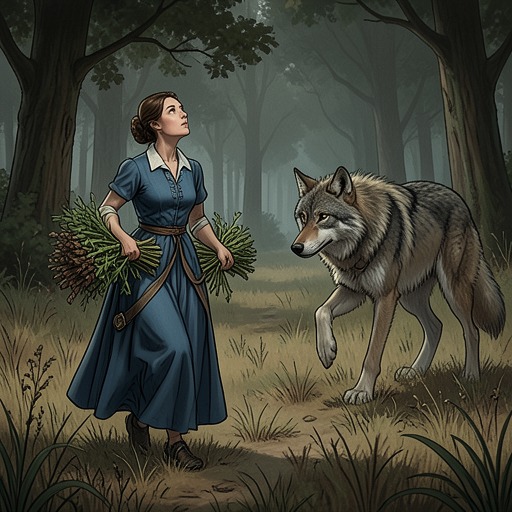
The social rule also shapes the meaning of Flora’s encounter with Charles. In the forest, Flora meets a tall, well-dressed man with green eyes and broad shoulders, a figure whose appearance distinguishes him from the farmers and herdsmen she knows. The setting recalls the Little Red Riding Hood motif: the red cloak, the mother’s departure, the forest path, and the apparently threatening male stranger all place Flora inside a familiar warning structure.
Yet the story redirects that warning toward adult desire and marriage. Charles’s intimacy begins before Flora knows who he is, and when she whispers that she does not even know him, he asks whether he should stop. She does not want him to stop, but the scene remains entangled with the dangers Morgan described. Flora remembers Mary and her baby and fears being forced into marriage through pregnancy, even as physical desire makes her thoughts feel less rational. The passage therefore places explicit consent, bodily vulnerability, and the premarital sex taboo in direct tension rather than presenting freedom as uncomplicated.
Charles later reveals that he has been tracking Flora for days at her farm and says that he wants to take her away from her life there. That disclosure complicates the romance: his attention is not accidental, and his knowledge of her precedes their formal understanding of one another. His proposal follows this revelation, turning a secretive forest encounter into a possible socially recognized union. The marriage rule is not abolished; it is recast through a man who offers desire, relocation, and status at once.
Charles’s Proposal and the Outcome
Charles identifies himself as connected to Endenbrook and offers Flora a castle rather than another farm. He explains that he is not first in line because he has six older brothers and their families, so he is unlikely to become king unless an extraordinary succession of deaths occurs. He describes himself as a “black sheep,” while Flora jokes that he means a black wolf, linking his social marginality to his werewolf identity.
His position changes the terms of Morgan’s desired match. Morgan had hoped Flora might meet a prosperous farmer or someone connected with the Royal Army and influential people. Charles instead presents himself as a member of a ruling family who possesses unusual freedom because of his affliction. He says that his father has allowed him to choose whom he will marry. The proposal therefore claims to satisfy the very autonomy Flora feared marriage would erase: the choice is represented as his, and he extends that choice to her.
Flora recognizes the sudden escalation and asks whether he is proposing. Charles confirms that he is. She then asks whether her family may accompany them to the castle, making clear that acceptance is conditional on preserving her connection with those at home. Charles answers that anyone she wants may come and promises that anything she wants can be hers. Flora accepts, whispering yes repeatedly and responding with tears, an embrace, and happiness.
The ending does not prove that Flora has escaped every structure of dependence. She has moved from a mother’s pressure to marry into a powerful man’s offer of protection and privilege, and the proposal follows sexual intimacy and Charles’s prior surveillance. Nevertheless, within the story’s romantic logic, the choice gives Flora a route away from farm labor while preserving her stated desire to bring her family with her. Marriage becomes both the institution Morgan demanded and the vehicle through which Flora imagines freedom, movement, and a new life. The rule’s force survives, but its meaning shifts from compulsory settlement to a chosen alliance that promises access to the world beyond the farm.