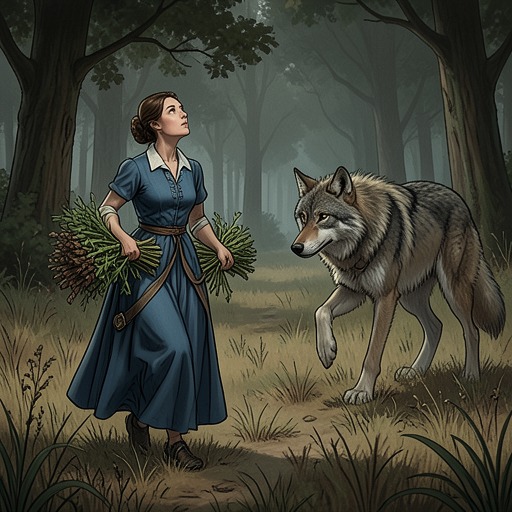
Morgan
Her First Werewolf (BBW, Werewolf, Prince Charming, Fairy Tale Romance)Morgan, known chiefly as Flora’s mother, is the emotional and practical center of the farm household after her husband’s death. Once celebrated as the town beauty, she has been visibly altered by hard work, poverty, and time, yet she remains energetic, affectionate, and determined to secure a better future for her daughter. Her efforts to move Flora toward marriage reveal both genuine maternal care and the restrictive social assumptions that make marriage appear to be a young woman’s safest available escape.
Identity and Background
Morgan is a widow living with Flora on a modest farm after Flora’s father dies when Flora is fifteen. The townspeople believe a werewolf killed him, although the family knows that a bear was responsible. In the years afterward, fear keeps the townsfolk away from the farm, leaving Morgan and Flora isolated and forcing them to manage their household through continuous labor. Flora spends her days milking cows, cleaning stalls, and helping Hans, while Morgan bears the larger burden of sustaining a household marked by loss and limited resources.
Morgan had once been regarded as the town beauty. Flora remembers descriptions of her mother’s hair as dark as raven feathers and as soft and shining as corn silk, qualities Flora also inherits along with her blue eyes. The contrast between Morgan’s former beauty and her present appearance is sharply tied to labor: her back has begun to hunch, and she looks increasingly withered as the years pass. Flora fears that the same work and hardship will determine her own future, making Morgan both a beloved parent and an image of the life Flora wants to escape.
Morgan’s marriage also carries a class history. Flora’s father came from a wealthy family, while Morgan was poor, and people objected to their union because of the difference in wealth. He nevertheless married Morgan for love. That history gives Morgan a complicated position in the story: she has experienced a marriage that crossed class expectations, but she now interprets marriage as the principal protection available to Flora rather than as one choice among many.
Maternal Care and Household Labor
Morgan’s affection appears through ordinary domestic work rather than grand declarations. When she discusses the coming party, she has just finished baking pies for sale, leaving the house rich with the scent of blackberries. Her white hair is pulled back, grey wisps cling to sweat on her face, and flour marks her brow. Flora smiles at this familiar scene, wipes the flour away, and takes a sugared berry from the food before Morgan smacks her hand and scolds her. The playful exchange briefly restores the intimacy of mother and daughter, even as Flora recognizes the household routine as a warning about the future awaiting her.
The kitchen also shows Morgan’s economic reality. She bakes pies to sell, while the family lacks enough fabric to replace Flora’s plain dark-brown dress even though its modest top has become too small. Morgan therefore treats clothing, food, and marriage as interconnected practical concerns. A suitable dress might make Flora visible at the town-hall party; visibility might attract a husband; and a good marriage might relieve the pressure that keeps both women tied to exhausting farm labor.
Morgan’s concern is not limited to appearance. She repeatedly tells Flora that life has been difficult since her father died and insists that he would have wanted Flora to become settled and to marry well. In Morgan’s understanding, a husband offers security in a world where a single young woman is exposed to dangers she may not yet understand. Her language transforms social vulnerability into a maternal warning: she is trying to protect Flora with the only institution she believes can reliably protect a woman.
Marriage Pressure and the Party
The town-hall party becomes Morgan’s chosen instrument for changing Flora’s circumstances. She announces that it will take place in one week and urges Flora to attend, calling it a chance for a new life. Flora initially laughs at the proposal because she has no suitable dress, but Morgan immediately begins imagining ways to solve the problem. She believes Flora is too beautiful and intelligent to remain trapped milking cows all day, even though the marriage she proposes would exchange farm labor for dependence on a husband.
Morgan’s pressure is explicit. She tells Flora that being a single young woman is no good and describes the dangers of the world. Flora answers that she enjoys her freedom and fears that marriage might prevent her from reading or thinking for herself. This disagreement places Morgan on the side of social security and Flora on the side of intellectual and personal autonomy. Morgan does not dismiss Flora because she lacks love for her; rather, her care has been shaped by widowhood, economic insecurity, and the belief that independence leaves a woman dangerously exposed.
The party is especially important because Morgan hears that a prosperous farmer will attend with a friend from the war. She is less interested in the farmer than in the serviceman, who is older and reportedly widowed, and she is excited by rumors that the gathering may include a high-ranking knight, a priest, and a special guest connected to important people. Flora responds with sarcasm, doubting that anyone royal would visit their town, but Morgan continues to imagine the social possibilities. She believes that someone might be caught by Flora’s beauty and that marriage could finally become possible.
Sending Flora into the Forest
Two days later, Morgan sends Flora to her grandmother’s house beyond the forest on a hillside. The destination is not merely a family visit: the grandmother is Flora’s paternal grandmother and is wealthy compared with the townspeople. Morgan prepares Flora’s red cloak and an overfilled basket containing bread, jars of jam and honey, and the grandmother’s favorite shepherd’s pie. She instructs Flora to ask for assistance indirectly, making the grandmother believe that the idea originated with her. Morgan is therefore not only sending Flora on a journey; she is staging a careful appeal for money or help with the dress needed for the party.
Flora feels uneasy about begging and regards a new dress for the party as frivolous, but she tells Morgan that she may marry someone just as Morgan wishes. She says this because it pleases her mother, not because it expresses her own settled desire. Morgan’s planning thus produces obedience without fully changing Flora’s convictions. The daughter accepts the task as a way of comforting her mother, while the mother treats it as a necessary intervention in a precarious social and economic situation.
Morgan’s final warning is to remain on the path. The command places her within the recognizable structure of the Little Red Riding Hood motif: the mother sends the girl toward a grandmother beyond the forest and warns her against straying. Yet the warning also expresses Morgan’s broader worldview. For her, danger lies outside the controlled route of household, family, and respectable marriage. Flora does stray into an encounter with Charles, and the forest becomes the place where the dangers Morgan fears are transformed into a supernatural and romantic possibility.
Change, Consequences, and Narrative Role
Morgan does not witness Flora’s meeting with Charles or learn within the supplied scenes that Charles is a werewolf. Her influence nevertheless reaches the ending. Charles tells Flora that she may bring her family to the castle and promises that anyone she wants may accompany her. Flora accepts his proposal with overwhelming happiness, and this promise directly answers the insecurity that has shaped Morgan’s decisions: Flora’s marriage may provide not only escape from the farm but also a future in which Morgan and the rest of the family can come with her.
That outcome complicates Morgan’s earlier insistence that Flora must marry well. Flora initially rejects marriage because she fears losing freedom, reading, and independent thought. Charles’s proposal appears acceptable because he grants her choice and promises that her family will be included. Morgan’s social strategy therefore succeeds in its immediate aim, but the result exceeds what she could have planned: the prospective husband is not simply a prosperous farmer or socially useful acquaintance, but Charles, a man who can offer access to a castle and a life beyond the farm.
Morgan’s narrative role is consequently double. She is a loving widow whose baking, labor, warnings, and matchmaking arise from real hardship, but she is also the voice of marriage obligations and social norms for young women. Her vision of safety presses against Flora’s desire for freedom, while her intervention supplies the route through which Flora reaches a different future. The story neither presents Morgan as a simple villain nor frees her entirely from the system she enforces. She is both its product and its agent, carrying the lessons of widowhood and poverty into her determination that her daughter should never remain trapped in the same life.