Summer
Her First Werewolf (BBW, Werewolf, Prince Charming, Fairy Tale Romance)Summer is the season in which Flora’s journey to her grandmother’s house begins and in which the story’s familiar Little Red Riding Hood motif becomes charged with adult uncertainty. As summer ends, the landscape shifts into autumn, while Flora moves from domestic obligation and marital pressure into the forest, where an apparently ordinary traveler proves capable of becoming a Wolf. The season therefore functions less as a fixed backdrop than as a threshold between safety and exposure, social expectation and forbidden possibility, and human identity and Lycanthropy.
Seasonal Setting and Departure
Summer appears at the moment Flora is sent away from her small town. Her mother dispatches her to her grandmother’s house beyond the forest, partly because the grandmother is wealthy and might provide money for a dress. The request is bound to the family’s history: Flora’s father had married her mother despite objections based on their unequal wealth, choosing love over the class expectations surrounding marriage. Flora is uneasy about being directed to solicit money from an old woman, especially for something she considers frivolous, but she agrees because she knows what her mother wants to hear.
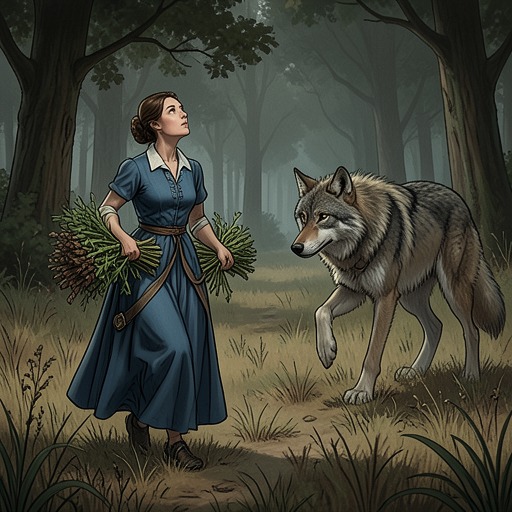
The journey occurs as summer is ending. Leaves have begun turning orange and yellow-gold, giving the season a visible sense of transition even while the day remains bright and warm enough for a long walk. Flora welcomes the journey as a break from work. She enjoys walking through the forest, hears her feet moving through fallen leaves, listens to birds singing, and notices a deer jumping over a log. The natural world initially offers release from the demands of the cabin and from the prospect of a marriage arranged according to economic expectations.
The Forest Threshold
The seasonal transition accompanies Flora’s movement away from prescribed social paths. Her mother warns her, “Don’t stray from the path!”; the warning establishes the journey as both a practical errand and a test of obedience. Flora carries an overfilled basket containing bread, jars of jams, honeys, and her grandmother’s favorite Shepherd’s pie, shifting the burden of domestic labor physically onto her as she travels.
Flora soon notices flowers in a clearing and decides there is no reason not to stop for them. The moment places her choice against the warning she has just received, though the evidence presents the deviation as an ordinary attraction to the landscape rather than a calculated act of rebellion. Summer’s beauty makes the forest seem welcoming: sunlight fills the glen, and the apparent safety of the place briefly replaces her unease. Yet the birds stop singing, the forest becomes completely quiet, and Flora’s bodily fear intensifies as her heart pounds and her breath becomes difficult. The seasonal landscape thus changes from pastoral refuge into a threshold space whose beauty conceals danger.
Encounter and Transformation
In the glen, Flora tries to reassure herself by listing things that do not exist, including fairies, trolls, and Werewolves. Her self-command is interrupted by booming laughter and the arrival of Charles. He is tall and handsome, with dark silky hair, green eyes, fine clean clothes, and broad shoulders that mark him as unlike a farmer or herdsman. His appearance introduces a human form of attraction into the forest at the same moment that the surrounding silence introduces threat.
The encounter reaches its decisive turn when a large black, fanged snake approaches Flora. Charles commands her not to move and takes up a stick, but the threatened rescue becomes a revelation of his own hidden nature. He changes before her eyes from a man into a large black-furred Wolf and consumes the twenty-foot snake in a single bite. The emerald glow in the animal’s eyes still expresses Charles’s kindness, allowing Flora to recognize continuity beneath the monstrous transformation. Summer’s open, sunlit setting therefore contains the story’s central contradiction: the season promises growth, pleasure, and romantic possibility, while the encounter exposes violence, mortality, and the danger of desire.
Narrative and Thematic Significance
Summer organizes a passage from the known world into a charged unknown one. Flora begins among work, family instruction, and pressure toward marriage; she enters the forest during the last phase of summer, when the changing leaves already suggest that one condition is giving way to another. The path, the cloak, the basket, and the grandmother’s distant house recall the Little Red Riding Hood motif, but the seasonal movement supports a more complicated transformation. Flora is not merely approaching danger in the woods: she is approaching knowledge about Charles, about her own attraction, and about the limits of the social categories governing her life.
The season also frames the contrast between appearance and identity. Flora’s red velvet cloak makes others call her “Red,” although she prefers her real name, Flora, which was chosen after field flowers. That contrast links her identity to the natural world while showing how quickly society replaces a person’s chosen name with a visible emblem. Against the changing forest, Charles likewise appears first as a refined man and then as a Wolf. Summer’s narrative function lies in this movement between surfaces and hidden forms: under its bright landscape, it prepares the story’s shift from ordinary courtship and travel into a revelation of Werewolf identity.