Werewolf
Her First Werewolf (BBW, Werewolf, Prince Charming, Fairy Tale Romance)Werewolf is both a feared folk belief and a concrete bodily condition in the story. At first, the villagers use the creature to explain Flora’s father’s death, but the account is false: a bear attacked him. Later, the Werewolf appears in Charles, whose human and wolf forms make the supernatural real while complicating the village’s simple opposition between civilized people and mythical beasts. Charles’s transformation is frightening, yet it also saves Flora’s life and becomes part of an intimate relationship that she accepts rather than condemns.
Rumor, Fear, and the Village Imagination
The Werewolf enters the narrative first as an explanation supplied by the townspeople. When Flora was fifteen, her father died, and the townspeople believed that a Werewolf had killed him. The belief made the death darker and more mysterious, and it helped isolate Flora and Morgan from the surrounding community: for several years the townsfolk avoided their farm because everyone was afraid. The actual cause was an ordinary bear, not a mythical beast. This distinction establishes an important contrast between communal legend and material reality: the village is willing to attribute violence to a supernatural predator even when the truth is less extraordinary.
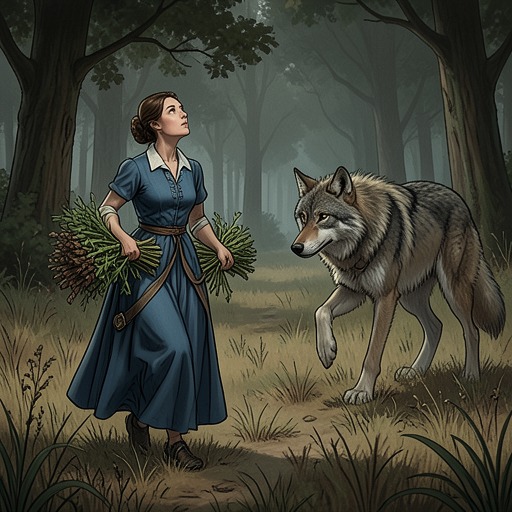
The Werewolf also belongs to the larger field of stories and warnings that surround Flora’s rural life. Morgan presents the world as dangerous for a single young woman, while Flora recalls her father’s books, his lessons in reading people, and his insistence that appearances and gestures matter. Against that background, Flora has learned to question inherited explanations rather than accept them automatically. In the forest, when silence and fear make the landscape seem threatening, she deliberately lists fairies, trolls, and Werewolves as things that do not exist. The statement is an act of self-reassurance, but it also creates dramatic irony: immediately afterward, Charles appears, and the supposedly impossible creature becomes part of her lived experience.
Charles’s Human and Wolf Forms
Charles initially presents himself as a tall, handsome traveler with dark hair, green eyes, fine clothing, and broad shoulders. His appearance suggests that he is neither a farmer nor a herdsman, and nothing in his first presentation openly identifies him as a supernatural being. During their encounter, however, the boundary between his human appearance and animal nature begins to break down. His eyes glow, his teeth grow longer and sharper, and a howl escapes from him. Flora recognizes the sound as wolf-like but remains uncertain whether it reveals Charles’s nature or merely belongs to sexual excitement. Her uncertainty delays the full revelation while showing how desire can compete with rational interpretation.
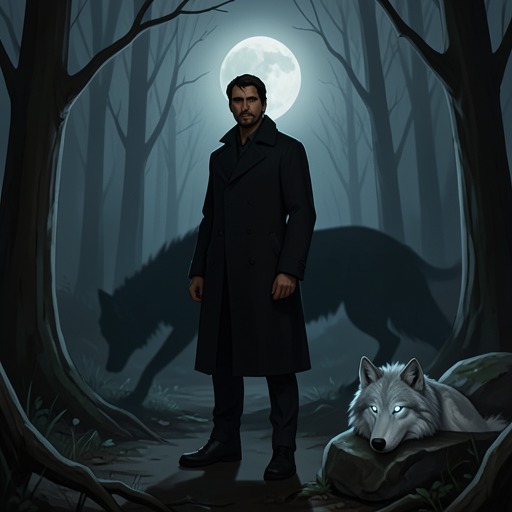
The transformation becomes undeniable when a large black snake threatens Flora. Charles tells her not to move and prepares to act with a nearby stick, but then he changes before her eyes. One moment he is a man; the next he is a large, black-furred wolf. In that form he eats the twenty-foot snake in a single bite, converting the creature associated with danger into an instrument of protection. The wolf’s emerald eyes still radiate kindness, allowing Flora to recognize continuity beneath the altered body. Charles is not replaced by an unrelated beast; the wolf remains Charles, although his physical power and mode of action are radically different.
Charles explains his condition through a voice inside Flora’s head rather than through ordinary speech. He says, “Yes, I am ashamed, but I am a werewolf,” and repeats the admission when Flora asks whether he has always been this way. The repetition emphasizes that Lycanthropy is permanent or deeply rooted rather than a temporary disguise. It also frames the condition through shame: Charles knows that the identity is likely to be judged, feared, or rejected. Yet the mental communication gives the wolf form a distinct subjectivity. He can answer, ask whether Flora is afraid, and object when she calls him a dog. His animal body therefore does not erase language, selfhood, or relational agency.
Power, Desire, and Protection
The Werewolf’s body carries both threat and attraction. Before the transformation is disclosed, Charles’s eyes glow and his throat produces a growl as his desire becomes intense. Flora experiences this change as a movement from the image of a simple traveler toward someone stronger and more determined. The scene makes his animality inseparable from erotic power, but it also records Flora’s hesitation and fear. She stops the encounter because she worries about what might happen if he impregnates her, then chooses to continue. The Werewolf thus appears at the point where bodily danger, consent, desire, and social consequence become difficult to separate.
The later transformation reinterprets the earlier signs. The howl, the glowing eyes, and the lengthened teeth were not isolated disturbances but manifestations of Charles’s animal nature. His capacity to become a wolf explains both the violence of his appetite and the force with which he protects Flora from the snake. The same creature can appear ravenous in one moment and tender in another; the narrative refuses to make animality equivalent to cruelty. Charles’s power is dangerous, but in the immediate crisis it is directed outward, against the snake, rather than against Flora.
Flora’s response is crucial to the creature’s meaning. She does not remain afraid after observing Charles’s conduct. She sees that he does not intend to hurt her, describes him as a powerful alpha male, and allows him to curl beside her and nuzzle her thigh. After he saves her, she thanks him, laughs when he licks her face, and hugs him closely. The Werewolf’s animal form therefore becomes a site of reciprocal contact rather than merely a spectacle of horror. Flora calls him beautiful, corrects herself when he objects to being called a dog, and accepts him as a wolf. Her language recognizes the difference between species without turning that difference into a reason for rejection.
Shame, Intimacy, and Possible Partnership
Charles’s confession transforms the Werewolf from an external category into a personal identity. The villagers’ belief had attached the word to an unknown killer, but Charles attaches it to his own history and vulnerability. He is ashamed, yet he remains close enough for Flora to touch his black fur. The exchange shifts the emotional logic of the story from superstition to disclosure: what matters is not whether the label is frightening in the abstract, but what Charles does with his power and how Flora responds to the person beneath it.
The creature’s identity also enters the question of marriage and future responsibility. Flora tells Charles that she might be pregnant after their encounter. Charles responds that he would not be surprised and promises to care for her if she wants him. The promise gives the Werewolf a social and ethical dimension. He is not presented only as an instinct-driven animal; he speaks of care, asks for Flora’s acceptance, and offers a possible future in which supernatural difference does not cancel obligation. The possibility of pregnancy makes the relationship consequential, linking bodily transformation to reproduction, family, and the social pressures that already surround Flora as an unmarried woman.
Charles then changes back into human form and returns to Flora’s arms. The reversal does not undo the wolf revelation; it establishes that both bodies belong to the same beloved figure. He kisses Flora’s shoulder, smells her hair, and tells her that he has been tracking her at the farm for days. His heightened animal senses are therefore connected not only to violence but also to courtship and surveillance. He wants to take Flora away from the farm, and she considers the proposal against her knowledge that storybook endings do not exist in ordinary life. Her ironic comparison of a Werewolf with a white knight captures the creature’s final reversal: he is not the conventional rescuer of romance, but he may occupy the same narrative function in a stranger form.
Narrative Significance
The Werewolf unsettles the story’s categories of human and nonhuman, monster and lover, danger and protection. The first village account treats the creature as a convenient explanation for death, while the later encounter gives the category a face, a voice, a history, and a capacity for tenderness. The narrative’s central movement is therefore not simply from disbelief to belief. It is from inherited fear to embodied knowledge, and from embodied knowledge to a negotiated form of acceptance.
The creature also intensifies the contrast between Flora’s constrained social world and the freedom she imagines beyond it. Morgan warns her against unmarried womanhood and urges marriage as protection, whereas Charles offers escape from the farm through an identity that lies outside respectable human expectations. This does not make the Werewolf uncomplicatedly liberating: Charles tracks Flora without her knowledge, his desire can appear ravenous, and his strength creates an unequal physical relationship. Nevertheless, the wolf form gives Flora an alternative to the dull repetition of farm life and to marriage arranged around security, status, or social approval.
Most importantly, the Werewolf becomes desirable without ceasing to be strange. Flora does not discover that Charles was secretly an ordinary man; she discovers that he is genuinely a Werewolf and continues to want him. His animal body remains visible, his telepathic voice confirms his difference, and his confession preserves the stigma of shame rather than erasing it. By allowing affection to follow revelation, the story turns the supposed monster into a relational subject whose identity must be encountered across human and animal forms. The Werewolf consequently functions as both supernatural creature and test of Flora’s capacity to choose intimacy beyond the limits imposed by village legend and social convention.