Wolf
Her First Werewolf (BBW, Werewolf, Prince Charming, Fairy Tale Romance)Wolf is the story’s central animal image and a literal presence within Charles’s transformation. It begins as a figure of threat in Flora’s conversation with Hans, where the image of a wolf chasing a lamb expresses the kind of aggressive courtship Hans believes young women secretly desire. Later, the image becomes embodied in Charles, whose howls, altered eyes, sharpened teeth, and final transformation into a large black wolf force Flora to reconsider the boundary between human lover and animal predator. The Wolf therefore carries the narrative’s decisive reversal: what begins as a symbol of danger becomes the form through which Charles protects Flora and presents himself as capable of intimacy, care, and marriage.
The Wolf as Courtship Metaphor
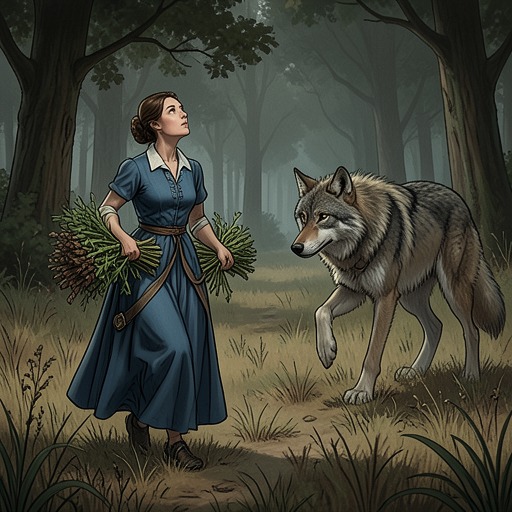
The first appearance of the Wolf is figurative. Hans argues that unmarried young women claim not to want marriage while actually wishing for someone to pursue them “as a wolf chases after a lamb.” Flora immediately exposes the violence concealed inside that romantic metaphor by asking whether the wolf does not eat the lamb. Her question distinguishes pursuit from safety: being desired is not the same as being protected, and the language of courtship already contains the possibility of consumption.
The metaphor also establishes a pattern that later governs Charles. Flora is repeatedly surrounded by signs associated with the Little Red Riding Hood motif: the red cloak, her mother’s instructions, the forest path, the grandmother’s distant house, and the warning not to stray from the path. Before Charles appears, Flora insists that there are no werewolves, using the denial as a way to steady herself when the forest falls silent. The Wolf is therefore present before it is seen, embedded in the fears and stories through which Flora interprets the woods.
Appearance and Transformation
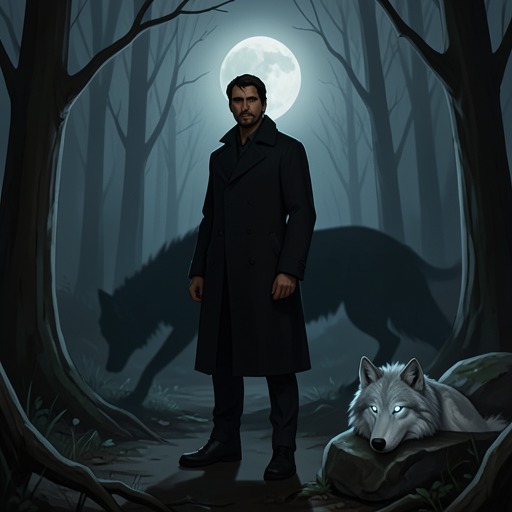
Charles first presents himself as a handsome, finely dressed man rather than as an obvious creature. His dark hair, green eyes, broad shoulders, and clean clothing suggest someone above the status of a farmer or herdsman. This human appearance allows him to enter Flora’s experience as an attractive stranger, while the surrounding forest and his deep voice preserve the danger already attached to the Wolf image.
During their sexual encounter, the human disguise begins to fail. Charles growls and howls, and Flora recognizes that the howl has come from him. His eyes glow more brightly, his teeth become longer and sharper, and his physical force is no longer that of an ordinary man. The narrative makes the transformation inseparable from desire: the animal signs intensify at the same moment that Flora experiences overwhelming pleasure. The Wolf is not introduced as a separate beast stalking the lovers; it emerges through Charles’s body, making his sexuality and his hidden nature part of the same revelation.
The complete transformation occurs when a large black, venomous snake threatens Flora. Charles tells her not to move and takes up a stick, but before any ordinary defense can occur, he changes from a man into a large wolf. The beast kills the twenty-foot snake in a single bite. This action gives the animal form a concrete protective function. The Wolf is terrifying in scale and strength, yet its first unmistakable deed is the destruction of another predator and the preservation of Flora’s life.
Recognition of the Werewolf
After killing the snake, the Wolf looks at Flora with the familiar emerald glow of Charles’s human eyes. Its lowered head and whimpering behavior allow her to recognize continuity beneath the altered body. Charles then speaks inside her mind and admits that he is a werewolf, repeating the confession with shame. The Wolf is consequently not merely a disguise or an external curse observed by Flora; it is a form through which Charles remains conscious, communicative, and emotionally vulnerable.
Flora’s response changes the meaning of the creature. She calls him a beautiful dog, and when he angrily rejects that name, she corrects herself by calling him a beautiful wolf. She pats his soft, furry head and tells him that she is not afraid because his movements show that he does not intend to hurt her. His strength marks him as an alpha male, but the scene emphasizes restraint rather than attack: he curls beside her and nuzzles her thigh. The animal body retains its power while acquiring tenderness and recognizability.
The contrast with Flora’s earlier lamb question is sharp. The imagined Wolf was a predator whose chase could end in eating; the actual Wolf saves Flora, submits to her touch, communicates his shame, and seeks reassurance about whether she fears him. The narrative does not erase the danger of his form, but it relocates danger from the animal appearance to the uncertainty of hidden identity and uncontrolled desire.
From Monster to Partner
The Wolf’s protective action becomes the foundation for Charles’s emotional claim. After Flora thanks him for saving her life, he licks her face, and she laughs and embraces him. He says that he is falling for her, while Flora answers that he had better be because she might be pregnant after their encounter. Charles responds that he would not be surprised and promises to care for her if she wants him. The Wolf’s body thus enters a conversation about consequence, responsibility, and possible family life rather than remaining confined to fear or erotic spectacle.
Charles then changes back into the man to whom Flora gave her maidenhood. His return to human form does not cancel the Wolf; it confirms that the two bodies belong to the same person. He tells Flora that he loves her scent and has been tracking her for days at her farm, revealing that the Wolf’s senses and instincts have shaped his attention to her even before their meeting in the forest. His wish to take her away joins animal pursuit to romantic escape, though the revelation also complicates the romance by showing that Flora had been watched before she knew who was watching.
Charles’s social identity further reverses the expected hierarchy. He reveals that he is not first in line to inherit the throne, since six older brothers and their families stand before him, and describes himself as a black sheep. Flora answers that he means a black wolf, turning his difference into an affectionate joke. His affliction has given him unusual freedom because his father allows him to choose whom he will marry. The Wolf, once associated with forbidden danger and predation, therefore becomes connected to Charles’s independence from ordinary dynastic marriage arrangements.
Narrative Significance
The Wolf gathers together the story’s recurring contrasts: path and deviation, human appearance and animal body, threat and protection, shame and acceptance, desire and social consequence. Flora’s red cloak and journey through the forest recall a familiar warning tale, but the expected predator is transformed into the object of recognition and affection. The old moral opposition between innocent girl and dangerous Wolf is replaced by an unstable intimacy in which the creature remains both powerful and emotionally exposed.
The image also gives physical form to Flora’s conflict over freedom and marriage. She has resisted being treated as a girl who must follow a prescribed path toward a husband, yet the Wolf’s appearance takes her into a more dangerous territory than her mother’s matchmaking plans. Its meaning shifts again when Charles promises care and proposes marriage. In this sequence, the Wolf does not simply symbolize Charles’s otherness; it makes possible a relationship that joins transgression with commitment and turns the supposedly monstrous body into a chosen partner.
By the end of the supplied episode, the Wolf has completed its movement from metaphorical pursuer to embodied lover, rescuer, and prospective husband. It remains a creature of the forest, marked by howling, glowing eyes, sharp teeth, immense strength, and mental speech, but Flora no longer treats those signs as proof that he must be feared. Her acceptance does not make the Wolf ordinary. Instead, it makes his difference the basis of the story’s romantic bargain: Charles is not a conventional white knight, but a werewolf whose animal form has become both the source of danger and the evidence of his capacity to protect.