Bright Hallow
Her First Werewolf (BBW, Werewolf, Prince Charming, Fairy Tale Romance)Bright Hallow is the small hometown that anchors Flora’s domestic life and frames the story’s movement from familiar rural expectations toward a transformative encounter. It is not merely a point on the map: it is the community where Flora is known by her disliked nickname, where her mother imagines marriage as her safest future, and where a town-hall party becomes the promised gateway to a new social and romantic life.
A Small Rural Community
Bright Hallow is described as a small town situated near the forest. Flora knows many of the local families through the trades conducted in the area, suggesting a closely connected community in which personal origins and family circumstances are readily recognized. Her own household lies at its edge, beside the woods, in a humble wooden cabin where she and her mother work, mend clothes, bake, and tend livestock.
The town’s limited resources are visible in Flora’s clothing and labor. She owns a rich red velvet cloak, but her everyday dark-brown dress is old and too small, while the household depends on fieldwork, milking cows, bread, preserves, honey, and shepherd’s pie. Bright Hallow therefore represents a materially modest environment whose routines define Flora’s present life even as her mother insists that she is meant for something beyond milking cows all day.
Family, Status, and Marriage Expectations
Bright Hallow is the social setting in which Flora’s unmarried status becomes a problem in her mother’s eyes. After Flora’s father dies, her mother believes that he would have wanted Flora to become settled and marry well. She warns that being a single young woman is dangerous and treats marriage as protection against the uncertainties of the wider world.
The town also carries the memory of class divisions. Flora’s father came from a wealthy family, while her mother was comparatively poor; local objections to their marriage arose from that difference, although Flora’s father married for love. His family’s greater wealth remains associated with Flora’s grandmother, who lives beyond the forest on a hillside and is considered wealthy compared with Bright Hallow’s townspeople. The community thus preserves a model of marriage based on social matching even while Flora’s parents’ relationship offers a contrary example of affection crossing class boundaries.
The Party and the Promise of Change
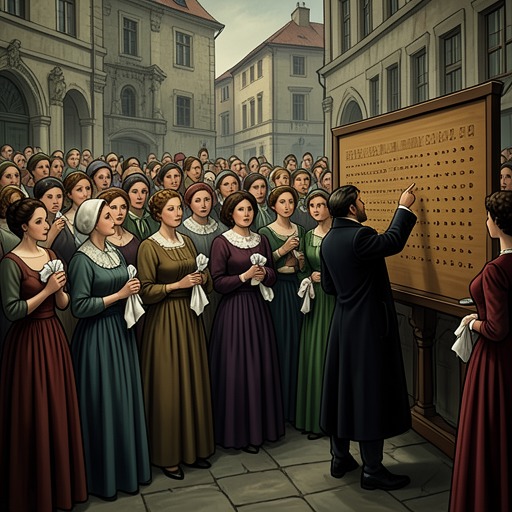
A party at Bright Hallow’s town hall is announced as an event taking place in one week. Flora initially laughs at the prospect because she has no suitable dress, but her mother interprets the gathering as her daughter’s chance at a new life. The party is expected to attract a well-off farmer and a former serviceman connected with important people, along with a high-ranking knight, a priest, and a special guest.
The significance of the party lies less in anything that happens there than in what Bright Hallow allows Flora’s mother to imagine. The town hall becomes a marriage market in miniature, where beauty, clothing, reputation, and social connections may determine Flora’s future. Her mother hopes that one of the visiting men will be caught by Flora’s beauty and that the encounter will finally lead to a respectable marriage, while Flora fears losing the freedom to read and think for herself.
Bright Hallow and the Forest Boundary
Bright Hallow borders the forest, making the town the threshold of the story’s Little Red Riding Hood motif. Flora leaves the town carrying a basket and wearing Flora’s red velvet cloak, bound for her grandmother’s house beyond the woods. Her mother’s warning to stay on the path turns the familiar local geography into a moral and narrative boundary between domestic safety and forbidden experience.
The forest initially appears to be a short distance from ordinary Bright Hallow life, but it quickly becomes a space of uncertainty. The birds fall silent, Flora becomes physically afraid, and she tries to reassure herself that there are no fairies, trolls, or werewolves. In the sunlit glen she meets Charles, a handsome stranger who says he is traveling to Bright Hallow for an event. His statement reverses the direction of the journey: while Flora is leaving the town to visit her grandmother, Charles is approaching the town from the supernatural world that the community’s rational assumptions cannot contain.
Narrative Significance
Bright Hallow supplies the ordinary social order against which the rest of the story is measured. Its party promises respectable courtship, its households enforce expectations about female security, and its class history explains why wealth and family standing matter so strongly to marriage prospects. Yet the town’s conventional future is displaced when Flora’s forest encounter reveals that Charles is a werewolf and when he later promises that she may bring her family to the castle and have anything she wants.
The town therefore functions as both origin and contrast. It is the place Flora belongs to, the place her mother wants her to leave through a good marriage, and the destination that brings Charles near enough for their relationship to begin. By the ending, the promise of a life beyond Bright Hallow does not erase the town’s importance; instead, it shows how the local world’s narrow expectations have been transformed into the possibility of love, wealth, family inclusion, and a radically different future.