Flora–Hans relationship
Her First Werewolf (BBW, Werewolf, Prince Charming, Fairy Tale Romance)The Flora–Hans relationship begins as a practical companionship within the farm labor that governs Flora’s life, but it also contains an implied courtship that Flora refuses. Hans is her family’s field hand and a regular presence in the barn and fields; Flora works beside him while milking cows, tending livestock, cleaning stalls, and helping with the farm’s seasonal demands. Their relationship therefore belongs to the intimate, repetitive world of shared work, even as Flora increasingly understands that world as a condition from which she wants to break free.
Identity and Everyday Proximity
Hans is introduced while Flora is milking a cow in the barn. His golden hair shines in the sunlight, and he speaks to her familiarly as “Red,” the nickname villagers use because of Flora’s red cloak. The ease of the address reflects his established place in the household: he is not a stranger or a passing admirer, but the field hand who works alongside Flora and participates in the farm’s daily survival. Their first exchange concerns a new lamb, a small domestic detail that places both characters inside the same agricultural routine.
Flora’s view of that routine is markedly different from Hans’s apparent acceptance of it. She experiences each day as nearly indistinguishable from the last, with the same questions about crops, sheep, food, and surviving another winter. When she walks with Hans while he discusses the year’s harvest, she feels that she has repeated the same conversation every day of her life. Hans consequently represents more than one individual: he is tied to the stable but narrow existence Flora associates with being a farmer’s daughter, the life her mother has endured and Flora fears inheriting.
Courtship and Resistance
Hans makes the relationship’s romantic possibility explicit when he says that he may someday want to take a wife. Flora answers that she does not share the eagerness of most young people to marry. Her refusal is not casual indifference. After her father’s death, she has continued to work hard on the farm, but she also wants education, self-direction, and a life beyond the household’s inherited limits. Her father taught her to read and to think for herself, and those lessons make marriage appear to her as a possible restriction rather than an automatic safeguard.
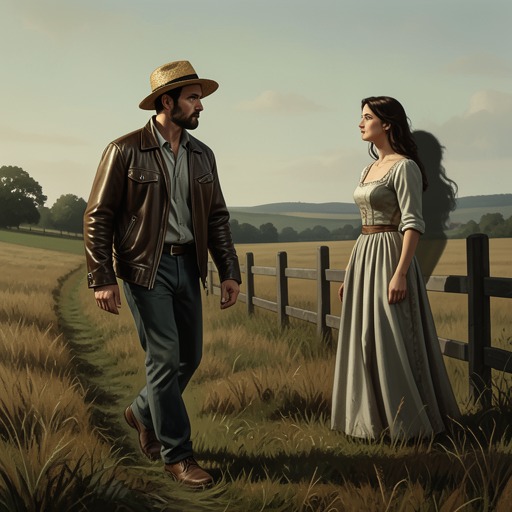
Hans responds by claiming that all young women secretly want a man to pursue them as a wolf chases a lamb. Flora exposes the danger contained in his romantic metaphor by asking whether the wolf does not eat the lamb. The exchange gives their relationship its central tension: Hans treats pursuit as a conventional sign of desire, while Flora recognizes that the language of pursuit can conceal domination and harm. His frustration, expressed through an exasperated gesture, does not alter her position.
Hans’s attention is nevertheless concrete and personal. When Flora finishes milking and reaches for the bucket, he eagerly takes it from her, telling her that helping her is no trouble. His willingness to assist her distinguishes his behavior from mere abstract matchmaking, yet Flora does not interpret the gesture as a reason to accept marriage. She thanks him, continues to speak with him, and watches him walk away, but her emotional response remains separate from his apparent hope. Familiarity and kindness create closeness without producing consent.
Labor, Class, and the Marriage Market
The relationship is also structured by class and economic position. Hans is a working field hand, while Flora’s family depends on farm labor and the sale of products such as milk and pies. Flora’s mother believes that marriage is necessary for a young single woman and urges her to attend a town-hall party where a well-off farmer and a widowed former Royal Army serviceman are expected to appear. The proposed matches show that marriage is being treated as an economic and social strategy, not simply as a private emotional choice.
Flora’s family history makes that strategy especially visible. Her father came from a wealthy family, while her mother was comparatively poor; his relatives objected to their marriage because of the difference in wealth, although he married Morgan for love. Flora inherits both the memory of that exceptional marriage and the material consequences of its aftermath. Her mother now looks worn by hard work, and Flora sees in her a possible future of labor, age, and narrowed opportunity. Hans’s position on the farm makes him part of the life Flora wants to escape, whereas the visitors at the party appear connected with wealth, military service, influential acquaintances, and a wider social world.
The contrast becomes sharper when Flora later encounters Charles, a tall and well-dressed man whose fine, clean clothes and polished appearance distinguish him from a farmer or herdsman. Charles eventually reveals that he will take Flora to a castle in Endenbrook and that his family gives him unusual freedom in choosing a spouse because of his affliction. Against that promise of movement, status, and personal choice, Hans’s presence remains anchored to the barn, harvest, pail of milk, and repetitive conversation. The text does not show Hans competing openly with Charles, but the difference between the two men clarifies why Flora’s future does not remain with the farmhand.
Separation Through Flora’s Choice
Flora does not reject Hans through a dramatic quarrel. Instead, she repeatedly redirects the relationship toward work. After listening to him discuss the harvest, she apologizes that she must attend to mending and ends the conversation. Hans leaves carrying the milk pail, while Flora turns toward the wooden cabin. This quiet separation is consistent with her character: she is shy and not naturally open with people, but she has learned from her father to read behavior and communicate deliberately. Her withdrawal is therefore a choice expressed through routine rather than confrontation.
The wider household reinforces that choice. Morgan sends Flora toward her grandmother’s house beyond the forest with the red cloak and a basket, hoping the comparatively wealthy grandmother will help provide a suitable dress for the town-hall party. Flora dislikes the idea of asking for money, yet she tells her mother that she might marry someone as desired. The promise is made to please Morgan, not as a declaration of feeling for Hans. In this context, Hans’s earlier suggestion of marriage is displaced by a more ambitious marriage search organized around wealth, family connections, and the possibility of a new life.
Narrative Significance
The Flora–Hans relationship establishes the ordinary model of courtship that the story subsequently complicates. Hans uses the familiar image of the wolf chasing the lamb, but Flora’s question turns the image into a warning. Later, the apparently dangerous male associated with the forest is revealed as Charles, whose identity as a Werewolf does not prevent Flora from accepting his proposal. The contrast gives the relationship a structural role: Hans is the known man within Flora’s everyday world, while Charles combines danger, mystery, social distinction, and escape.
Hans also embodies the limits of a future based solely on customary gender expectations. He assumes that young women ultimately want pursuit and marriage; Flora insists that freedom includes the ability to read and think independently. Although Hans shows practical care by taking the milk bucket, his courtship language remains bound to the social script Flora resists. The relationship therefore ends not with an explicit betrayal but with Flora’s movement away from the farm, toward a choice that promises her family a place at Charles’s castle and offers her a life beyond the repetitive labor represented by Hans.