Little Red Riding Hood motif
Her First Werewolf (BBW, Werewolf, Prince Charming, Fairy Tale Romance)The Little Red Riding Hood motif provides the central narrative architecture of the story while radically changing its moral and erotic direction. Flora, known as Red because of her red velvet cloak, is sent through the forest toward her grandmother’s house with a basket, warned not to leave the path, and intercepted by a handsome stranger who proves to be the wolf of the familiar pattern. Yet this wolf does not simply devour or defeat her: Charles becomes both a sexual partner and a prospective husband, turning a cautionary children’s tale into a fantasy about desire, autonomy, and a monster made intimate.
Fairy-Tale Framework
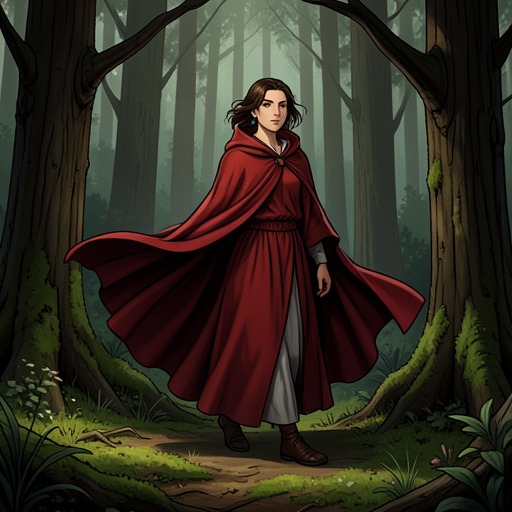
The motif is announced through concrete objects and movements rather than through an explicit retelling. Flora’s red velvet cloak gives her the name Red, while the cloak itself links her to the recognizable girl in red who travels through dangerous woodland. Her mother prepares the cloak and a heavily loaded basket containing bread, preserves, honey, and shepherd’s pie, then sends her beyond the small town to the grandmother’s house on a hillside past the forest. The destination, the maternal warning, and the journey combine to reproduce the basic sequence of the traditional tale.
The family history complicates that inherited pattern. Flora’s grandmother is her father’s mother and is wealthy compared with the townspeople. Flora’s parents had faced objections because her father came from wealth while her mother did not, but he married for love. The errand therefore carries more than the surface business of delivering food: Flora is being sent to seek her grandmother’s help with a dress, in accordance with her mother’s plan to make her more marriageable. The old fairy-tale route becomes a route through competing models of marriage, class, and female dependence.
The Path and Its Warning
The mother’s command, “Don’t stray from the path!”, is the story’s clearest direct invocation of the motif’s traditional rule. Flora waves goodbye at the edge of the woods and initially follows the expected route, but the warning is already tied to social rather than purely supernatural danger. Her mother wants her to approach the grandmother indirectly and persuade the older woman to provide money for a dress. Flora agrees outwardly because it pleases her mother, while inwardly feeling ill at the prospect of begging for something frivolous.
The forest journey gives the rule a second meaning. Summer is ending, the leaves are turning orange and yellow-gold, and Flora enjoys the walk as a respite from work. Carrying the overfilled basket, she plays at avoiding twigs and listens to birdsong. When she sees flowers in a clearing, she decides that bringing them to her grandmother could strengthen her case. This is the decisive deviation: she leaves the prescribed path not through reckless ignorance, but through a small act of practical kindness and self-directed judgment. The flowers thus transform the old warning into a test of agency. Her choice brings her nearer to danger, but it also brings her to the encounter that changes her life.
The Wolf Recast as Desire
Before meeting Charles, Flora is already thinking about the conflict between sexual curiosity and social prohibition. She rejects her friend’s account of premarital sex and fears the consequences of becoming pregnant and forced into a rushed marriage. Her resistance to marriage is connected to a larger desire for freedom: she worries that marriage might prevent her from reading or thinking for herself. Against this background, the wolf encounter is not merely an external threat. It dramatizes the desire Flora has been taught to fear and the independence she is trying to preserve.
The forest falls silent as she nears the glen, and Flora reassures herself by listing creatures that do not exist, including werewolves. Immediately afterward, booming laughter comes from behind her. Charles appears as a tall, handsome man with dark silky hair, green eyes, fine clean clothes, and broad shoulders. His appearance deliberately divides the wolf figure into two registers: the threatening creature of folklore and the attractive stranger of romantic fantasy. The story’s own promotional description identifies him as the “big bad wolf,” but the encounter turns that predator into an object of fascination. Flora is shy and caught off guard, while Charles is intrigued by the girl in red and asks where such a young maid is going.
The wolf-and-lamb language had already appeared in Flora’s conversation with Hans. Hans claims that young women who deny wanting marriage really want someone to chase them as a wolf chases a lamb. Flora answers that the wolf eats the lamb, exposing the danger hidden inside the metaphor. Charles later embodies both sides of that image. His desire becomes frighteningly animalistic, yet the narrative also presents his pursuit as the fulfillment of a fantasy of being wanted. The motif therefore retains the language of predation while relocating its meaning into an explicitly adult, sexualized romance.
The Monster Behind the Man
Charles’s transformation makes the motif’s concealed identity literal. During their sexual encounter, his growl becomes a howl, his eyes glow, and his teeth lengthen and sharpen. Flora recognizes the sound as wolf-like but remains uncertain about what it means. When a large black, venomous snake threatens her, Charles changes openly into a huge black-furred wolf and kills the twenty-foot snake in one bite. The familiar wolf is consequently not the danger Flora expected. He is the danger’s destroyer.
The revelation does not erase the monster’s power. Charles has been tracking Flora at her farm for days, and his animal form possesses overwhelming physical strength. He can hold her as if she weighs nothing, and his body shifts between human and wolf states. Yet the transformation is accompanied by shame and vulnerability rather than triumph. Charles confesses through a voice inside Flora’s head that he is a werewolf and looks down with doglike sadness. The wolf identity is thus framed as an affliction and a source of stigma, not simply as a secret weapon.
Flora’s response reverses the expected ending of the fairy tale. She initially calls him a beautiful dog, then corrects herself to call him a beautiful wolf. She pats his fur, accepts his nuzzling against her thigh, and says that she is not afraid because his movements show that he does not intend to hurt her. The supposedly monstrous body becomes an object of tenderness. His animality remains visible, but it no longer determines his moral position: the wolf is dangerous to the snake and protective toward Flora.
From Forest Encounter to Union
The story’s final transformation is social as much as physical. Charles says that he is falling for Flora, promises to care for her if she wants him, and changes back into the man to whom she has given her maidenhood. He tells her that he wants to take her away from her present life. The gesture echoes the rescue logic of romance, but it does not restore the conventional white knight. Flora explicitly contrasts her reality with storybook expectations: she receives a werewolf rather than a knight, and treats that substitution as an unexpectedly favorable bargain.
Charles then reveals that he is not merely a mysterious traveler. He is not first in line to inherit the throne, since six older brothers and their families stand before him, but he is nevertheless connected to royal status. He describes himself as a black sheep, allowing Flora to answer that he is more accurately a “black wolf.” The joke converts social irregularity and lycanthropic difference into a shared intimacy. His affliction gives him unusual freedom, because his father has allowed him to choose whom he will marry.
The proposal completes the motif’s reversal. In the traditional warning tale, the girl’s encounter with the wolf threatens to end in violation, disappearance, or death. Here the forest encounter leads to a declaration of love and a proposal in which Charles’s exceptional condition helps him escape rigid dynastic marriage expectations. Flora, who has resisted being married off to the first wealthy man her mother can find, is not simply handed from one authority to another. The narrative presents her attraction, consent, and response as central to the movement from danger to partnership.
Significance and Adaptation
The Little Red Riding Hood motif organizes a shift from imposed social destiny to chosen desire. The red garment, the mother’s assignment, the basket, the grandmother’s distant house, the path, the flowers, and the wolf all remain recognizable, but their functions are revised. The mother’s warning is connected to marriage strategy; the path is left for a useful and compassionate reason; the wolf is a beautiful man before becoming an actual wolf; and the grandmother’s destination becomes the point of departure for a relationship that promises escape from maternal pressure.
The adaptation also joins sexual awakening to the dismantling of the monster category. Charles’s wolf form initially appears to confirm Flora’s fears about danger, especially after he declares his ravenous desire. But the later rescue from the snake and the intimate mind-to-mind confession reframe him as both othered and lovable. His animal body carries power, shame, appetite, and protection at once. Flora’s acceptance does not make him human; instead, it makes the wolf compatible with affection, erotic attraction, and marriage.
Finally, the motif gives the story a language for negotiating women’s freedom. Flora begins as a milkmaid under pressure to secure a wealthy husband, yet she values reading, independent thought, and the ability to avoid a marriage without love. The fairy-tale structure could have punished her for leaving the path. Instead, it rewards a deviation that brings her into contact with a partner who claims the freedom to choose as well. The resulting fantasy is not a return to the old warning, but an adult inversion of it: the girl in red enters the forest, meets the wolf, discovers the truth of his body, and finds in the supposedly dangerous encounter the possibility of a chosen future.