Bethlehem
Here There Is No WhyBethlehem functions in the novel as more than a destination. It is a border-space through which characters move uneasily, a name that can conceal military activity, and a Palestinian city repeatedly enclosed by Israeli security and political language. Its significance lies in the way ordinary movement, armed patrol, historical memory, and peace negotiations become inseparable there.
A City Beyond the Narrator’s Social Border
Judah Loeb’s first meaningful relation to Bethlehem occurs during his year in Israel, when he remains socially enclosed within an English-speaking bubble of American and Canadian students. Although he can manage practical Hebrew tasks, he is too timid to cross into ordinary Israeli social life, finding Israeli students’ rapid, confident speech intimidating. Instead, he is more willing to explore Bethlehem and Hebron, Arab cities that seem less frightening to him than the Israeli society in which he is actually living. Bethlehem therefore marks both geographical movement and a psychological retreat: Judah crosses a national and cultural boundary while avoiding the immediate social boundary around him.
That movement also reveals Judah’s limited knowledge of the country. His willingness to visit Bethlehem does not mean that he understands the political structures governing the city. The contrast between his curiosity and his naivete is central to the setting’s narrative function: Bethlehem is initially approached as an accessible place of exploration, but the story gradually makes visible the military, historical, and territorial conflicts that ordinary tourism leaves out.
The Military Code of “Peaceful Patrol”
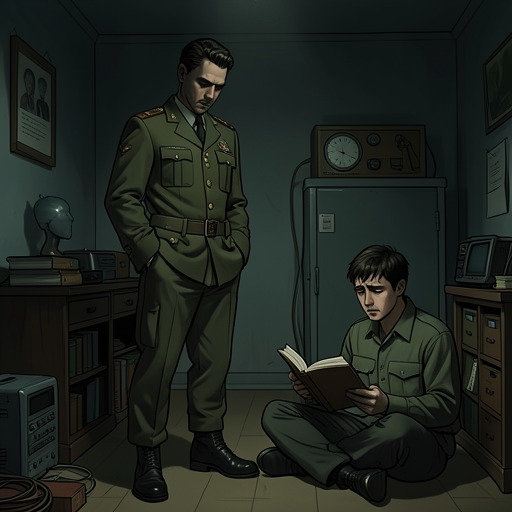
Bethlehem becomes more sharply political when Charlie prepares for his first reserve duty. He disassembles and cleans his rifle before reporting for service, while Judah asks whether he will be sent to Lebanon, where Israel has invaded Southern Lebanon three months earlier. Charlie refuses to describe his assignment directly, invoking military secrecy, but then identifies it as a location near Bethlehem. He calls it a peaceful patrol and warns Judah not to tell his supposed spymasters.
The phrase is deliberately unstable. Charlie’s rifle, the secrecy surrounding his orders, and the proximity to Bethlehem all place the city inside a militarized landscape, even while the patrol is described as peaceful. Charlie says that he would find a way to avoid Lebanon and argues that shooting wives and children is a less effective form of intimidation than other kinds of bullying. His remarks express both revulsion at violence and awareness of the coercive logic surrounding occupation. Bethlehem is consequently not presented as a neutral backdrop to military service; it is the place where the language of peace coexists with surveillance, weapons, and the possibility of force.
A Threshold of Evidence
Bethlehem also shapes the investigation into Chaim Lerner’s death. When Hannah Loeb, Michal, and Judah arrive at the Lerner home, Hannah insists on seeing the balcony from which Chaim supposedly fell. The group passes through the house and climbs three flights of stairs toward the railing associated with his death. Although Bethlehem is not the location of the fall, the journey through the surrounding Jerusalem landscape recalls Judah’s earlier willingness to cross into Arab cities and establishes a wider geography of thresholds, restricted knowledge, and contested access.
The same concern with hidden facts appears when Hannah investigates Kamal’s failed suicide bombing attempt. Kamal says that the target was Sbarro in Hod HaSharon, less than twenty minutes from Dahaisha, the refugee camp where he lives, and describes his family’s expulsion from Sylia during the Nakba. He links his planned attack to his grandfather’s loss of home, education, and social standing. Bethlehem belongs to this same regional network of cities, camps, patrol routes, and inherited grievances: places are not merely points on a map but containers of displacement, memory, and retaliatory purpose.
Settlement, Maps, and the Future of Territory
The novel later places Bethlehem within the political geography of the West Bank. Chaim Lerner travels with Judah to Pisgat David, a settlement whose suburban houses, lawns, garages, and children playing American football surprise Judah because they resemble an American suburb more than his image of Jerusalem. Chaim identifies the settlement’s religious settlers as people he hates and people who hate him, yet he addresses them in a crowded theater, attempting to speak across Israel’s internal divisions.
In the London Israeli–Palestinian peace talks, the territorial question becomes concrete. Israel offers roughly 95 percent of the West Bank, while the Palestinians demand the whole territory with limited border adjustments to accommodate most Jewish settlers. Judah glimpses maps showing Pisgat David on the Palestinian side in both versions. Bethlehem is not named as the decisive point in the negotiations, but its position within the West Bank gives the city a clear structural importance: it belongs to the territory whose ownership, borders, access, and political future remain disputed. The maps convert lived places into bargaining positions, while the people who inhabit them remain exposed to the consequences of those abstractions.
The talks begin with warmth and hope but collapse over Jerusalem, the right of return for Palestinian refugees, recognition of Israel as a Jewish state, the connection between Gaza and the West Bank, and the role of Hamas. Bethlehem thus stands within a political landscape where proximity does not produce agreement. Its nearness to Jerusalem and its place in the West Bank make it emblematic of the unresolved boundary between attachment to homeland, religious settlement, Palestinian displacement, and the search for a viable peace.
Narrative Significance
Bethlehem’s recurring presence gives the novel a spatial grammar of crossing and obstruction. Judah can travel there more readily than he can enter Israeli social life; Charlie can patrol near it while withholding the details of his assignment; political actors can redraw its surrounding territory on maps while failing to resolve the histories attached to it. The city therefore exposes the difference between physical mobility and political freedom.
Its name also carries a persistent irony. Charlie’s description of a peaceful patrol near Bethlehem places the rhetoric of order beside the reality of armed control. The peace negotiations place nearby settlements and Palestinian territory into diplomatic formulas, yet the talks collapse and the broader conflict continues through terrorism, barriers, missiles, bombs, tanks, and new settlements. Bethlehem remains significant precisely because it cannot be reduced to any one of these descriptions. It is at once a city Judah approaches as an outsider, a location shadowed by military power, and part of the territorial question that the characters repeatedly attempt—and fail—to settle.