Chaim Lerner–Judah Loeb mentorship
Here There Is No WhyThe Chaim Lerner–Judah Loeb mentorship is less a formal teacher-student arrangement than a bond formed through work, conversation, and the trust Chaim extends to a young man in pain. Chaim gives Judah practical access to his literary life and a language for suffering, prayer, and moral uncertainty. Yet the relationship does not deliver easy answers: Judah later remembers advice that once captivated him but could not protect him from grief, and turns the mentor’s disputed death into an investigation that resists a single explanation.
Work and Apprenticeship
Judah’s apprenticeship takes shape through ordinary literary labor. While interning for Chaim, he sorts papers, manages fan mail, and helps edit an English-language collection of short stories. The work brings him close to Chaim’s writing without making its meanings transparent. A story from the Planet of the Jews series, Blue Jews, prompts Judah to think about religious disillusionment: aliens who seem to renew Jewish ritual and belief prove to be thieves, leaving a community whose sacred practices collapse into cynicism. Judah is intrigued by the story’s movement from apparent blessing to betrayal, and by the suicide cult that follows, but admits that he has only a vague sense of what Chaim intends. Rather than treating mentorship as the transmission of a settled interpretation, the episode shows Judah’s curiosity beginning in uncertainty.
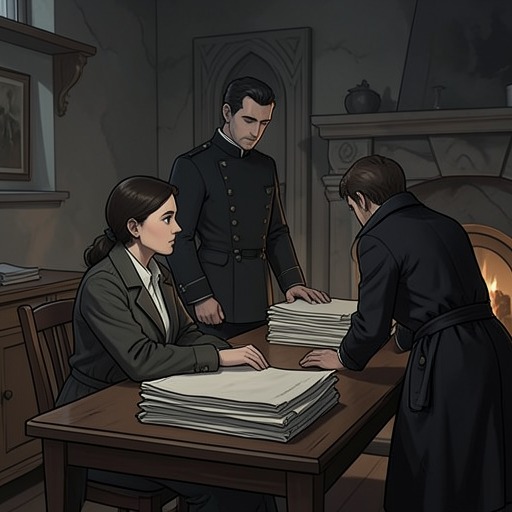
Their working relationship also has a physical setting. Chaim rarely works at the university outside his teaching, and his apartment lies three doors from Michal’s home, reached by a walk through Wadi Joz. When Judah returns to Israel after a breakup, Chaim offers to spare him that bittersweet route and meets him in his university office instead. Books, journals, papers, and manuscripts cover the floor, chairs, shelves, and desk. Chaim clears a path for Judah, transfers piles from the chairs to the desk, and pauses to catch his breath. The clutter makes the meeting feel like an entrance into a life already crowded with thought and work; Chaim’s effort to make room for his visitor is an equally concrete act of welcome.
Care in the Face of Heartbreak
Judah seeks Chaim out because he is suffering over Michal and does not know how to speak about the pain. Chaim recognizes the situation before Judah can explain it: he apologizes for having mistaken the pair for good friends and university colleagues, observes Judah’s distress, and responds in a parental tone. When Judah feels ashamed that his heartbreak seems puny beside Chaim’s history, Chaim refuses to rank their suffering. The wound is genuine, he tells him, and Judah should not judge it by comparison with someone else’s.
Chaim’s counsel is not to reason pain away. He urges Judah to allow suffering its place, but not to let suffering become the whole of life. Even in the camps, he says, there were moments of reprieve; life could still contain enjoyment, wonder, or rest. The advice draws on a distinction central to Chaim’s way of speaking about experience: acknowledging horror need not mean surrendering every other kind of attention. Judah is captivated, perhaps by Chaim’s repeated conversational yes, but also by the unearned love he feels in the exchange. Years later, after his wife’s suicide, depression, and addiction, Judah recalls the advice verbatim and judges it worthless in that later crisis. The reversal does not erase the care of the original encounter; it marks the distance between being moved by wisdom and being able to use it against grief.
Teaching Prayer and Uncertainty
Chaim’s mentorship also reaches Judah through religious argument. In April 1983, after a discussion of the Zohar in the Kotel Tunnel, Chaim guides him through the plaza and explains that the discussion itself had been prayer. He is unusually energetic that morning, gesturing sharply and speaking in a rough, hoarse voice. Judah has struggled to follow the discussion and does not pray; his religious experience is largely limited to occasional services he attends with Michal. Chaim nevertheless treats him as someone capable of entering the question rather than as a believer who already knows the answer.
The question is petitionary prayer: why ask a God who fails to grant what people request? Chaim describes his deity as less than all-powerful, which allows him to understand unanswered prayer without concluding that God has rejected the person praying. Prayer, in his account, is a relationship; getting exactly what one wants is not its sole purpose. Judah does not respond as a theologian, but the lesson belongs to the intimacy of the mentorship: Chaim offers an interpretive framework while leaving room for Judah’s uncertainty. Judah also suspects that Chaim imagines him staying in Israel, finishing his degree at Hebrew University, working for him, and perhaps marrying Michal. He later concedes that this imagined future may have been his own fantasy as much as Chaim’s.
The Mentor as Witness and Problem
Judah’s relation to Chaim extends beyond private conversations into the larger burden of interpreting his life. Chaim’s writing makes room for unlikely moral and spiritual claims: an apple slice stolen in Auschwitz can become a moment of life and wonder; camp theft can be described through an ethic in which stealing without giving is a sin. These writings complicate any simple picture of Chaim as either permanently haunted or untouched by the past. They also help explain why Judah’s investigation cannot reduce his mentor’s death to one neat cause. The evidence of Chaim’s future plans and joyful reputation sits beside the possibility of depression, Holocaust trauma, illness, and an accidental fall; each interpretation changes the story without settling it.
That tension matters because Chaim’s mentorship teaches Judah to resist easy rankings and conclusions, but does not make him immune to the temptations of explanation. Chaim’s son, Yoav Lerner, later recounts the massacre at Sabra and Chatila and describes killing two Lebanese boys after mistaking them for armed fighters. The account places Judah before the painful gap between what a witness sees, what a report claims, and what can responsibly be concluded. In a later conversation, Michal tells Judah that she pushed Chaim away as he raised his hand to strike her; because of his injured knee and hip, he lost his balance and fell from the balcony. This disclosure overturns the public uncertainty around Chaim’s death, but it does not transform the earlier mentorship into a simple key that unlocks his life. Judah’s eventual book keeps the death a mystery, offering possible explanations rather than publishing the truth he has learned.
Legacy and Limits
Chaim gives Judah forms of attention rather than a final doctrine: attention to suffering without comparison, to reprieve within horror, and to prayer as relationship rather than guaranteed fulfillment. Judah carries these lessons into later periods of grief, even when he finds them insufficient. Their significance lies partly in that failure. The mentorship is neither a cure nor a complete interpretive guide; it is a relationship whose warmth remains real even when its wisdom cannot undo loss.
The bond also shapes how Judah remembers his own formation as a writer and reporter. Chaim’s crowded office, stories that resist immediate explanation, and conversations that move between intimate pain and theological questions all become part of Judah’s apprenticeship. But the book’s retrospective structure makes mentorship itself a subject of scrutiny: the teacher is not fully knowable, the student’s memories do not resolve every contradiction, and love for a mentor can coexist with the decision to withhold the most decisive fact about his death. In that unresolved space, the relationship preserves both Chaim’s influence and Judah’s responsibility for the story he tells.