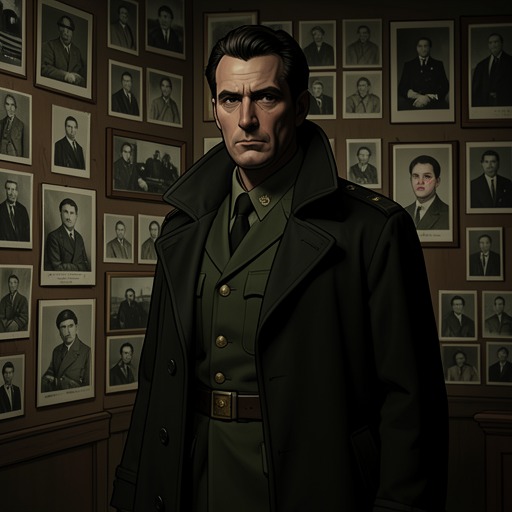
Chaim Lerner–Otto Schiller ethical relationship
Here There Is No WhyChaim Lerner–Otto Schiller ethical relationship centers on a delayed encounter between a Holocaust survivor and the civilian boss who had overseen his forced labor at Buna. Decades after Auschwitz, Schiller sought a personal meeting and forgiveness; Chaim answered with a distinction between acknowledging an individual act of decency and absolving someone who had lived within an indecent system. The relationship never reached face-to-face reconciliation: Schiller died just as Chaim was preparing to send his reply.
Buna and the asymmetry of survival
Before the war, Chaim had trained as an industrial chemist in Kraków. At Auschwitz he was put to work in Buna, the rubber factory, where his specialized knowledge made him useful to the German war effort. That usefulness helped keep him alive, but did not spare him torture, beatings, exhaustion, or humiliation. His father and sisters were killed, as were about a million other Auschwitz victims. Schiller, a German civilian, was Chaim’s boss at the factory, occupying a position of authority within the system that held Chaim as a slave laborer.
The relation between the two men therefore began under radically unequal conditions. Chaim’s survival as a laborer depended in part on his value to the factory; Schiller’s civilian status and authority were not equivalent to the prisoners’ condition. After liberation, Chaim abandoned chemistry and became one of the Hebrew University’s first PhDs in modern English literature. The later convergence of the two men as scholars of English literature did not erase the circumstances of their earlier connection. Instead, it gave Schiller a route back to Chaim—and made their shared academic field the setting he proposed for a reckoning.
Schiller’s request and Chaim’s scrutiny
In early 1970, when Chaim’s son Yoav was ten, Chaim received a postcard inviting him to speak at an English literature conference in London. It was signed by the organization’s vice president, Otto Schiller. Chaim initially ignored it. A week later, a five-page, single-spaced letter arrived in German, confirming that the writer was the same Schiller who had been his civilian boss at Buna and had since become a university professor. Schiller said that he had left chemistry after the war because the field had made him a necessarily harsh manager. His chosen phrase, “necessarily harsh manager,” stood out to Chaim as a euphemism that softened the power and violence surrounding their wartime roles.
Schiller said that the invitation was not principally about Chaim’s academic work: he wanted to sit with him in his favorite London pub and ask forgiveness. The request occupied less than half a page of the letter. In the remaining pages, Schiller explained himself. He portrayed civilians as having been constrained too, while conceding that they were paid and lived in conditions far better than the prisoners’ crowded, dirty bunks. He also recalled smuggling food to Chaim three or four times. Chaim had no memory of receiving it. Schiller stressed that he had never beaten Chaim or used physical pressure against him. Chaim’s recollection supported that particular claim: other people had whipped him and his fellow prisoners, but Schiller had not.
That limited acknowledgment did not settle the question of Schiller’s responsibility. Chaim could allow that Schiller had not personally tortured him, while still asking whether Schiller had ordered others to beat prisoners. He could not establish that he had, and Chaim was willing to give him the benefit of the doubt about the beatings. Schiller also denied knowing about the genocide, gas chambers, and crematoria. Chaim was baffled, but had heard similar denials from so many Germans and Poles that he could not dismiss the claim outright. His recurring challenge was concrete rather than abstract: the smell. The letter thus confronted him with disputed memory, limited evidence, and the question of what a civilian could plausibly have known.
Chaim’s answer: decency without forgiveness
Chaim did not want to travel to London or meet Schiller in a pub, but he considered the request a serious ethical question. In his view, Schiller was a bystander, and being a bystander was a sin; repentance and forgiveness were central to Jewish ethics. Chaim responded by writing a six-page letter in English. He told Schiller that he could sometimes accept forgetting under the pressure of stressful events, but not when it came to the camp: he believed God had cursed him with perfect memory. He therefore rejected Schiller’s claim that he had smuggled food to him, describing Schiller as mistaken rather than calling him a liar.
On the question of physical violence, Chaim’s answer was different. He affirmed that Schiller had not tortured him, and said that this meant Schiller had preserved some measure of decency in an indecent place. That effort deserved acknowledgment, even praise. But acknowledgment was not pardon. Chaim wrote: “In a world with no Auschwitz, it is sufficient to preserve a modicum of decency. But in a world with Auschwitz, which is to say our world, the world that you and I endured, it is necessary to restore decency, not merely to preserve it.” The distinction defines their relationship: Schiller’s restraint mattered, but Chaim judged it against a world whose moral conditions demanded more than restraint by individuals who had not been imprisoned.
Chaim accepted the conference invitation and agreed to meet Schiller at a pub to discuss Milton, Shakespeare, Chaucer, or any other subject Schiller chose. He expressly withheld forgiveness. The willingness to speak was not a reconciliation, nor did shared scholarship supersede the history of Buna. It was an offer to meet and talk while leaving the central moral judgment unresolved.
A meeting that never took place
The correspondence ended before the proposed meeting. Chaim took more than a week to compose his letter and was about to walk to the post office when Schiller’s wife telephoned. Schiller had died of a heart attack two days earlier; his wife called because she thought Chaim should know. There was no London conference meeting between them, no pub conversation, and no opportunity for Schiller to respond to Chaim’s refusal to forgive.
Yoav later told the story to his mother, Zehava, and to Judah, describing how he had heard his father read several drafts of the letter when he was ten. The episode gives the relationship an afterlife through Chaim’s family: his answer was remembered and retold even though the two men never completed their exchange. It also frames Chaim’s ethics as more than a private response to his own survival. The same insistence on distinguishing direct violence from bystander responsibility informs his later condemnation of standing aside during the Sabra and Chatila massacre. In the Schiller correspondence, that distinction remains intimate and unresolved: Chaim can credit an act of decency without allowing it to stand in for the restoration of decency, and he can accept a conversation without granting the forgiveness it was meant to obtain.