Chaim Lerner–Zehava Lerner relationship
Here There Is No WhyThe Chaim Lerner–Zehava Lerner relationship is presented as a marriage in which public argument and private care occupy the same rooms. Chaim is a Holocaust survivor, thinker, and religious teacher; Zehava is a prominent Israeli politician whose political standing grows over the years. Their life together appears in modest domestic scenes, debates about responsibility and violence, and rituals in which the two respond differently but remain part of a shared household. The novel does not reduce their bond to either intellectual agreement or marital discord: it shows a couple able to host, argue, and mourn together, while leaving much of their private history unspoken.
A Shared Home and Public Life
When Judah Loeb first visits the couple, Zehava welcomes him with an embrace and says he is welcome in the house. The setting is not the intellectual salon he expects. The four of them—Chaim, Zehava, Michal, and Judah—sit in the modest living room: Chaim and Zehava share a loveseat, while the guests occupy the room’s two other chairs. The food and smells recall Judah’s childhood Friday nights, and Zehava serves him petel while Chaim and Michal drink bourbon. This first encounter establishes the marriage through ordinary hospitality rather than a display of status, even though both spouses are prominent in public life.
At that dinner, Chaim turns Judah’s uneventful American upbringing into an argument about the banality of goodness. Zehava lays a hand on his knee and begins to caution him that he need not continue. Chaim gently insists on finishing his point. The gesture is intimate and the exchange is small, but it reveals a recurring difference in their roles: Chaim is eager to develop an idea in conversation, while Zehava knows the argument and tries to temper or redirect it. Their familiarity is evident in her ability to intervene without ceremony and in his affectionate refusal, not in any claim that they think alike.
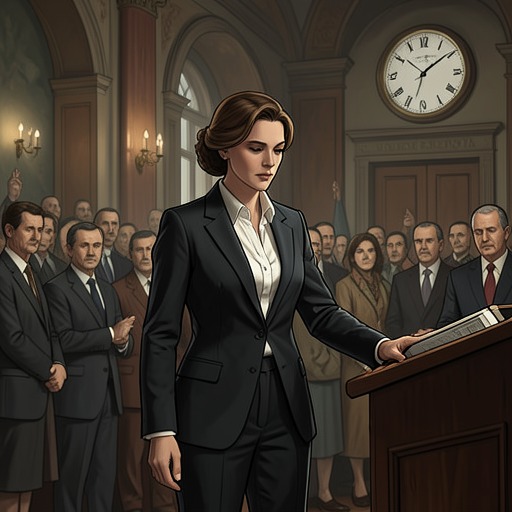
Zehava’s public importance later becomes part of the pressure surrounding Judah’s investigation into Chaim’s death. During the Second Intifada, her eloquence and activism carry her into the upper ranks of Israel’s political opposition, and commentators predict she might become the country’s first woman prime minister since Golda Meir. Michal warns Judah that renewed attention to Chaim’s death could reopen the worst moment of Zehava’s life and damage her. Zehava’s political stature does not make her private loss less vulnerable; it makes the investigation consequential in more than one sphere.
Argument, Responsibility, and Difference
The couple’s sharpest visible dispute at the first dinner begins when Judah asks about the massacres in Lebanon. Zehava rejects his description of the violence as an inexplicable black hole and argues that hatred has roots, accusing the Israeli government of knowing what it invited. Chaim interrupts to reject her accusation as dangerous and irresponsible, insisting that the government did not perpetrate the massacre. Zehava answers, and the two launch into a heated argument in Hebrew, with sweeping gestures and Chaim tapping his cane against the carpet.
Judah initially understands the exchange as a real defense of opposing political positions. Later, however, he learns that neither spouse actually believed the claims each had made. This reversal complicates the scene: their performance of disagreement is not straightforward evidence of a settled marital or ideological division. The novel leaves the purpose of the performance open, but makes clear that the couple can inhabit an argument forcefully without its literal positions defining their beliefs. Their fluency in dispute is itself part of their shared life.
A quieter exchange shows them facing the burden of Chaim’s past. When Judah asks how he can help, Chaim answers that telling stories helps him, whereas it does not help Zehava as much. He nods toward her; she is looking down at his ankle. The moment joins two different responses to trauma without treating one as a failure of care. Chaim can make narration a form of relief, but he recognizes that the same method does not serve his wife in the same way. Zehava’s downward gaze and his acknowledgment suggest attention to her limits, even as the scene offers no easy resolution to what the Holocaust has left between them.
Ritual and Shared Household
After Chaim speaks about storytelling, he invites Judah to join the Havdalah ceremony marking the end of Shabbat. Chaim lifts the cup and sings in a pleasing baritone; Judah holds the braided candle, careful not to drip wax on the carpet. Zehava stands silent and still through much of the ritual. Judah assumes she has lost whatever religious faith she once had, but when Chaim reaches the final stanza and the song to Elijah, she joins in with gusto and harmonizes with Judah. Her participation unsettles his assumption without establishing a simple account of her beliefs. In this household, religious practice is shared, but the spouses do not perform it in identical ways.
Their domestic coordination also appears when Judah asks after their son, Yoav Lerner. Chaim and Zehava look at one another before Zehava answers that things have been difficult. Chaim describes Yoav’s military role as being in the rear while still part of the battle. The exchanged glance and division of response give a brief view of parents negotiating what to disclose about their son: Zehava first names the difficulty, and Chaim supplies its circumstances. The scene does not explain their private conversations about Yoav, but shows their common concern and their different ways of voicing it.
When Chaim explains his research on God, Torah, and Israel, Zehava gets up to clear the plates and empty beer bottles, saying she has heard the account several times already. The ordinary task and her weary familiarity sit alongside his wish to persuade others. The novel records the asymmetry of this moment—Chaim remains seated, shaping an argument for Judah, while Zehava handles the table—without turning it into a complete verdict on their marriage. Her departure from the conversation indicates both that she knows his ideas intimately and that she does not always wish to hear them again.
Loss and the Marriage’s Afterlife
Judah’s return to the Lerner home, many years after his first visit, brings the marriage back through the house and the unanswered question of Chaim’s death. Hannah Loeb asks to see the third-story balcony where he fell. Zehava is not part of that balcony scene, but the investigation Judah undertakes is inseparable from the possibility that revisiting Chaim’s death will reopen her grief. Judah eventually accepts Charlie’s deal and publishes a biography that leaves the death unresolved, offering possible explanations as speculation rather than fact. The uncertainty preserves the distinction between the public account of Chaim and whatever Zehava knew or endured privately.
Zehava remains a presence in Judah’s life after Chaim’s death. When he sees her again decades after their first meeting, she embraces him warmly, with a hint of desperation, and recalls him as though he has not changed. Judah notices how much he has changed and how strongly she still resembles the protective matriarch he remembers. Much later, after Zehava has died, Michal invites Judah and Hannah to her funeral and says she has something to tell him in person. The marriage’s aftermath thus reaches the novel’s final return to Israel: Chaim’s death is an enduring mystery, while Zehava’s death prompts a last meeting and an unfinished disclosure. Their relationship is never fully explained, but its domestic gestures, arguments, rituals, and losses form a continuous thread through Judah’s account.