Charlie
Here There Is No WhyCharlie is one of the most consequential figures in Judah Loeb’s life in Israel: first a roommate and fellow American, then a soldier, police officer, investigator, and finally a clandestine participant in the Israeli–Palestinian peace process. His biography joins intimate companionship to the machinery of the state. The armed young immigrant who once cleaned an Uzi on a cheap Persian carpet becomes the policeman who reopens the mystery of Chaim Lerner’s death, only to reveal that the investigation itself has been manipulated to protect a fragile political coalition. His eventual assassination turns that deception into a personal and historical loss.
Identity and Early Life
Charlie shares a tiny dorm room with Judah on Mount Scopus when Judah tells him that he may be getting a girlfriend. Charlie’s response is characteristically disarming: he reaches beneath his bed and brings out an Uzi because he has to clean it. The weapon makes visible the difference between the two roommates. Both grew up in the American Midwest, followed baseball, played pickup basketball, listened to Led Zeppelin, and drank Maccabi Beer, but Charlie had made Aliyah three years earlier and had just completed his army service. At twenty-one, he is only beginning college, while his military experience has already made him more permanently embedded in Israeli society than the temporary American students with whom Judah usually socializes.
Their friendship develops without much deliberate cultivation. Judah spends time with less permanent Americans; Charlie spends time with fellow new immigrants, and the two rarely socialize together. Yet they grow fond of each other in the quiet, practical way of good roommates. Charlie’s first reserve duty gives this bond a military setting: he dismantles his rifle, lays out a rag and cleaning oils on Judah’s carpet, and announces that he must report at seven the next morning. The domestic room and the military weapon occupy the same small space, making Charlie’s Israeli identity both intimate and unsettling to Judah.
Charlie’s service coincides with the Israeli invasion of Southern Lebanon. His unit spends the first week training with new weapons in the Negev and the next patrolling Ramallah and Nablus, but he never faces combat. He is discharged the following week, three years after joining, becoming a college freshman at twenty-one. About a month later, after the Sabra and Shatila massacres, he and Judah drink together for the first time. Charlie introduces Judah to “hats on the bench,” a mixture of Heineken and gin learned from a Dutch peacekeeping soldier in the Sinai. The episode captures Charlie’s position between ordinary student life and the permanent afterlife of military service: he is both a young man experimenting with drunken camaraderie and a recent soldier living inside a national catastrophe.
From Roommate to Policeman
As Judah’s relationship with Michal intensifies, Charlie sees less of his roommate, and Judah recognizes how singular their friendship has become. Apart from Michal, whose connection to him is romantic, and Chaim Lerner, whose importance Judah cannot yet define, Charlie is his only friend in Israel. Charlie is therefore not merely background companionship; he is Judah’s primary point of continuity as the investigation and the personal relationships around it become more dangerous.
Charlie studies Israeli serial killers, then broadens the subject to murders and homicide. He tells Judah that he wants to become an Israeli police officer. His interest in crime is not presented as detached academic curiosity. He is drawn toward the institutions, weapons, and moral ambiguities that define the country he has chosen. When he asks whether Judah has met Yoav Lerner, his professional curiosity begins to converge with the Lerner family’s history. His joking response when Judah asks whether he has ever shot at ten-year-old children—“Not yet”—is deliberately disturbing: Charlie’s humor acknowledges the proximity between policing, military power, and violence against civilians without resolving that tension.
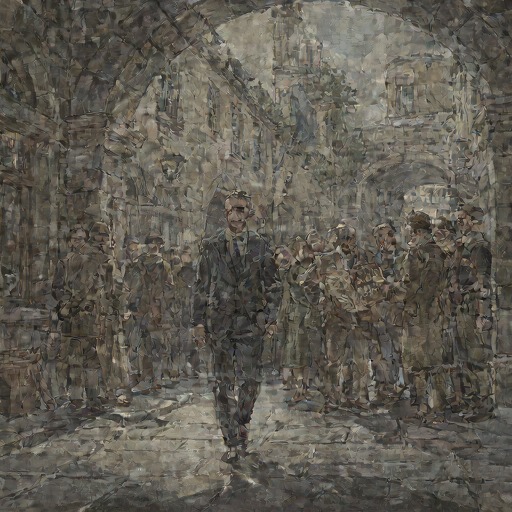
Twenty-two years later, Charlie reappears in an Israeli police uniform at the Russian Compound. He wears navy trousers, a light-blue shirt, epaulets, and sleeve and pocket patches, and carries a large brown leather briefcase packed with folders and loose papers. Judah notices that Charlie still resembles the young soldier from their dormitory years: sandy-brown hair, red and slightly puffy cheeks, and no visible gray or middle-aged paunch. The reunion makes Charlie seem preserved while Judah feels changed, and Israel appears to Judah as a place marked simultaneously by perpetual war and an improbable fountain of youth.
Charlie uses his official position to recruit Judah into the investigation of Chaim Lerner’s death. He explains that five neighbors heard the body fall at seven in the evening, a thump like a load of flour striking pavement, preceded by someone saying “Whoops.” The witnesses agree on the time, and two confirm that Michal and Zehava were nowhere near the apartment. Charlie’s reasoning eliminates Yoav, Zehava, and Michal as immediate suspects and directs attention toward Meir Alon. He presents Judah with Alon’s photograph and asks whether the name means anything, converting an old friendship into an investigative partnership.
The investigation is constrained by political power. Charlie explains that Alon and Rabbi Kaplowitz are important figures—Alon now a deputy prime minister whose faction can bring down the government, and Kaplowitz perhaps the most popular and powerful rabbi among the settlements. Charlie cannot simply summon them to police headquarters and interrogate them. He needs outside pressure and tells Judah that Judah is that pressure. The request gives Judah public leverage while keeping Charlie’s own institutional limitations in view: the policeman needs the writer, and the investigation depends on the uneasy cooperation of both.
Investigation, Evidence, and Deception
Charlie conducts the interview with Meir Alon at six in the morning in an empty office at police headquarters. He chooses the hour because there will be fewer witnesses and because he believes it is the best time to catch someone in a lie. The scene establishes his procedural confidence, but it also reveals his reliance on controlled circumstances. He leads the questioning across a metal card table, carrying the authority of the police uniform and the accumulated contents of his briefcase into an improvised interrogation room.
The eventual evidence complicates the early suspicion. Michal recalls that she and Zehava were shopping for a wedding dress at the relevant time and had brought the receipt to the police years earlier. The receipt from Rafik’s Boutique records May 5, 1983, at 19:00, while neighbors heard the fall at 18:30. It confirms the women’s alibi. Charlie’s case therefore moves through a forensic structure of witness time, documentary proof, and the physical geometry of the balcony rather than through confession alone. The old receipt, preserved from a purchase in the Arab Market, becomes more decisive than the political reputations Charlie initially places under scrutiny.
Charlie’s apparent investigation of Alon and Rabbi Kaplowitz is eventually exposed as a fabrication from the beginning. Judah learns that the two men are members of a new peace coalition organized by Zehava. They have invented their performances to misdirect suspicion from Zehava, and because Charlie controls the investigation, the deception carries little real legal risk for them. The detective story thus reverses itself: the investigator is not simply uncovering a conspiracy but administering one. The false leads are a protective screen around a political project whose stakes extend beyond the death that ostensibly motivated the inquiry.
Charlie admits that he will join the negotiating team and that he and Zehava have discussed the possibility for years. His role in the investigation is therefore double. He is genuinely Judah’s friend and an experienced police officer confronting violence, but he is also an intermediary who needs Judah’s writing to generate pressure while keeping the real political objective hidden. The lie does not erase his attachment to Judah; it makes their friendship inseparable from the ethical cost of withholding the truth.
Peace Politics and Final Separation
Charlie explains that Zehava’s rise during the Second Intifada has made her central to Israel’s political opposition and that her relationship with Ariel Sharon and Palestinian Authority leaders could point either toward war or peace. Sharon might be broadening the coalition for an invasion of the West Bank, or Zehava might be entering government to negotiate an agreement. Charlie hopes for peace because he spends most nights dealing with bombings, relying on strong espresso while the violence continues. He believes Zehava has both a proposal and the credibility to end the fighting.
At their final meeting, Charlie asks Judah to write quickly, sell many books, and publish an excerpt online. He needs official permission to pursue Alon and Kaplowitz, and Judah’s public pressure can provide it. Charlie frames the request as an off-the-record bargain: Judah’s success as a writer will help unlock the police investigation. Yet the arrangement also prepares Judah to become an instrument in a campaign whose real aim is peace rather than prosecution.
When Judah confronts him, Charlie does not deny that the entire Alon–Kaplowitz affair was a lie. He confirms that he will serve on Zehava’s negotiating team. The admission transforms the meaning of their earlier work together. What looked like a conventional investigation into Chaim’s death had also been a cover operation designed to protect the people building a peace coalition. Charlie’s secrecy has protected negotiations, but it has also deprived Judah of informed consent and forced their friendship to operate through strategic concealment.
Charlie and Judah part at the same café where they met when Judah first arrived. Judah expects to miss the hummus, olives, and fresh pita, but the food is also bound to the emotional geography of the friendship. Charlie continues to help from a distance: he arranges for Judah to observe the secret London Israeli–Palestinian peace talks, provided Judah postpones reporting until a final agreement and uses no direct quotations. Charlie cannot attend because he must remain in Israel in case another terrorist wave begins. During the talks, the Israeli side offers roughly 95 percent of the West Bank, while the Palestinians demand the whole territory with limited border adjustments; Pisgat David appears on the Palestinian side in both versions of the maps. Charlie’s absence from the room is itself part of his role: he makes access possible while remaining tied to emergency policing at home.
Death and Narrative Significance
Three years after Judah’s final embrace with Charlie, a terrorist bomb destroys the door of Charlie’s office and kills him instantly. His death is both an act of terrorism and the violent interruption of a political possibility. Charlie had lived amid weapons, investigations, military reserve duty, and recurring bombings, but he had also tried to redirect those instruments toward peace. The bomb turns the threshold of his office into the final boundary in his story, converting the policeman and negotiator into another casualty of the conflict he had spent his life trying to contain.
Michal later tells Judah that Charlie was sad to have lost Judah’s friendship. That detail prevents the political deception from reducing Charlie to a manipulator. His lies were consequential, yet his attachment to Judah remained real, and the loss between them wounded him. Charlie’s narrative function lies in this contradiction: he is simultaneously ally, investigator, gatekeeper, deceiver, and peacemaker. His life shows how private loyalty and public secrecy can sustain one another for a time, while his death exposes the human price of a world in which even friendship may be recruited into political strategy.