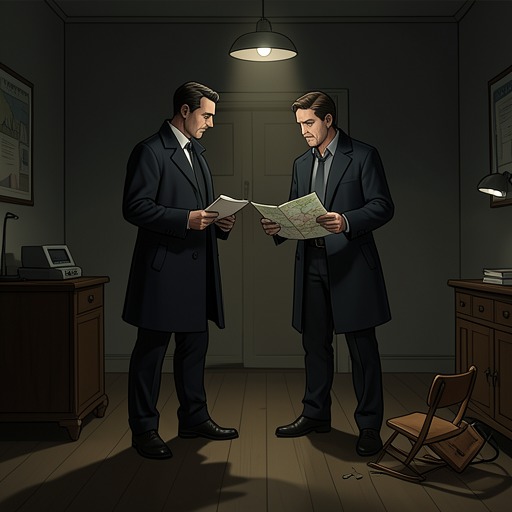
Charlie’s assassination
Here There Is No WhyCharlie’s assassination is the terrorist bombing that kills Charlie at his office three years after his final meeting with Judah. The event closes a relationship marked by secrecy, war, journalism, and repeated postponements of reckoning: Charlie promises that the friends will not allow another twenty-two years to pass before seeing one another again, but the promise is broken by sudden political violence. His death also turns the Russian Compound into a final point of convergence for the novel’s personal and public histories, linking Charlie’s work in Israeli security to the wider cycle of terrorism and reprisal that continues after the London peace talks collapse.
The Promise Before the Death
Charlie’s assassination is prepared by an apparently ordinary farewell. At their last embrace, Charlie asks Judah whether they will see each other again soon and whether they will avoid another twenty-two-year separation. Judah agrees and even means the promise, at least partly. The physical details of the goodbye make the later death more severe: Judah recognizes the shampoo Charlie once used and occasionally lent him, and the familiar scent brings back the shared past with almost overwhelming force. Charlie is not leaving the story in a moment of declared finality; he is expecting another meeting. The assassination therefore arrives as a violent interruption of an anticipated future rather than as the completion of a consciously staged farewell.
Three years later, the promise has become impossible. A terrorist bomb blows up the door of Charlie’s office and kills him instantly. The brevity of the act contrasts with the long interval of waiting that precedes it. Charlie and Judah have spent years living with unfinished conversations, and the bombing eliminates the possibility of repairing that delay through another meeting. The death is both an attack on a person and an attack on continuity: friendship, professional work, and political hope are all stopped at once.
Political Context and Location
The bombing occurs against the background of an unending Israeli–Palestinian conflict. Charlie remains in Israel during the London Israeli–Palestinian peace talks because he must be available if a new terrorist wave begins. The talks initially appear promising. Israel offers roughly 95 percent of the West Bank, while the Palestinian negotiators demand the whole territory with minor border adjustments intended to accommodate most Jewish settlers. Yet Pisgat David, the settlement Judah has seen as a prosperous suburban landscape rather than the militarized frontier he expected, appears on the Palestinian side of both versions of the map. That detail gives the negotiations a concrete spatial stake: the question of peace is not abstract territory but the possible transfer of an inhabited place and the reclassification of its residents.
The negotiations soon break down over Jerusalem, Palestinian refugees’ right of return, recognition of Israel as a Jewish state, the connection between Gaza and the West Bank, and the role of Hamas. The collapse occurs only a week after the London meetings, and the subsequent violence resumes its familiar rhythm. Suicide bombings diminish as Israel builds its West Bank barrier, but Hamas missiles and flammable kites from Gaza are followed by Israeli bombs, tanks, and new settlements. The West Bank becomes quieter without becoming free of terrorist violence, and Israel proper remains vulnerable as well. Charlie’s assassination is thus presented not as an isolated criminal act but as one episode in a political environment where every apparent lull remains provisional.
The Russian Compound gives that instability an institutional address. The bombing outside it kills the head of Israel’s police homicide division, who is also Judah’s friend, Charlie. The setting joins the machinery of law enforcement to the violence it is meant to contain. Charlie’s professional identity makes him a figure positioned near the state’s attempt to investigate and control political violence, while the bomb demonstrates that no institutional proximity guarantees safety. His office door, a threshold between public duty and private life, becomes the point through which violence enters.
War, Secrecy, and the Burden of Testimony
Charlie’s earlier military service establishes his wary relationship to armed conflict. He habitually begins army stories by warning that he is not permitted to discuss them, even though during his first month with Judah the service is almost all he wants to talk about. His secrecy is therefore both a military posture and a social performance, leaving Judah uncertain whether Charlie is genuinely bound by confidentiality or simply poor at maintaining it. When Charlie cleans each component of a gun, he says that if the assignment were in Lebanon, he would find a way to avoid it. The statement becomes an early sign of his distance from the kind of war that later defines the novel’s moral landscape.
The IDF invades Southern Lebanon nearly three years into Charlie’s service. His unit spends the first week after the incursion training in the Negev with new weapons and the following week patrolling Ramallah and Nablus, two relatively quiet West Bank cities. Charlie never faces combat, and his service ends the next week, three years after he joined, when he is discharged as a twenty-one-year-old college freshman. His personal proximity to the Lebanon War is therefore indirect, but the war remains central to his friendship with Judah and to the political world in which he later works.
That indirect proximity matters because the novel repeatedly distinguishes between witnessing, failing to intervene, and directly killing. In the account of the Sabra and Shatila massacres, Israeli soldiers hear shots, Arabic commands, and screams, assume that children are being executed, and receive no order to intervene. When orders finally come, a force of roughly 250 soldiers enters the camp and disarms Phalangist fighters. Charlie’s later interpretation insists that chronology must not be manipulated: the Phalangists stop after hearing that Israeli forces are coming, and the Israelis then march into the camp. The Israelis therefore do not physically halt the massacre, even though their intervention helps end it. The distinction between perpetrating, permitting, witnessing, and belatedly stopping violence becomes one of the novel’s governing ethical problems.
The same problem is dramatized through the account of children used in combat. Soldiers are instructed to return fire when live rounds are fired, but stone-throwing children create a situation in which the available targets may be children even when the presumed shooters are hidden behind buildings, homes, fountains, or statues. In the incident that haunts the family history, two boys are mistaken for Hezbollah fighters. The account describes the confusion between military necessity and the presence of children, while an earlier parental instruction has told the soldier to shoot when life seems threatened even without complete certainty. The event’s moral pressure comes from the collision between a rule framed as survival and the irreversible consequences of applying it under uncertainty.
Aftermath and Narrative Consequences
Charlie’s death changes the meaning of the novel’s later disclosures. Judah has accepted Charlie’s deal and written the book about Chaim Lerner while preserving Chaim’s death as a mystery, presenting possible explanations that include suicide, lingering Shoah nightmares, illness, the burden of being a witness to Jewish history, loneliness, accident, and murder. Judah acknowledges that these speculations are fiction, although the biographical portions of the book help revive his journalism career and eventually lead him to the Washington Post. Charlie’s assassination remains part of the cost of that arrangement: the deal secures a book and a professional future, but it cannot protect the friend who made the agreement possible.
The death also gives renewed weight to Judah’s silence. The London talks are eventually reported, but the Washington Post buries the account in the middle of the paper, where it attracts little attention. Charlie has helped Judah gain access to the negotiations while remaining in Israel to respond to a possible terrorist wave; later, a terrorist bomb kills him. The contrast is stark. Political peace is treated as marginal news, while political violence is immediate and fatal. Charlie’s professional labor—security, investigation, and access to information—cannot overcome the public’s indifference or the durability of the conflict.
Judah’s later reconstruction of Chaim’s death shows how Charlie’s own death remains entangled with the investigation. When Judah eventually realizes that Michal and Zehava lied about their alibis, he understands that one of them killed Chaim. He recalls Michal’s one-armed embrace on the night she claimed to have found Chaim’s body, notices that she winced because of an injured arm, and infers that she had fought back against Chaim’s assault. Zehava protected Michal and concealed the truth. Judah could have published Zehava’s confession, but he chose not to, partly because he feared damaging her and Chaim’s reputation. Charlie’s later assassination does not resolve the novel’s culture of secrecy; instead, it leaves Judah carrying a further loss alongside the suppressed truth he chose to preserve.
Significance
Charlie’s assassination repeats the novel’s pattern of delayed understanding. The bombing itself is sudden, but its full significance emerges only through the earlier military stories, the contested account of Sabra and Shatila, the unresolved responsibility for the deaths of children, the failed London talks, and Judah’s long effort to decide what should be told. Charlie’s death is therefore not merely an endpoint in the plot. It is the event that proves how little control the characters possess over the histories they try to interpret, and how political violence can convert postponed intimacy into permanent absence.
The event also intensifies the novel’s contrast between testimony and silence. Charlie is associated with secrets, security work, and carefully managed information, yet his death becomes another fact that others must narrate after the fact. Judah remembers the promise of reunion; the public record reduces the loss to a terrorist bombing; the private meaning remains in the friend who was supposed to return. Through that contrast, Charlie’s assassination joins individual grief to the broader question of how violence is named, who is blamed, and which deaths receive sustained attention. The bombing ends Charlie’s life instantly, but it continues to act through memory, journalism, political history, and the unfinished obligations between survivors.