Israeli invasion of Southern Lebanon
Here There Is No WhyIsraeli invasion of Southern Lebanon is not merely a military episode in the narrative. It is the event that links the state’s language of security to the private language of guilt, trauma, and responsibility. The invasion places Israeli soldiers beyond the border, produces the massacres at Sabra and Chatila, provokes Chaim Lerner’s public condemnation, and becomes inseparable from the actions of his son, Yoav Lerner. Although the war is repeatedly discussed through competing accounts, its decisive force lies in what it makes impossible to separate: military duty from civilian suffering, national memory from political power, and historical witness from personal blame.
Causes and Immediate Setting
Israeli invasion of Southern Lebanon begins as a contemporary war already underway when Judah Loeb arrives in Jerusalem. Israel had invaded Southern Lebanon three months earlier, and the military presence was close enough to shape ordinary conversation even for civilians who had never seen combat. Charlie, Judah’s roommate, had completed his army service and was preparing for his first reserve duty. When Judah asks whether the assignment concerns Lebanon, Charlie answers that his unit has not yet been posted there, though the possibility hangs over the exchange. Charlie’s guarded explanation shows how the war enters domestic space through rifles, reserve orders, military secrecy, and the expectation that a young man may soon be sent across the border.
Charlie’s service illustrates the war’s uneven geography. During the incursion, his unit spends its first week in the Negev training with new weapons and the following week patrolling Ramallah and Nablus, two comparatively quiet West Bank cities. He never faces combat, and his service ends three years after he joined the army. The contrast is important: the war is nationally pervasive, but its risks and responsibilities are distributed unevenly. Charlie can handle a rifle on the cheap Persian carpet in his apartment, while other soldiers fight Lebanese militias and Palestinian terrorist groups; Judah’s closest approach to combat remains watching his roommate clean his weapon.
The night after the Sabra and Chatila massacres, about a month after Charlie’s discharge, the two roommates drink together for the first time. Their drunken conversation turns toward the Christian Lebanese soldiers allied with Israel and their slaughter of Palestinian civilians in the refugee camps. Charlie says that the killers do not even know why they do it, while Judah proposes fear, domination, or forced acquiescence as possible motives. The exchange does not resolve responsibility, but it establishes the war as a moral problem that exceeds the official distinction between Israeli forces, allied militias, Palestinian civilians, and distant observers.
Public Condemnation and Political Conflict
For much of Judah’s early life in Israel, it is easy for him to forget that the country is at war. Thousands of young men are fighting every day, while his own experience consists of university classes, romance, and the sight of Charlie’s gun. That distance collapses when Michal explains that Chaim Lerner is preparing a statement condemning the Lebanon War and every government decision that led to the conflict. Chaim, previously portrayed as a saintly Holocaust survivor and a beloved public intellectual who had avoided politics, is about to use his authority to influence public opinion.
The announcement also reveals a conflict within the Lerner household. Judah remembers Chaim silencing Zehava Lerner when she criticizes the war, but Michal explains that Zehava supports the invasion’s aims and execution even though she belongs to the opposition. Chaim’s condemnation therefore threatens not only the government but also the political and marital arrangements around him. His position places him against the national consensus, against Zehava’s politics, and against the religious and nationalist constituencies that regard retreat or compromise as surrender.
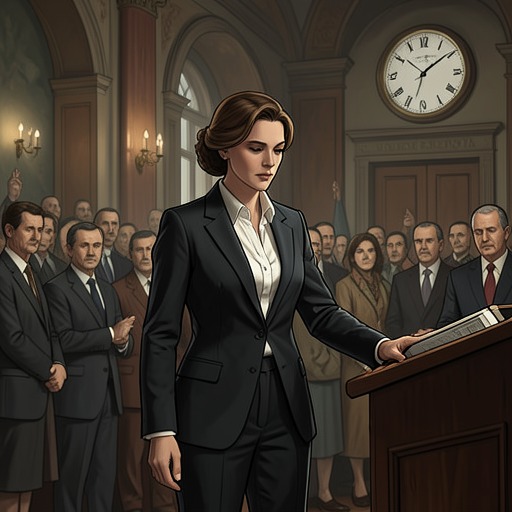
Chaim carries this confrontation directly into the West Bank settlement of Pisgat David. Judah expects a militarized frontier of tents, guard towers, prefab buildings, and barbed wire, but finds a suburban landscape of red-roofed houses, garages, lawns, and children playing American football. The settlement’s ordinary appearance makes the political dispute more unsettling: occupation is not presented as an abstract border but as a lived residential environment, materially comfortable and socially normalized. Chaim speaks to roughly 1,000 people in a packed theater. He first wins laughter with jokes and Holocaust stories, then turns the crowd silent and tearful before telling them that their actions are creating perpetual war, corrupting Jewish culture and memory, and producing a permanent occupation. He compares their project in the territories with Hitler’s ambitions, deliberately provoking the dialogue he claims to seek.
The speech makes Chaim vulnerable to charges from opposite directions. His theology already angers religious opponents because it imagines a God who wants to help but lacks unlimited power; his political statement gives secular officials and nationalist activists another reason to regard him as dangerous. Charlie later identifies both political and religious extremists as possible enemies, citing Chaim’s opposition to the Lebanon War, his condemnation of the occupation, the Pisgat David speech, his criticism of religious authority, and the heresy accusations surrounding his book. The war thus expands the list of people who might resent Chaim, while also encouraging a misleading theory that his death must have been a political assassination.
Military Experience and the Burden of Memory
The war’s most intimate meaning emerges through Yoav Lerner’s account of his military service. Yoav describes an army culture in which children may throw stones from behind buildings and then appear to be connected to live fire. Soldiers are ordered to return fire when they face bullets, yet the available targets may still be children. The conflict turns the rules of self-defense into a moral trap: refusing to shoot can leave soldiers exposed, while shooting can kill those who appear to be combatants but are not.
Yoav recalls one attack from the rear. He crouches behind his shield against stones, then hears gunfire and an order to return fire. His driver does not hear the order, but Yoav believes he does. He rises from beneath his seat and fires two continuous rounds at what he thinks are two Hezbollah fighters carrying Kalashnikovs. By what he describes as pure luck, he hits both targets in the chest. Only afterward does he realize that the targets are two ten-year-old boys, ununiformed and unarmed. The incident becomes the concrete center of the war’s effect on his family: military procedure, fear, imperfect perception, and personal responsibility converge in two deaths that cannot be reduced to either intentional murder or an uncomplicated accident.
Yoav’s parents had taught him before enlistment that if his life seemed threatened, he should shoot even without absolute certainty and face the consequences later. The advice reflects a culture of survival shaped by historical persecution, but the war exposes its terrible cost. The instruction guarantees immediate self-preservation only by postponing the moral consequences. Yoav survives, and the army eventually clears him of responsibility, but the official decision comes after Chaim’s death and cannot undo what Yoav saw or what Chaim imagined.
For Chaim, the Lebanon War is not an operation that can be assessed objectively or strategically. It becomes a reversal of the historical roles embedded in Holocaust memory: Israel, once imagined as David confronting Goliath, appears to him as Goliath, or worse. Sabra and Chatila, the shooting of children, and the possibility that Jewish soldiers have become agents of violence against the vulnerable enter his recurring nightmare. In that dream, he becomes a Nazi colonel in the Israeli army who hunts and murders Arab children; the nightmare then shifts a generation, making Yoav the child-killing figure and Chaim the witness who cannot survive the identification. The war’s decisive damage is therefore transmitted through memory: the father’s Holocaust trauma is reorganized around the son’s alleged guilt.
Responsibility, Representation, and the Politics of Witness
The war also becomes a contest over the language of responsibility. Yoav’s account distinguishes between firing the shots, issuing or failing to hear an order, misidentifying targets, and later accepting or denying blame. The same problem appears in the discussion of Sabra and Chatila. Charlie’s father, Chaim, reads conflicting reports: some initially claim that Israeli forces perpetrated the massacres, while others say that Israel allowed them to happen. Yoav insists that the more precise moral fact is worse than either simplified formulation. Israeli forces did not carry out the killings, but they stood by while allied Phalangist soldiers murdered civilians in the camps. The distinction between direct perpetration and nonintervention remains legally and morally significant, yet the narrative refuses to treat nonintervention as innocence.
Yoav reconstructs the massacre through the sounds and aftermath experienced by his unit. Soldiers heard gunfire, Arabic commands over a loudspeaker, and what sounded like children screaming. The following day they found that hundreds of civilians had been killed, including mothers, babies, and children. Israeli troops then entered the camps, disarmed Phalangist soldiers, and forced them to stop. The chronology matters: the Phalangists halted when they learned that Israeli forces were coming, rather than because Israeli troops had physically interrupted the killings at the moment they occurred. This sequence allows competing accounts to manipulate responsibility by changing the order of events, turning a belated intervention into an immediate rescue or converting military presence into direct authorship of the massacre.
Chaim’s response is not presented as a simple conversion of victim into perpetrator. Yoav rejects the idea that his father killed himself merely because of Palestinian suffering or collective Israeli guilt. Instead, he says that Chaim killed himself because of him: because the Lebanon War made Yoav’s killing of the two boys, and the father’s own Holocaust nightmares, impossible to separate. The war therefore operates through a chain of mediated knowledge—reports, military testimony, family memory, and political interpretation—rather than through one stable public account.
Family Conflict and Personal Consequences
The invasion transforms the relationships within the Lerner family. Michal opposes the war, and her anger intensifies when Yoav applies for officer training, since the decision would involve him more deeply in the conflict. Their argument ends with Michal hanging up, after which she begins a relationship with Judah Loeb. Later, Zehava tells Michal that Yoav has shot two ten-year-old boys in northern Lebanon and has been admitted to a military psychiatric ward in Haifa. Zehava repeatedly asks Michal to visit him, invoking the maternal bond she has always claimed with Michal. When Michal finally goes, the war reopens the relationship she believed had ended.
Yoav’s military experience also becomes part of the explanation offered for Chaim’s death. Chaim is described as haunted by the Lebanon War, unable to view it as a limited operation against a terrorist organization. The war instead makes him see Israel as the stronger party and forces him to confront the possibility that his own son has participated in the killing of children. Yoav believes that Chaim’s recurring dream of becoming a Nazi colonel in the Israeli army has escaped the realm of nightmare and entered reality through him. Although the army later clears Yoav of responsibility, that official finding arrives only after Chaim has fallen from the balcony. It cannot restore the father, erase the deaths, or release Yoav from the belief that he caused the suicide.
Other explanations remain in circulation. Michal points to Chaim’s post-traumatic stress, injured leg, chronic pain, and depression, as well as the exhaustion produced by his final book about God. Judah considers disappointment with Israel and Chaim’s condemnation of the war as possible causes. Yet Michal eventually refuses to keep interpreting the death, saying that the living have to continue with their lives. The war thus remains both central and unresolved: it is a plausible political cause, a source of physical and psychological damage, and the background against which the family’s private guilt takes shape, but it does not yield a single final motive.
Political Uses of the War
Chaim’s condemnation of the invasion makes his death appear politically legible. Judah and Charlie consider political extremists, religious extremists, and nationalist groups that might have opposed his theology, his criticism of the occupation, or his public statement on Lebanon. Charlie argues that a political murder would normally announce its purpose, whereas throwing Chaim from his own balcony and making the death resemble suicide is too intimate and too subtle for a conventional act of terrorism. The war therefore generates a persuasive but ultimately misleading field of suspects.
The political right frames the conflict in opposite terms. Chaim’s critics describe him as a defeatist leftist who knows nothing about Hezbollah, the Shiite communities on the northern border, or the alliance between Fatah and the ayatollahs. From that perspective, the invasion must be completed, the Golan and the territories must be annexed, and withdrawal would merely feed further attacks. The language of homeland protection converts territorial expansion and military force into necessities, while the language of peace treats those same commitments as obstacles to ending the conflict.
Zehava later uses the war’s continuing political stakes to defend the concealment of Chaim’s death. By then she has become a leading opposition figure and is about to enter government while negotiating with the Palestinian Authority. She tells Judah that revealing her role could damage her character, destroy public trust, and cause peace efforts to collapse. Charlie confirms that she wrestled Chaim away from the balcony and killed him, but accepts her claim that she acted in self-defense. He also accepts the political argument that prosecuting her could destroy a rare opportunity for peace. The logic that once protected military inaction at Sabra and Chatila is echoed in a new form: truth and accountability are deferred because larger national consequences are said to be at stake.
Aftermath and Historical Significance
The war’s consequences extend beyond the original invasion. Chaim’s planned condemnation becomes one of the motives that investigators and journalists use to construct theories about his death, even though the final disclosure shifts the cause toward family violence and inherited trauma. The investigation repeatedly risks turning political history into a detective mechanism: the Lebanon War supplies enemies, ideology supplies motives, and the balcony supplies a mystery. The eventual truth does not remove the war from the story; it shows how public violence enters private life without necessarily producing a politically organized murder.
Years later, the London Israeli–Palestinian peace talks briefly suggest that the conflict might be negotiated. Israel offers roughly 95 percent of the West Bank, while the Palestinians demand the whole territory with minor adjustments to accommodate most Jewish settlers; Pisgat David appears on the Palestinian side of both maps. The territorial gap seems manageable, but disputes over Jerusalem, Palestinian refugees’ right of return, recognition of Israel as a Jewish state, the connection between Gaza and the West Bank, and Hamas cause the talks to collapse within a week. The war’s unresolved territorial logic survives the negotiations, while the settlement landscape remains one of the material forms through which that conflict is reproduced.
The later history is not a peace settlement but a continuation of violence in altered forms. Suicide bombings diminish as Israel builds the West Bank barrier, yet Hamas missiles and incendiary kites from Gaza are followed by Israeli bombs, tanks, and new settlements. Violence continues in the West Bank and inside Israel itself. Charlie is eventually killed by a terrorist bomb outside the Russian Compound, a death that links the political world he served to the same cycle of violence he once tried to interpret. Israeli invasion of Southern Lebanon therefore ends neither with a clean military resolution nor with a stable moral verdict. It remains the event through which the book tests the boundaries between combat and occupation, intervention and bystanding, memory and guilt, and the promised peace that can itself become an argument for postponing justice.