Judah Loeb–Hannah Loeb relationship
Here There Is No WhyThe relationship between Judah Loeb and Hannah Loeb is a father-daughter bond formed under the pressure of an early, devastating loss and sustained through years of grief, care, and things left unsaid. After Hannah finds her mother, Mary Loeb, dead by suicide, Judah’s collapse makes him temporarily unable to care for her; in later years, his daughter’s brief messages and pointed questions expose how much their shared history remains present even when neither has spoken of it openly.
Loss and the rupture of childhood
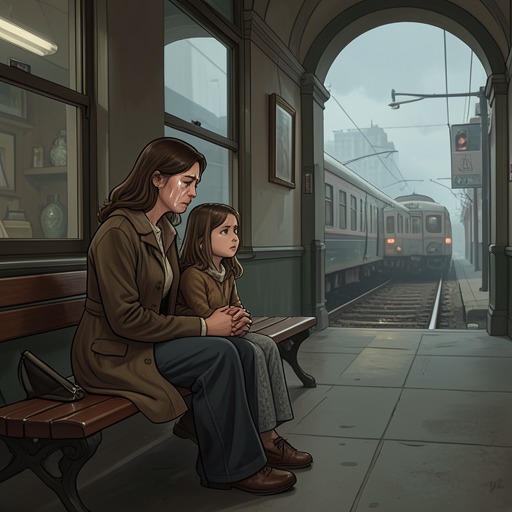
Hannah was five when Judah brought her home early from kindergarten because she had an ear infection. She found Mary’s hanging body and screamed for her father. Judah remembers the scene through specific details: Mary’s tan yoga pants, the Bruce Springsteen shirt he had bought her, and her wedding ring still on a swollen, blue finger. His account makes Hannah’s childhood loss inseparable from his own memory of finding his wife, while also establishing that Hannah encountered the death directly, before she was old enough to understand it as an adult might.
Judah says that he fell apart after Mary’s death, drinking himself into a haze every night for eight months. Hannah’s aunt Ilana and Ilana’s husband Stan took the child from him before his condition could cause irreparable harm. Ilana brought Judah to rehabilitation three times and later helped him and Hannah settle in with her family in Scarsdale. For a year, the household included three adults and four children. Ilana organized the practical work of recovery—making sure Judah showered, dressed, and reached his job at The New York Times—and walked him to the train station because she feared he might get lost. She also took Judah and Hannah to therapy appointments. Their bond was thus protected by a wider family network: Judah remained Hannah’s father, but for a time his sister supplied much of the stability he could not provide.
Childhood care and silence
Judah worried that Mary’s death would become a delayed crisis in Hannah’s life. When Hannah’s sixth-grade mathematics grade slipped from an A to a B, he took her to a therapist, listening for signs that the trauma had begun to surface. The therapist told him that Hannah appeared healthy and well-adjusted, and suggested that being five had allowed her to assimilate the tragedy; she barely remembered her mother. Judah, by contrast, was the one the therapist considered more vulnerable after the loss of a spouse and the circumstances of Mary’s death.
The apparent absence of questions did not reassure Judah. Hannah had not raised the subject of her mother’s suicide with him, Ilana, or her cousins, and her therapist said that she seemed to have little curiosity about why Mary had died. Judah wondered whether that detachment was normal, but the evidence gives no simple answer. He was attentive to the possibility of hidden damage while also choosing, at least in one moment, not to press her: when he saw Hannah focused on her laptop during his trip to investigate Chaim Lerner’s death, he considered raising the subject of suicide and then let it go. Their silence was not proof that the past had disappeared; it was a condition Judah watched anxiously without knowing how to interpret.
Growing up beside her father’s past
Years later, Hannah accompanies Judah to Israel. On the flight, she wakes him by gripping his wrist and tells him that she is not a Zionist. The declaration surprises him, but their exchange soon turns toward the history closer to home. Hannah asks whether he had ever thought of killing himself. Judah answers that he had not, recalling both the moment she found Mary and the months when his drinking left him unsure of his ability to parent. Hannah replies that she has not considered suicide either, then returns her attention to the screen. The conversation is brief, but it breaks a silence that had lasted for years: father and daughter acknowledge the possibility of self-destruction without turning the exchange into a full explanation.
At the airport, Hannah and Michal greet each other with an intensity that surprises Judah. Michal hugs Hannah tightly, and Hannah returns the embrace; the two seem already close. The contrast is notable within the father-daughter relationship: Hannah remains physically close to Judah as they walk through the airport, as if afraid of being separated, but then steps away to reach for the car door. Judah’s account registers both her lingering attachment to him and the independent connections she has made beyond him.
During the investigation, Hannah also becomes a listener and questioner in a story Judah cannot control. As Yoav Lerner describes killing two ten-year-old Lebanese boys and connects the event to his father’s suicide, Hannah asks where Yoav was on the night Chaim died. Her question directs attention from Yoav’s account of inherited guilt to the circumstances of the death Judah came to investigate. The evidence does not show Hannah resolving that mystery, but it places her inside the inquiry as more than a child accompanying her father: she listens closely enough to ask for the missing fact.
Adult candor and unresolved questions
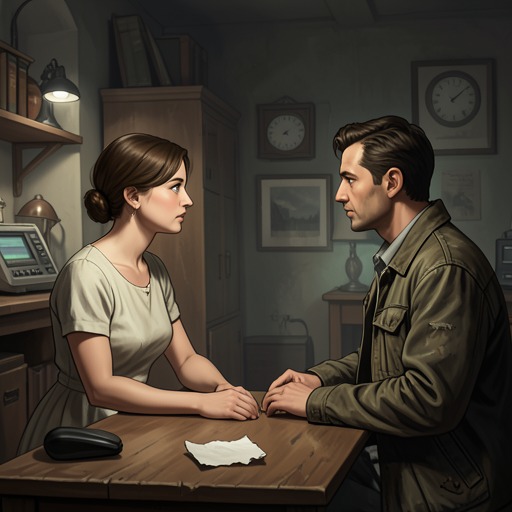
The closeness between Judah and Hannah eventually makes room for disclosures about his life after Mary’s death. Judah tells Hannah that Michal came to New York a few times a year and that their relationship was mostly sexual, though it meant something to him and no longer meant what it had once meant. Hannah then asks whether the relationship had also taken place while Judah was married to her mother. Judah shuts his eyes and cries. He recalls that after Mary’s suicide he could cry easily, but that stopping was the problem; in this exchange, he manages to steady himself enough to confide in his daughter, yet her question brings him to tears again. The supplied scene ends before he answers whether he was unfaithful during the marriage, leaving the disclosure unfinished rather than converting it into a settled confession.
That unfinished exchange echoes the larger pattern of the relationship. Hannah’s questions are direct, but they do not guarantee a complete answer; Judah’s memories are detailed, yet his grief and guilt sometimes interrupt his speech. Their bond has endured the consequences of Mary’s death and Judah’s period of addiction, but it is not presented as a simple story of recovery or reconciliation. It becomes more candid as Hannah grows older, with her brief text about a funeral and her later questions making the past newly present. In the relationship’s most consequential moments, a small gesture—a wrist held on an airplane, a question asked in a room, a hand squeezed three times—opens a conversation that the two have not yet finished.