Judah Loeb–Mary relationship
Here There Is No WhyJudah Loeb and Mary Loeb’s marriage joins companionship and family devotion to a silence that becomes more consequential as Mary’s cancer advances. They share years of ordinary life and a daughter, Hannah Loeb, but cannot bring themselves to discuss the death they know may be approaching. After Mary dies by suicide, Judah’s memories of their marriage become part of his effort to understand her, his own failures of intimacy, and the limits of asking why.
Marriage and shared life
Mary is Judah’s wife and Hannah’s mother. Their marriage is presented less through its beginnings than through the life they built together: professional work, parenting, travel, and the private stories they shared. When illness temporarily recedes, the couple take trips that their earlier busy lives had rarely allowed. Mary accompanies Judah on reporting assignments to the World Cup in Barcelona, the Super Bowl in Dallas, a Bob Dylan concert in Paris, and an interview with Salman Rushdie in Bombay. They also go snorkeling in Cozumel and skiing in Vail, with Ilana caring for Hannah during their vacations. The trips are a concentrated period of pleasure and renewed closeness, though their expense nearly exhausts the couple’s savings.
Mary’s interest in visiting Israel brings one of Judah’s concealed histories close to their shared life. She notices his calls to friends there and asks why they have not gone. Judah declines, saying they have plenty of time. He has not told her the full story of his past with Michal or of the Jerusalem connections that include Chaim Lerner, Zehava Lerner, and Yoav Lerner. Their marriage therefore contains a boundary: Mary knows that Michal was part of Judah’s earlier life, but does not know the whole story or how profoundly that past continues to shape him.
Cancer and the narrowing of intimacy
The cancer diagnosis follows Judah’s discovery of a hard nodule in Mary’s breast on their wedding anniversary. He urges her to have it examined and eventually arranges for her family doctor, Mary’s college roommate, to confront her after work. Tests confirm cancer. At first, Judah believes the disease is treatable, and both spouses expect that surgery and chemotherapy will mean a longer recovery rather than the end of their shared future. Mary undergoes a radical mastectomy and chemotherapy; after treatment, she travels with Judah and appears to regain her energy, although he notices small signs of fatigue that he explains away.
When the cancer recurs, the atmosphere changes. Mary understands the medical odds and discusses her case with doctors who are also friends and colleagues. Judah accompanies her to appointments, but the clinical language he can follow consists largely of recurrence, malignancy, staging, and metastasis. Mary makes notes on the rides home and speaks about her case with relatives in medicine, while sharing less of her illness with Judah than with Ilana. The difference is not simply a lack of care: Judah is present at the appointments, but he experiences their medical discussions from the edge of a world Mary can inhabit more fluently.
As the illness worsens, Ilana moves in to help with housework and childcare. Mary continues working, spends evenings watching television with the family, and enrolls in a clinical trial. Judah later resists describing her only through despair or hopelessness. He remembers her as conserving energy, researching her disease, and continuing to work and care for Hannah as far as she could. That account captures both her activity and the couple’s mistaken sense that there was still time.
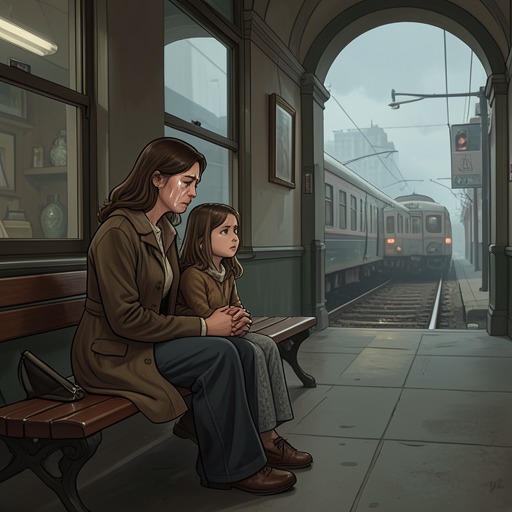
Their marriage nonetheless contracts. Mary stops initiating dates, sex, and conversation; their exchanges become practical requests about errands and the household. Judah understands that genuine communication would require them to discuss her death, but neither is able to begin that conversation. In his later account, their silence is mutual, not a settled agreement: both give up on the kind of talk that might have made their fear speakable. Mary also becomes less present in Hannah’s daily care. Ilana or Judah reads to the child at night, while Ilana takes on meals, school pickups, activities, and Saturday synagogue visits. Mary gives no objection when Ilana brings Hannah to synagogue, although she had previously been a committed atheist.
Bereavement and the return of the past
Mary dies by suicide after Hannah, then five, finds her body at home. Judah remembers the details with painful precision: Mary is wearing tan yoga pants and the Bruce Springsteen T-shirt he bought at a concert five months earlier, shortly before the diagnosis that altered their lives. Her wedding ring remains on her swollen finger. The image becomes an enduring wound, and Judah falls into heavy drinking for eight months. Ilana and Stan take Hannah into their care and help Judah enter rehabilitation; afterward, Judah and Hannah live with them in Scarsdale for a year.
Judah’s understanding of the marriage is complicated by the absence of a note. At first, he assumes that Mary’s illness explains her decision and that no further explanation is necessary. Years later, while putting Hannah to bed, he begins to question that assumption. He remembers Mary’s apparent cheerfulness during treatment, her jokes through chemotherapy, new activities, and outward warmth, and recognizes that he had taken those signs as evidence of courage and a determination to live. In retrospect, he believes that her sunny manner concealed something, but cannot say exactly what. His uncertainty does not erase his memory of her vitality; it makes that vitality harder to interpret.
As Mary’s death returns to him, Judah also revisits his earlier attachment to Michal. In a conversation with Mary during her illness, he had described Michal as his first love and Mary as the love of his life, trying to distinguish youthful longing from adult serenity. He also described the relationship with Michal as an adventure. Mary’s questions about his romantic past lead him toward memories of the Lerners and Chaim Lerner’s death, a story he had not told her in a way that challenged the accepted account of suicide. Judah later suspects that Mary’s interest in these stories may have been connected to her own thoughts about suicide, but this remains his retrospective interpretation rather than something she disclosed to him.
Confession, note, and the unresolved question
After Mary’s death, Judah resumes a sexual relationship with Michal, who visits New York several times a year. He tells Hannah that the relationship mattered, though not as it once had, and admits that he was unfaithful to Mary once while they were married. He breaks down while answering. Hannah forgives him and says she believes Mary would forgive him too; her questions reveal that she has been investigating her parents’ history as well as the deaths that led Judah to Israel. Their exchange exposes a painful asymmetry in the marriage’s aftermath: Judah has carried his past as a private burden, while Hannah has grown up piecing together what her parents could not tell each other.
Twenty-seven years after Mary’s death, Hannah gives Judah a folded note dated May 11, 1995, the day she found her mother. Addressed to Judah and Hannah, it apologizes for the hurt Mary’s action will cause, asks them to be strong for and help each other, and closes with an expression of love. Judah returns the note to Hannah, observing that Mary had not meant for her to find it. The message offers tenderness and an appeal to family solidarity, but it does not explain why Mary believed suicide would make things easier for them. Judah reacts with anger and presses the unanswered question; Hannah responds that why was never the right question. The marriage’s lasting significance lies in that unresolved exchange: the note confirms Mary’s love, but neither love nor the fact of her illness can make her decision fully intelligible to those she left behind.