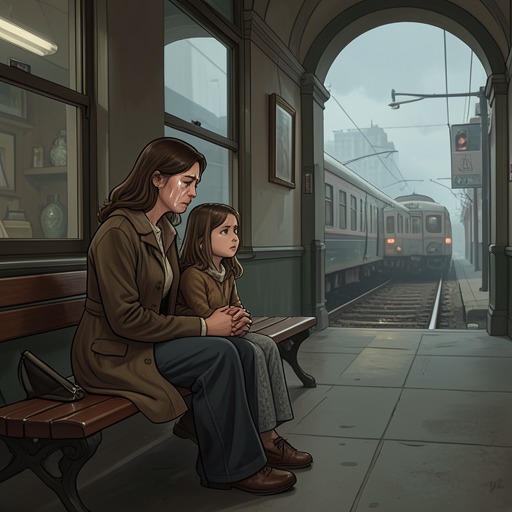
Kamal
Here There Is No WhyKamal is a Palestinian prisoner whose failed suicide bombing gives the novel one of its clearest examinations of how political violence is made meaningful by the person who commits it. His account does not absolve him: he deliberately sought to kill civilians, understood that they were innocent, and describes his own act as cruel and wrong. Yet the recorded interview also breaks apart the simple identity of “terrorist,” revealing a young man shaped by inherited displacement, poverty, rage, family expectation, financial incentive, religious language, and the wish to make an insignificant life matter.## Identity and BackgroundKamal comes from Dahaisha, the refugee camp where he lives, near the Israeli city he selected as his target. His grandparents had lived in Sylia, an Arab village north of Hod Hasharon, before being expelled during the Nakba. His grandfather lost his place at Cairo University’s medical school because refugee status prevented him from continuing his education; he later worked as a janitor at a Christian school in Ramallah and died young, a death Kamal understands as a heart attack and a broken heart. This family history turns political dispossession into intimate inheritance: the grievance is not an abstract account of the past but a story attached to a grandfather whose abandoned future helps organize Kamal’s anger.The interview presents Kamal as thin, olive-skinned, clean-shaven, and handcuffed on a concrete bench. His physical restraint contrasts with the dramatic force of his speech. He modulates his voice as though chanting a sacred text and moves his bound hands rhythmically while describing the planned attack. Michal translates his Hebrew answers for Hannah, producing a layered testimony in which Kamal speaks, Michal filters, and the camera preserves the performance for later judgment.## The Failed BombingKamal chose Sbarro’s in Hod Hasharon as his target, intending to blow himself up and kill as many Jews as Allah allowed. He concealed his purpose from his parents by claiming that he was going to visit his fiancee, Milah, in Jenin, although his family could hear him reciting martyr verses at night and saw him becoming increasingly consumed by rage. They also noticed the bulky coat he wore in November, which concealed the bomb.He traveled by car to Ramallah, was smuggled into South Tel Aviv in the trunk of a van, and then took a public bus. At the restaurant entrance, a passing soldier noticed him and began speaking to him in a friendly manner while frisking him. The soldier touched Kamal’s left side, while the bomb’s trigger was on the right. Kamal reacted instantly, reaching toward the trigger. The soldier understood what was happening, embraced him, and dragged him away from the restaurant. As they wrestled on the ground, the soldier told him that they would both die there but that Kamal would not enter the restaurant.Kamal reached past the soldier’s forearm and pulled the trigger. Nothing happened. He pulled again, and still nothing happened: the bomb was a dud. In Kamal’s own interpretation, God had prevented the deaths of the people in the restaurant, the soldier, and Kamal himself. The failed mechanism transforms the planned massacre into an arrest and a testimony, but it does not erase the intention behind it. The moral fact remains that Kamal went to kill civilians, and the later interview forces that intention to remain visible even as it investigates its causes.## Motives, Meaning, and Political SpectacleKamal first describes revenge as his motive, but revenge is only one layer. He dismisses the promise of heavenly virgins, saying that the religious reward meant little to him. Money mattered more: Hamas would pay his family enough, perhaps, to leave the camp and move to Ramallah, London, or Detroit. Religion also supplied a possible justification, since he could tell himself that he was following Sharia and that God might be pleased, but he does not present religious obedience as the central explanation.His deepest stated motive is significance. He felt trapped in a muddy, unpleasant refugee camp, poor and unable to live a meaningful life for his people. Death seemed to offer the only available route to importance, even if achieving that importance required his own death and the deaths of innocents. He knew the intended victims were not the oppressors, yet he imagined their deaths as a message addressed to the entire world, including America, Russia, China, Egypt, Syria, and Israel. The attack was therefore both murder and communication: a violent attempt to force distant audiences to recognize Palestinian desperation.Kamal also describes the recorded statement made before such attacks. The perpetrators explain their goals in the expectation that children in China, Muslims in Indonesia, and people everywhere will see the video and come to their defense. He calls this expectation narcissistic and mad, but also identifies it as the reason for the violence. The bomber does not merely seek destruction; he seeks an audience large enough to turn private insignificance into public meaning.## The Confession and Its Ethical ReversalThe interview becomes especially significant when Kamal objects to Michal’s decision not to translate part of his answer. She had dismissed his omitted words as an unimportant correction, but Kamal insists that the missing material matters. He says that suicide is cowardly, cruel to the family, selfish, and wrong. The assertion is awkwardly expressed but morally direct: he refuses to let the record preserve only the grand political explanation while concealing his condemnation of his own act.Hannah responds sharply because the confession touches her mother Mary Loeb’s suicide. Kamal’s bombing would have killed fifty innocent people, whereas Mary killed only herself, and Hannah insists that the two acts cannot simply be equated. Kamal’s significance in the novel lies partly in this distinction. He is not offered as a parallel that makes every suicide identical; rather, his testimony exposes how the word “suicide” can conceal radically different relations to victims, family, responsibility, and public meaning. His insistence that his own planned act was selfish and cowardly complicates the heroic language of martyrdom without turning him into an uncomplicated penitent.## Kamal and the Novel’s Larger ArgumentKamal’s story echoes the novel’s concern with the danger of compressing human beings into moral or political labels. Other characters describe Chaim Lerner through competing categories: Holocaust writer, arrogant monopolist of the Shoah, possible suicide, or victim of the Holocaust’s delayed wound. Yoav Lerner attacks journalists for replacing facts with theories, while the investigation into Chaim’s death moves from an apparent suicide toward the hidden circumstances of Michal’s struggle with him. Against this background, Kamal’s confession supplies another case in which the first label is inadequate but cannot be discarded. He is a prisoner, a would-be murderer, a product of historical dispossession, a manipulator of public attention, a son whose family might profit from his death, and a speaker capable of naming his own cowardice.The novel also places Kamal beside the argument that Chaim may have been the “six million and first victim,” a Holocaust writer destroyed by the burden of seeing and narrating horror. Kamal’s violence is not Holocaust testimony, but both figures are connected through the question of how historical catastrophe is converted into identity and action. Chaim turns unbearable history into literature; Kamal turns inherited grievance into a planned spectacle of death. In each case, the narrative asks what happens when suffering is made to carry the entire burden of a life.The recorded interview further creates a formal distance between Kamal’s performance and the reader’s judgment. His words arrive through a video, Hannah’s questions, Michal’s translation, and Judah’s retrospective narration. That mediation prevents the confession from functioning as transparent access to motive. Kamal is speaking to a camera, to his interrogators, to his family, to an imagined global audience, and to the people he intended to kill. His testimony is therefore both evidence and self-presentation: it reveals his motives while showing how urgently he wants those motives to become a public message. In that tension, Kamal becomes one of the novel’s sharpest studies of the distance between an act, the story told about the act, and the meaning an individual hopes death will impose.