Michal’s killing of Chaim
Here There Is No WhyMichal’s killing of Chaim is the accidental act in which Michal, defending herself from her father-in-law’s sexual assault, pushed him against the balcony railing and caused his fatal fall. The death was publicly understood as suicide, but its concealed circumstances become the decisive answer to the investigation: Chaim’s injured knee, the geometry of the railing, the neighbors’ testimony, Michal’s dislocated arm, and her strange one-armed farewell hug all point toward a struggle rather than a deliberate jump. The event also reveals how Chaim’s authority as one of Israel’s great minds had enabled his abuse to remain unseen, while Zehava’s protection of Michal turned an accidental death into a family secret and a political risk.
Abuse Before the Fall
Michal’s confrontation with Chaim was the culmination of a long pattern of boundary violations rather than an isolated encounter. When she was a teenager, Chaim had touched her improperly, then kept his distance for three years while she grew closer to Yoav and to Zehava, who treated her as the daughter she had never had. After Michal entered university, Chaim resumed his advances under the cover of intellectual intimacy. He called her his colleague, shared philosophical and theological writing with her, and incorporated her comments into published work. The respect and attention flattered her, especially because they made her feel valued by a major thinker, but the relationship remained structurally unequal: he was her teacher and an older family authority.
Around the time of Yoav’s traumatic service in Lebanon, Chaim’s conduct became openly aggressive. He touched Michal while she discussed her thesis and kissed her without consent. Over the following months she learned to duck his kisses, remove his hands, and treat the encounters as an absurd game, hoping that he would lose interest. Instead, he groped her even when others might have noticed, rode away on her bicycle so that she would have to retrieve it from him, and grabbed her clothing as she left class. The surrounding people either failed to intervene or chose not to acknowledge what they saw. The event therefore grows out of accumulated violence, social indifference, and the absence of a language of accountability; the period was explicitly not the #MeToo era.
The Balcony Struggle
The immediate setting was Zehava’s apartment on a night when Zehava invited Michal to share wine from the Golan and planned to look at wedding dresses with her the next morning. Zehava briefly went to her office to take a telephone call, leaving Michal on the living-room sofa. Chaim appeared, took the bottle, drank deeply, and spoke in a subdued voice so Zehava would not hear. He presented himself as repentant, saying that he had behaved terribly and needed to stop, and asked Michal to join him on the balcony for a private conversation. Because she was exhausted by their pursuit-and-evasion pattern, she accepted the supposed apology.
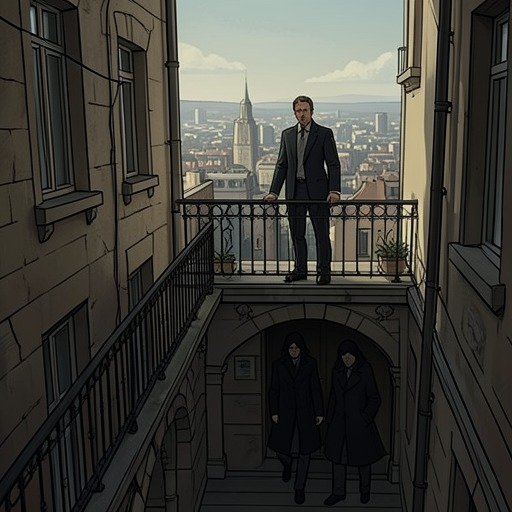
Once the balcony door closed, Chaim attacked her. He pulled her into an embrace, kissed her forcefully, and touched her breast. Michal shoved him away with her right arm. Chaim seized her left hand to steady himself, twisting it and wrenching the arm from its socket. The pain caused her to draw back her right arm and push hard against his chest. Chaim stumbled backward, struck the railing, and for a moment balanced with his back on its top rail. He looked at Michal, reached toward her, said, “Whoops,” and went over the railing, landing on his head. The sequence is presented as a defensive reaction under extreme pressure, but its result is irrevocable: Chaim is dead, and Michal has become the accidental killer of the man who had been assaulting her.
Evidence Against Suicide
The physical scene later challenges the official appearance of suicide. At the Lerner home, Hannah studies the dark metal railing and the dirty white balcony floor while Judah and Michal remain back, frightened or respectful of the place where Chaim crossed the boundary between concrete and air. The railing consists of four rusting metal bars, approximately neck-high for a medium-height man. Hannah argues that Chaim could not have climbed over it with his injured knee. Judah initially finds the climb difficult but not impossible, preserving the uncertainty that had allowed the suicide explanation to survive.
The auditory evidence narrows the possibilities. Five neighbors heard a body fall at 7 p.m., a heavy thump preceded by someone saying “Whoops,” which they recognized as Chaim’s voice. The witnesses consistently confirmed the time, while two witnesses placed Michal and Zehava away from the apartment. The first account appears to eliminate the family, but the later disclosure changes the meaning of those alibis: Michal and Zehava had claimed they were shopping for a wedding dress, and the police had received a receipt from Rafik’s Boutique in the Arab Market of the Old City.
The receipt bears the date May 5, 1983, and the time 19:00. It establishes that Michal and Zehava were purchasing the dress at the hour associated with the fall, apparently confirming both women’s alibi. Yet the investigation’s chronology also contains a discrepancy: the neighbors’ account places the bump at 18:30, while the receipt records 19:00. That documentary contradiction helps reopen the case. The wedding-dress purchase, once a reassuring piece of evidence, becomes part of the mechanism by which the truth was hidden.
The Delayed Recognition
Judah does not understand the truth immediately. When he first encountered Michal after Chaim’s death, she had just found the body beneath the balcony and rushed to embrace him. He remembered that the embrace felt almost like that of a lover, but it was performed with only one arm. He also saw her wince. At the time, consumed by his own heartbreak and unable to think beyond his departure from Israel, he treated the gesture as an awkward expression of friendship rather than evidence of injury.
Years later, the memory becomes legible. Michal confirms that her left arm had been dislocated during the struggle and that Zehava restored it to its socket five minutes later, drawing on a skill remembered from early motherhood. By the time the police arrived, Michal appeared fine. The bodily trace that had briefly escaped concealment thus becomes the key to the event: the one-armed hug was not merely emotionally strange but mechanically consistent with the assault and the defensive push.
Judah’s recognition is also shaped by the wider pattern of Chaim’s conduct. Once Judah learned about Chaim’s relationships with women and young students, he concluded that Michal had been one of the women who resisted him. He had initially hoped that Zehava, rather than Michal, was responsible, but the recollection of the injured arm made Michal’s involvement clear. The discovery is therefore forensic and ethical at once: the case is solved not by a confession at the scene, but by reading a suppressed bodily fact against the public story of suicide.
Concealment and Consequences
Zehava’s response prevents the death from becoming an immediate public scandal. She repairs Michal’s arm, supports the alibi, and helps preserve the interpretation that Chaim died by suicide. Her protection is deeply personal because she had become a substitute mother to Michal, teaching her domestic and feminine skills and telling her that she was the daughter she had never had. It is also politically dangerous: Zehava was already an important political figure, and exposing the circumstances of Chaim’s death could have threatened her reputation, freedom, and public work.
The concealment alters every later understanding of the death. Chaim had been an acclaimed thinker, a writer on theology and war, and a man whose supposed suicide could be folded into the familiar cultural narrative of a Holocaust survivor overwhelmed by history. The hidden reality is less monumental and more immediate: a powerful man assaulted a young woman on his balcony, and his resistance to her attempt to escape ended in his fall. His reputation does not erase the violence; it helps explain why the violence was difficult to see.
The event also binds Michal, Zehava, and Judah to different forms of silence. Michal carries the knowledge of having caused Chaim’s death while maintaining that it was an involuntary act of defense. Zehava turns maternal loyalty into a cover-up. Judah, after discovering the truth, recognizes that he could expose Zehava’s confession and perhaps have her arrested, yet he understands that she risked everything to protect Michal. The killing consequently becomes not only the hidden cause of Chaim’s death but the moral center of the investigation, forcing the characters to distinguish murder from survival, secrecy from betrayal, and public truth from the truth of a violated body.