Rabbi Kaplowitz
Here There Is No WhyRabbi Kaplowitz is the elderly rabbinic authority whose relationship with Chaim Lerner joins intellectual combat, affection, warning, and unanswered suspicion. He teaches the Zohar in a private chamber beneath the Western Wall, where arguments about divine names and suffering become a living model of Jewish inquiry. He later survives Chaim, inherits his teacher’s institutional duties, and quietly shapes the spiritual future of Judah Loeb’s daughter Hannah. His significance lies in this double function: he protects an old tradition of questioning while also appearing to police the boundaries of what may safely be said about God, Israel, and Chaim’s theology.
Identity and Religious Authority
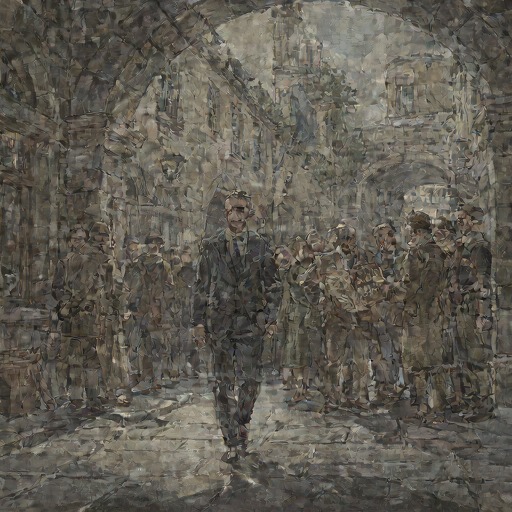
Rabbi Kaplowitz is introduced through the Zohar class held at the Western Wall. The room is small, damp, and enclosed, but its participants include a deputy defense minister, a former finance minister, the director general of the foreign ministry, and the CEO of Bank Leumi. The setting makes religious study inseparable from public power. At exactly seven o’clock, Kaplowitz enters as an ancient-looking man in a long black coat and hat, supported by two younger haredim who also carry his books. Once he sits, newspapers disappear and the room falls silent.
His teaching is not presented as passive reverence. Short Aramaic readings lead to explanations, jokes, questions, digressions, and loud arguments in Hebrew. When Chaim asks a question, Kaplowitz’s students ridicule him, but Chaim answers in kind, shouting like a drill sergeant, singing objections like a yeshiva student, and rolling his Rs like a Yemenite. Kaplowitz eventually pounds his book, calls for silence, and turns toward the ceiling or heavens as if closing the dispute before prayer. The scene establishes his classroom as a disciplined arena in which hostility can remain a form of fellowship.
Kaplowitz’s central lesson concerns the Zohar’s wordplay on divine names. “Mi,” meaning “Who,” becomes a name for the remote aspect of God approached through the stars and the natural world. “Mah,” meaning “What,” names the aspect of God close to human hearts and souls. For Kaplowitz, God’s name is therefore a question rather than a settled answer: asking who created the universe or what can comfort the suffering person becomes a form of spiritual inquiry. The theology turns questioning into devotion and makes uncertainty part of religious life.
The lesson also offers a theory of healing. If suffering is severe, Kaplowitz teaches, the divine element already within the sufferer rises to the rescue. That part of the self remains untouched by pain, and persistent questioning helps a person discover it. The idea links mystical study with modern therapeutic language, but it also carries particular weight because Chaim is a Holocaust survivor and theologian whose work is organized around suffering, divine absence, and the limits of God’s power.
Relationship with Chaim Lerner
Kaplowitz is one of Chaim’s favorite teachers, yet their bond is marked by public opposition. Chaim has studied with the group for almost two years, and Kaplowitz is described as a friend even while the rabbi’s circle attacks Chaim’s views. The disagreement is understood as a makhloket, a disputation for the sake of heaven: argument is not necessarily a rupture but a recognized religious practice through which truth is pursued.
The intimacy beneath their antagonism becomes visible after a book talk to Modern Orthodox rabbis. Chaim has publicly argued that God is not all-powerful, a heretical claim that, in his view, explains how divine goodness can coexist with the Holocaust. After the audience leaves, Kaplowitz embraces him, kisses both his cheeks, and whispers a warning. He says that if Chaim continues declaring that God is not all-powerful, God may be forced to show His power. Chaim laughs, treating the remark as a joke; Judah hears it as a threat. The exchange preserves the novel’s uncertainty: Kaplowitz may be teasing an old friend, expressing theological alarm, or communicating something more dangerous through religious language.
The rabbi’s earlier private warning is equally difficult to interpret. After praising Chaim as a good man and a mensch, Kaplowitz pulls Judah’s face down as though to bless him, then whispers, “Be careful.” He repeats the warning and pushes Judah away, telling him that his teacher is waiting. The gesture combines tenderness and coercion. Kaplowitz recognizes Judah as Chaim’s chosen student and says that Chaim has great plans for him, but he also implies that entering Chaim’s intellectual and religious world carries risk.
Kaplowitz’s attachment survives Chaim’s death. He says that he never missed Chaim’s birthday and later reveals that, on the night God took his friend, he walked to Chaim’s house. The confession is accompanied by tears and the explanation that Chaim’s birthday was near. Because the novel investigates whether Chaim died by suicide or was killed, Kaplowitz’s presence at the house becomes a troubling piece of circumstantial knowledge. His grief is genuine, but his unexplained movements place him among the figures whose affection does not eliminate suspicion.
The Son, the Office, and the Inheritance
After Chaim’s death, the narrator discovers that the rabbi he had known as a teacher is also the father of the younger haredi attendant who once served him in the tunnel. That son has become Rabbi Kaplowitz, taking on his late father’s titles and duties. The younger man’s transformation is physical as well as institutional: the formerly tall, dark-bearded attendant now has gray hair, a paunch, and the bearing of a middle-aged haredi, though his clothing and manner remain almost unchanged.
The younger Rabbi Kaplowitz receives Judah warmly, kissing both cheeks and embracing him before gripping his arm and pulling him into an office deep in the tunnel. The office contains a black desk, two computers, a laser printer, a copier, a fax machine, leather couches, a conference table, and numerous chairs. He has another office in Pisgat David as well. Yet he speaks of these resources as though they were a punishment. He says he belongs in the beis midrash with his books, not in a modern administrative space filled with machines. The contrast makes him a figure caught between inherited learning and institutional modernization.
His question about whether Judah has spoken with Meir Alon places him inside the posthumous investigation into Chaim’s life. He knows that Judah is meeting political and religious actors, and his warmth does not prevent him from testing what Judah has learned. The narrator wonders whether Charlie has arranged these meetings merely to expose possible suspects or to reveal the larger ideological forces that may have converged around Chaim’s death. Kaplowitz therefore operates as both source and possible participant in a network of religious authority, political pressure, and concealed motives.
Influence on Hannah and Spiritual Continuity
Kaplowitz’s influence extends beyond Chaim’s generation through Hannah Loeb. Before Hannah leaves Israel, he gives her three thick books, including Returning for the Answer: A Guide to Coming Home for the Young Jew. The gift is directed toward her and, indirectly, toward Judah; Kaplowitz believes the book may be what Judah needs for his spiritual life. The gesture transforms his earlier warnings and investigations into a more constructive act of transmission. He does not simply preserve Chaim’s memory; he offers a text through which the next generation might approach Jewish religious life.
Seven years later, Hannah cites Kaplowitz’s book as her most important religious influence when she applies to rabbinical school. Her movement toward Jewish spirituality is not a simple conversion into the black-hatted world Judah fears. At her senior sermon at Hebrew Union College, she confidently and humorously presents Chaim Lerner’s theology of a God with infinite love but limited power. Kaplowitz’s influence thus helps carry Chaim’s ideas forward through a new institutional setting, where inherited theology is reinterpreted rather than merely repeated.
Hannah initially approaches the book with uncertainty. She does not know exactly what “spiritual life” means, but she likes Kaplowitz and decides to read during the long flight. She distinguishes this new interest from her earlier project on suicide bombers, remarking that at least the book is not about suicide. The line gives Kaplowitz’s gift a precise consequence: it redirects Hannah from an obsession with violent death toward a sustained exploration of Jewish spirituality.
Narrative Role and Ambiguity
Kaplowitz embodies the novel’s recurring refusal to separate care from danger, or faith from argument. His teaching says that questions bring a person closer to God, and his relationship with Chaim is built through disagreement rather than agreement. Yet the same religious world that legitimizes questioning is also capable of warning, exclusion, and threatened expulsion. In the Orthodox reaction to Chaim’s Our Imperfect God, Kaplowitz speaks of forbidding Chaim from attending the seminar and openly discusses excommunicating him. His attachment to Chaim therefore coexists with institutional pressure against the book’s theology.
The later history of the Kaplowitz family preserves this contradiction. The son becomes an administrator surrounded by computers while longing for the study house; he embraces Judah while participating in a system whose boundaries can be hostile; and he gives Hannah books that eventually guide her toward a theology Chaim himself had developed. Through him, religious tradition appears neither as a fixed refuge nor as a simple antagonist. It is an argumentative inheritance, carried through teachers, sons, books, warnings, and acts of affection.
Kaplowitz’s final importance is consequently less a solved role in the mystery than a continuing pressure on its meaning. He is a teacher who insists that God must be approached through questions, a friend who warns Chaim about divine power, a mourner who admits walking to Chaim’s house on the decisive night, and a benefactor whose books help shape Hannah’s vocation. The novel leaves these identities in tension. Rabbi Kaplowitz does not close the question of Chaim Lerner’s death; he makes the question itself part of the spiritual and ethical inheritance that survives him.