Rafik's Boutique
Here There Is No WhyRafik's Boutique is a large shop in the Arab Market of Jerusalem's Old City, remembered by Judah as Michal's favorite store and ultimately important to the investigation into Chaim Lerner's death. Its most consequential object is not a dress but the receipt recording Michal and Zehava's purchase at the hour when Chaim fell from his balcony. The boutique therefore stands at the intersection of romance, evidence, memory, and political geography: a place of wedding hopes that becomes a test of whether an official alibi can bear scrutiny.
Setting and Appearance
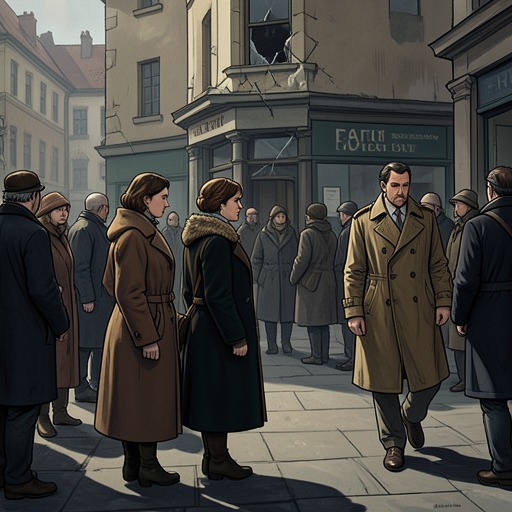
Rafik's Boutique stands beyond Damascus Gate in the Christian Quarter, reached by passing fruit and vegetable stalls, leather goods, butchered calves, smoky cafes, and olive-wood crafts. Judah remembers the route through the smells of donkey dung, mint tea, leather, and water-pipe tobacco, which guide him through the market like an olfactory map. The souvenirs change as the route enters the Christian Quarter, where crosses, fish necklaces, and New Testaments replace the earlier merchandise; at the next intersection, Rafik's remains the biggest store in the shuk.
Inside, the shop gathers several worlds into one commercial space. Near the entrance are postcards, mosaic tiles bearing Hebrew surnames, multilingual shirts, olive-wood crosses, mezuzahs, knitted yarmulkes, and hamsas associated with both Arab and Jewish traditions. Elsewhere are expensive jewelry and women's clothing, including Bedouin wedding dresses with veils and head coverings. The shop's inventory makes cultural difference visible without separating it cleanly: religious symbols, tourist goods, Jewish objects, Arab designs, engagement rings, and bridal clothing occupy the same establishment.
The store also carries a social history through its walls. Rafik displays signed black-and-white photographs of celebrated Israeli customers, including Moshe Dayan, Yitzhak Navon, Arik Sharon, Yehudit Ravitz, Shalom Hanoch, and Arik Einstein. At the top hangs a photograph of Zehava, younger and smiling, with a personal inscription praising the shop and its prices. The image turns the boutique into more than a retail setting: it is an archive of relationships that official records do not fully capture.
The Wedding-Dress Alibi
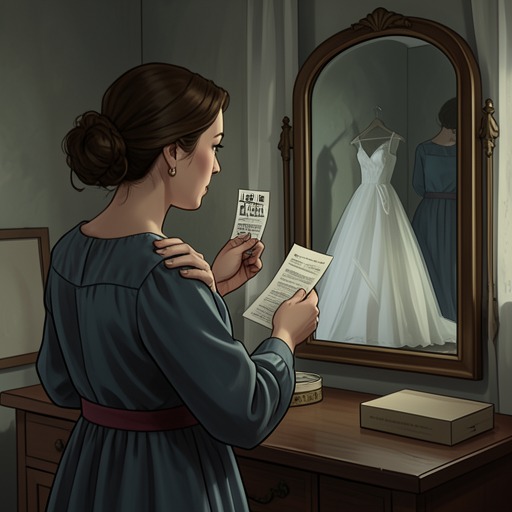
Michal tells Hannah that she and Zehava were shopping for a wedding dress with her future mother-in-law when Chaim died. She says the police questioned them, that both supplied their alibis, and that the shopkeeper was interviewed. The dress receipt records the date and time as May 5, 1983, at 19:00. Because the neighbors heard the thump at 18:30, the document appears to place Michal and Zehava away from the Lerner home when Chaim fell.
The alibi is tied to a specific future: Michal was selecting the dress in which she expected to marry Yoav, while Zehava was accompanying her future daughter-in-law. In Judah's memory, the boutique is therefore inseparable from the loss of Michal as a romantic possibility. When he enters it after realizing that Michal will marry someone else, the bridal department confronts him with the life that has moved forward without him. The shopkeeper assumes Judah is the groom and offers to show him wedding rings, while Judah cannot explain that he has just lost the woman he expected to spend his life with.
The receipt later becomes less conclusive than it first appears. Judah recognizes that a wedding dress normally requires measurements, fitting, and probably a deposit before the final purchase. The document in hand records only the date and price, leaving open the question of whether Michal and Zehava had visited the shop earlier. The ordinary material process of buying a dress thus creates a new investigative gap: the alibi may be genuine, but the evidence supplied to support it may not describe the entire transaction.
Return, Recognition, and Testimony
In July 2005, Judah returns to the shop with Hannah. The route is still recognizable, although the Intifada has evidently damaged Rafik's business and left fewer tourists than Judah remembers. Rafik himself appears changed but continuous: his hair is gray and his stubble has turned salt-and-pepper, yet he retains the tall, thin figure, thick-lensed glasses, dark trousers, and white shirt that Judah recalls. He greets Judah warmly, pumps his hand, kisses both cheeks, and asks why Judah stayed away so long and what he is buying for his daughter.
Judah identifies himself as a reporter investigating Chaim Lerner's death and asks whether Rafik remembers Chaim. Rafik recalls the famous Israeli figure and the police questioning him for hours as though he were a suspect. When Judah asks what the police wanted, Rafik produces the receipt and points to the handwritten date and time. His wife's handwriting is nearly illegible, but the numerical entry is clear: 5/5/83, 19:00.
Rafik's testimony confirms the receipt's role in the original investigation, but it also preserves the human circumstances around the document. He remembers the police treating him as someone who might be implicated, while he presents the paper as an ordinary record made by his wife. The boutique becomes a place where institutional suspicion, commercial routine, and personal hospitality overlap. After serving tea and cookies, Rafik refuses payment for Judah's silver chai necklace and Hannah's Grateful Dead shirt, calling them special friends; generosity interrupts the investigative transaction and recalls the older relationship that the receipt alone cannot convey.
From Romantic Memory to Crime-Scene Reconstruction
The boutique's importance grows because Judah's investigation is not satisfied with a simple contrast between a receipt and a death. At the Lerner house, Hannah studies the balcony's dark metal railing and argues that Chaim could not have jumped because his injured knee would have made climbing it impossible. Judah measures the four rusting bars, about neck-high to a man of medium height, and finds the feat difficult but not clearly impossible. The railing becomes physical evidence whose geometry must be tested against competing narratives.
The neighbors' accounts provide another point of comparison. Five neighbors hear a body fall at 19:00, described as a thump like a load of flour hitting pavement, preceded by Chaim saying, "Whoops." Earlier reports place four neighbors hearing the bump at 18:30, while the receipt records 19:00; the discrepancy makes time itself part of the mystery. Charlie initially uses the witnesses and the family's whereabouts to remove Michal and Zehava from immediate suspicion, but the boutique's document does not end the inquiry because its date and price do not establish when the dress was measured or ordered.
The later disclosure of Michal's account changes the meaning of the balcony and the alibi. Chaim brought her there under the pretense of apologizing, then attacked her. When she shoved him away, he struck the railing, reached toward her, said, "Whoops," and fell to his death. The boutique's receipt remains evidence that Michal and Zehava were at the store at a recorded time, but it no longer functions as a complete explanation of Chaim's death. It is one material fragment in a case whose truth depends on aligning documents, witness sounds, bodily injury, spatial limits, and delayed testimony.
Narrative Significance
Rafik's Boutique repeatedly converts ordinary objects into contested signs. A wedding dress represents Michal's anticipated marriage to Yoav, Judah's excluded future, and Zehava's role as an approving mother-in-law; a receipt represents an alibi, yet its omissions invite further questions. The shop's photographs and Rafik's recognition similarly challenge the assumption that history survives only in official archives. Personal inscriptions, remembered routes, handwriting, tea, clothing, and gifts preserve connections that police reports flatten into names and times.
The boutique also complicates the novel's political boundaries. It lies in the Arab Market and Christian Quarter, yet serves Jewish customers, sells Jewish ritual objects beside Arab and Christian goods, and preserves Zehava's friendship with Rafik. Its location is not a neutral backdrop: Judah's movement through Damascus Gate and the market crosses social and political divisions that the investigation otherwise treats as categories of suspicion. The shop briefly makes coexistence tangible, even as the case surrounding Chaim remains marked by violence, secrecy, and the failure of competing communities to share a stable account of the past.
For Judah and Hannah, the return to Rafik's is both an investigative visit and a ritual of re-entry into an earlier life. Judah revisits the store where Michal once shopped and where Zehava imagined accompanying her future daughter-in-law; Hannah, now a young custodian of the evidence files, helps turn those memories back into questions. Rafik's Boutique consequently matters not because it solves the case by itself, but because it makes the past touchable. The disputed death is approached through a dress, a receipt, a railing, a remembered voice, and a shop that remains standing while the meanings attached to it change.